Updated on July 7, 2026
In short: the 5 main causes of a project cost overrun in a service company, and how to detect drift before it eats up your margin.
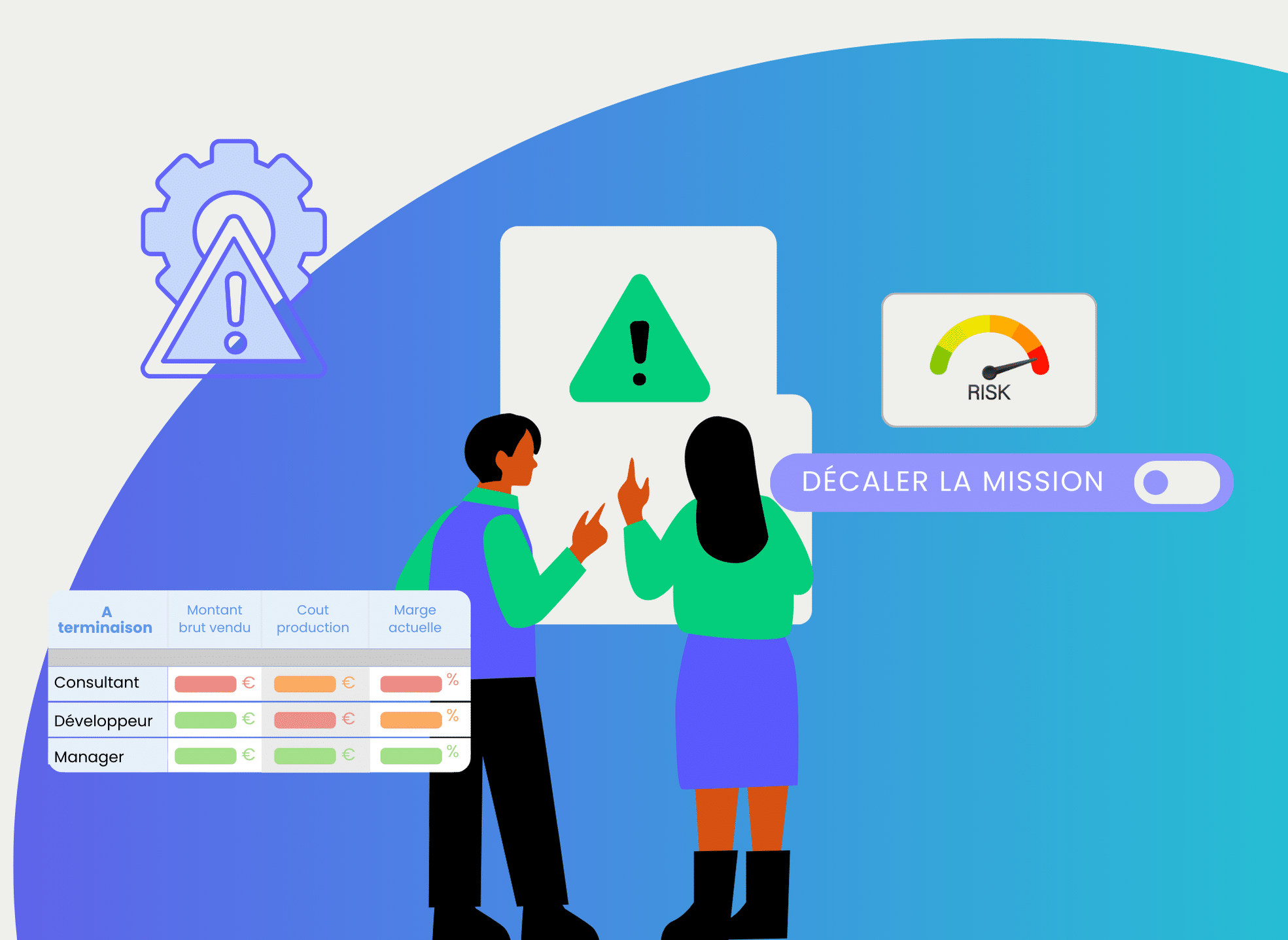
In a service company, a cost overrun is not visible: no stock is missing, no bill is inflated. Just time sold that is consumed faster than expected, and a margin that melts quietly, until the close, too late to react.
Managing projects in a cost-effective manner is essential for all businesses that want to maintain a consistent profit and meet their customers' expectations. Unfortunately, many projects fail due to cost overruns, and the larger the project, the more severe the implications.
Inaccurate forecasts on costs and timelines, poor cost management, and underutilization of resources can lead to project cancellations, budget overruns, and even a significant financial loss that stunts your growth.
This article details the main causes of cost overruns on a project, how to prevent them, and concrete actions to turn around a project that is getting out of hand, with examples in IT and consulting.
🔎 Key elements to remember
- A cost overrun occurs when the actual cost of a project exceeds its original budget.
- In a service company, the causes are first and foremost human: scope, estimate, intercontract, late follow-up.
- The 5 causes: change of scope, unrealistic budget, poor resource planning, lack of suitable tools, unfunded contingencies.
- The real lever: detecting drift during the mission, when the forecast margin is still moving.
- Around 70% of IT projects are over budget (Flyvbjerg and Budzier, HBR).
The signal that prevents overshoot: the margin at the end
Margin at completion is the margin projected at the end of a project, continuously recalculated from the remaining amount to be done. It is the only indicator that says, during the mission, whether a project will end up in the green or in the red, before closing, when there is still time to act.
Formula: margin at completion = selling price − (cost already incurred + cost of the remainder to be re-estimated).
Alert threshold: as soon as the budget progress exceeds the actual progress (for example, 80% of the budget consumed for 60% of the work produced), the margin at completion drops. This is the time to arbitrate, not to the final bill.
Project Cost Overrun: Definition and Formula
What is a Cost Overrun?
A cost overrun is usually an unforeseen cost that has a negative impact on the profitability of a project. When the actual cost of a project exceeds its initial budget, it can be referred to as a budget overrun.
It’s a common issue across industries, often caused by mismanagement, unexpected scope changes, or inaccurate forecasting.
Projects with a strong human component are particularly exposed. A McKinsey-Oxford study on large IT projects showed that they exceed their budget by an average of 45% while delivering 56% less value than expected. In a service company, this situation results in a project with a fixed price of 40 man-days that consumes 58 man-days, for example because of unregulated customer round trips. The additional 18 days are not billed to anyone: they come directly from the margin.
A common large-scale example is the Channel Tunnel. Construction costs exceeded 80% of forecasts, and financing costs exceeded 140%. As revenues were half as low as expected, the ROI of the project was negative, resulting in a loss of $17.8 billion for the UK economy.
How To Determine Cost Overruns in Project Management?
To calculate the budget overrun for a project, you need to determine the difference between what you planned to spend and what you actually spend.
Budget overrun formula: cost overrun (in percentage) = (actual cost − budgeted cost) × 100 / budgeted cost.
Example: if the initial budget of the project was €100,000, but the actual cost is €125,000, the calculation would be: (125,000 − 100,000) / 100,000 × 100 = 25%. The project went over budget by a quarter (25%) of what was originally planned.
This percentage can help stakeholders understand the magnitude of cost overruns and take action to address what has been problematic, such as revising the projected budget, controlling the scope of the project, or improving the cost tracking process.
What Is the Difference Between Cost Growth and Cost Overrun?
Although often used interchangeably, cost growth and cost overrun are distinct terms.
Let's take a project with an initial budget of 1 million euros. Along the way, the client adds deliverables: the budget is revised, in agreement with him, to 1.2 million. This assumed increase of €200,000 is an increase in costs. At the end of the day, however, due to unforeseen events, the real cost reached 1.5 million. The €300,000 that exceeds the revised budget is the budget overrun: an unforeseen additional cost. In total, the project cost €500,000 more than at the beginning, including €200,000 in assumed growth and €300,000 in overruns.
| Nature | Assumed increase in the budget (expanded scope, inflation) | Incurred additional cost: the actual cost exceeds the revised budget |
| Example | Budget €1 million revised to €1.2 million = +€200,000 | Actual cost €1.5 million vs. revised budget €1.2 million = +€300,000 |
| Decision | Validated with the client (amendment) | Not planned, to be corrected |
The good news is that budget overruns can be avoided, and sometimes even corrected. This requires that project managers and other stakeholders have the opportunity to identify the issues that trigger these budget deviations, whether it is a change in scope, an unrealistic budget, a lack of resource management, or simply a lack of technical means.
What are the consequences of a cost overrun?
A cost overrun initially attacks the margin, but its effects go further: tight cash flow, degraded customer relations, damaged reputation. An overrun is paid for on several levels:
- Margin : every man-day not sold or every unforeseen expense comes directly from the result of the project;
- Cash flow : an additional cost that is not re-invoiced increases the need for working capital, especially when invoicing follows progress;
- Customer relations : renegotiating a budget during the course of the assignment creates friction, sometimes enough for the client to go to a competitor for the next project;
- Commercial reputation : a project delivered above the announced budget undermines credibility, an asset that takes a long time to rebuild;
- The cascading effect : a loss-making project mobilizes resources that are lacking elsewhere, spreading the delay throughout the portfolio.
Cause no. 1: Project Scope Creep
The change in perimeter remains one of the main causes of exceedance. According to the Project Management Institute, nearly one in two projects has its scope extended along the way. This can be due to:
- Clients requesting additional features mid-project.
- Changes in business priorities or emergencies.
- Lack of scheduling or agreement on deliverables upfront.
For example, a client may initially request a building basic website but later ask for advanced features like e-commerce integration without considering the additional costs or timelines.
In IT Services This type of scope creep in a fixed-price project is called scope creep . A "quick" request from the client, verbally accepted by the consultant on-site to preserve the relationship, accumulates deliverable after deliverable. Without a contract amendment, these additions consume unsold man-days and directly erode the project's profit margin.
How to avoid scope creep?
The best way to avoid a change in project scope is to formalize clear expectations from the beginning, and to comply with the previously mentioned and accepted requirements as firmly as possible.
Clearly define expected deliverables and deadlines in the project schedule. Presenting them to the client for signature is a way to keep track of this consent and to better justify the accommodations needed in the event of an additional request and to facilitate negotiation.
The implementation of a COPIL to monitor the perimeter and approve or not the changes can avoid missing these changes in trajectory. It is also recommended that risk analyses be conducted and that potential scope changes that may occur be incorporated.
Finally, align stakeholders upstream: overspending often arises from a gap between what the customer expects and what the team has understood. Regular milestones and clear communication channels cut short costly misunderstandings.
To stay proactive, opt for project management software that notifies the team when costs deviate.
How to resolve the change in project scope?
If a perimeter overflow has already occurred, take the time to sit down with the relevant stakeholders. Communicate excessively if necessary and engage in transparent discussions with customers to manage their expectations.
Be prepared for possible budget trade-offs : reallocating funds or asking for a raise to cover additional tasks.
Remember that changes affect processes; Make sure you get the customer's approval to extend the lead times to maintain quality standards. To avoid this, timeboxing sets a time limit per task and alerts before drifting.
When faced with a request outside the scope of work, a formulation that preserves the relationship is: "It's feasible, I'll estimate the impact in days and we'll add it via an amendment." We don't say no, we make the cost visible.
Cause no. 2: Unrealistic Budget and Cost Tracking
An unrealistic budget is born from an estimate without historical data and a follow-up that is too late. On a project under direct management, non-billable hours accumulate without being seen. The solution is in two steps: estimate based on past projects, and monitor costs in real time.
Prevention is better than cure, which is why it's essential to start with realistic project budgeting. Lack of experience or lack of historical data can easily lead to an unsustainable budget. Properly estimating the costs of a project in advance reduces this risk. Common mistakes include:
- not analyzing data from past projects to identify recurring patterns of delays or hidden costs ;
- Neglecting the cost estimating phase of the project, resulting in inaccurate estimates.
For example, a time-based project without real-time time tracking could not take into account non-billable hours, resulting in an accumulation of time offered that went unnoticed.
How do you plan a realistic project budget?
To mitigate these risks, it is essential to have robust project accounting in place. Implement project accounting to track key metrics such as:
- The utilization rate : the percentage of billable hours in relation to total hours worked;
- Earned Value Management (EVM): a forecasting method to assess whether a project is on the right track;
- Variance at Completion (VAC): Used to predict the variance of costs at the end of the project.
Also, use real-time cost tracking tools and set up management control to monitor expenses, such as outsourcing, purchasing, and non-billable costs. This management is part of the project cost management stages.
What should the budget for an IT project contain?
An IT project budget must detail four elements: the breakdown of work, the estimation method, a contingency reserve, and alert thresholds. Without these, the initial underestimation turns into an overrun. An IT project budget rarely consists of a single line item for "service price." In practice, it structures, at a minimum:
- Work breakdown (WBS): Each batch, task, or group of tasks is costed separately, rather than an opaque global package.
- an explicit estimation method : analogue (by comparison with a past project), parametric (by ratio, e.g. a cost at the function point), or three-point (optimistic, realistic, pessimistic);
- a contingency reserve : an envelope dedicated to unforeseen events, separate from the production budget;
- Deviation thresholds and authorization levels : at what percentage of drift an alert goes up, and who has the authority to incur additional expenses.
The main items to be quantified in an IT project budget: workforce (internal man-days per profile and ADR), subcontracting and freelancers, licenses, infrastructure and hosting (cloud, tools), acceptance, testing and data transfer, training and change management on the user side. A budget that incorporates these elements transforms the overshooting of an end-of-project surprise into a signal detected early, when there is still room for manoeuvre.
Cause no. 3: Lack of Resource Planning
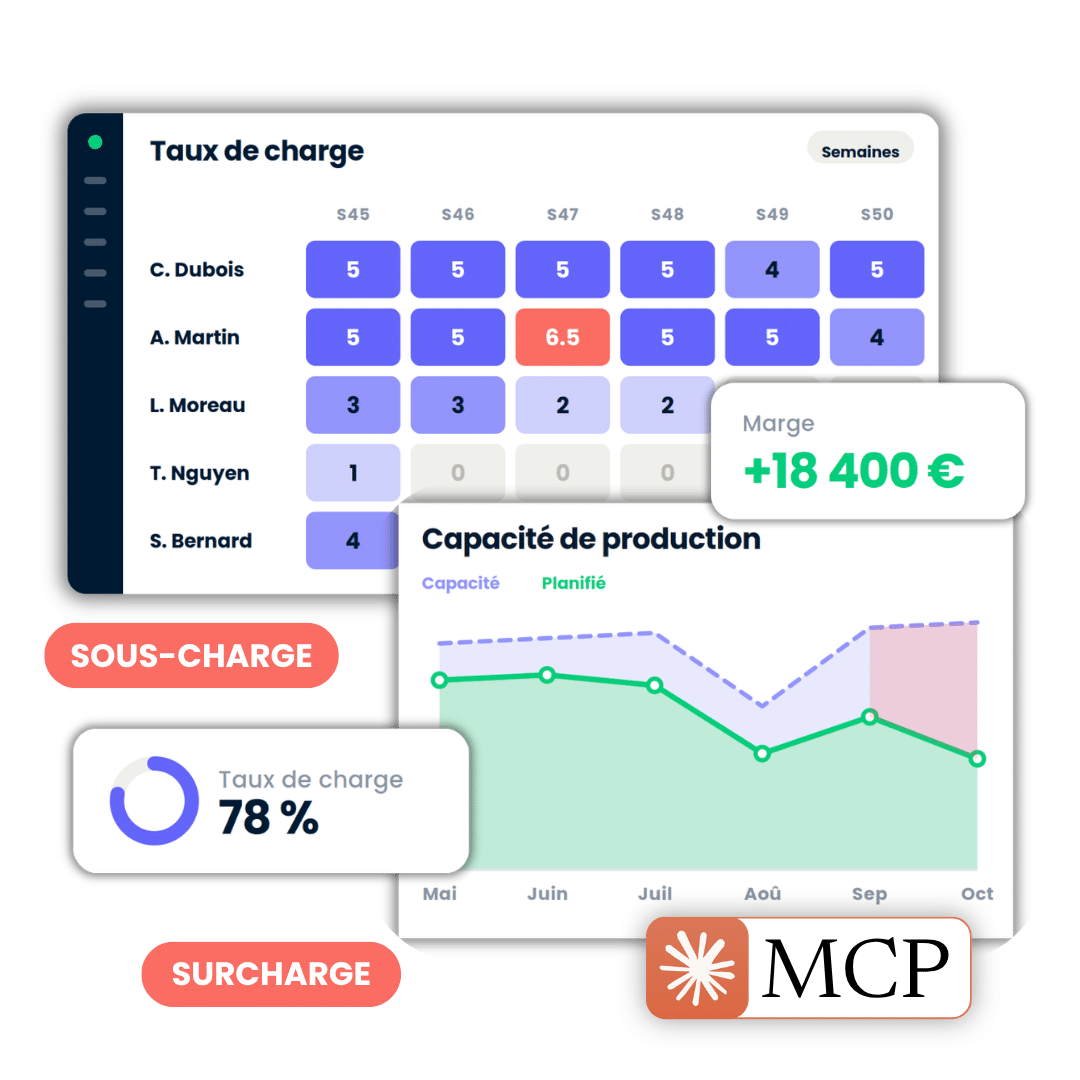
Poor resource planning causes costs to spiral out of control due to a lack of visibility into availability and a mismatch between skills and tasks. In a service company, it also feeds the intercontract. A resource planning scenario-based forecasts corrects it.
Inadequate resource management can lead to inefficiencies, delays, and higher costs. This often stems from 2 main reasons:
- Lack of real-time visibility into resource availability
- Assigning tasks to team members who lack the necessary skills, causing delays.
For example, a client may require a senior consultant who specializes in a niche market segment, such as regulatory compliance in the healthcare industry. If the company fails to accurately forecast the availability of this specialist, taking into account their existing commitments and unforeseen customer demands, it can lead to significant delays . It will then have to look for a suitable replacement in an emergency, risking compromising the quality of the service or having to charge extra for an expedited delivery.
Additionally, if junior consultants are assigned to tasks that require advanced analytical skills or client-facing responsibilities without adequate mentoring and support, it can result in lower quality deliverables, damage client trust, and damage the company's reputation.
In a consulting firm, this poor planning has an additional hidden cost: the intercontract. A consultant between assignments continues to cost his salary without producing turnover. Conversely, urgently staff an over-qualified profile (i.e. at least average daily rate, ADR, high) on a task that does not justify it inflates the real cost of the mission without the price being sold.
How to avoid poor project resource planning?
Use tools to create scenario-based resource planning to forecast resource needs and manage resource availability .
By understanding the potential impact of different scenarios, you will be able to make more informed decisions about how to allocate resources effectively. This will help you avoid understaffing or overstaffing, optimize budgets, and ensure the right resources are available at the right time.
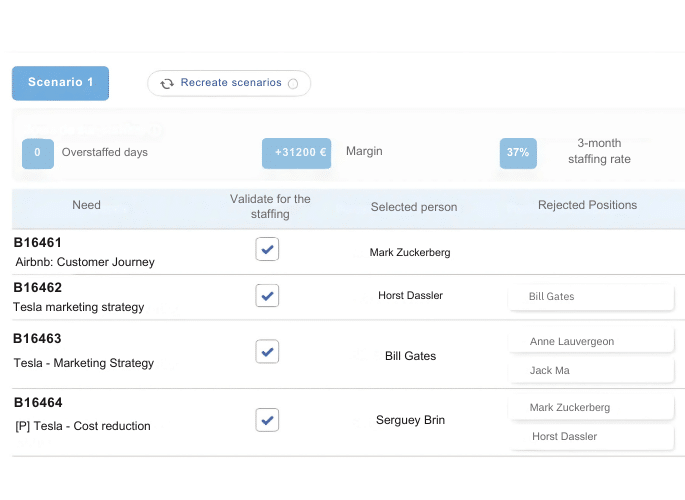
Ensure that project managers are accountable for regularly updating resource schedules and identify skills shortages to escalate to management. This will make it possible to initiate appropriate training or recruitment actions.
Also keep an eye out for subcontracting : by IT Services, a freelancer or a hired partner without a clear contractual framework (deadlines, penalties) is a frequent source of additional costs. Formalize commitments and follow up on outsourced production like yours.
Cause n°4: the lack of appropriate tools to manage and steer your projects
An unsuitable tool deprives the team of cost and margin tracking, up to and including incorrect invoicing. The right tool brings together time tracking, cost control, and forecasting in one system, right from the start.
Many organizations use inadequate tools, which can hurt productivity and lead to cost overruns. For example, a marketing consulting firm might use a basic task management tool, neglecting features such as tracking expenses or allocating workloads. This can easily lead to inadequate billing or budget overruns.
How to equip yourself with the best project monitoring tools?
Defining the needs from the start is the best way to identify the key features your team needs, such as time tracking, cost control , and forecasting.
Start by mapping out your typical project workflows. What are the key stages? What tasks are involved? How do team members collaborate?
Prioritize features: must-haves that are critical to team success (e.g., time tracking, task assignment, file sharing), and secondary options that would improve efficiency but are not essential (e.g., Gantt charts, custom reports). Next, compare a range of tools. Take advantage of free trials or request demos to test the tools live.
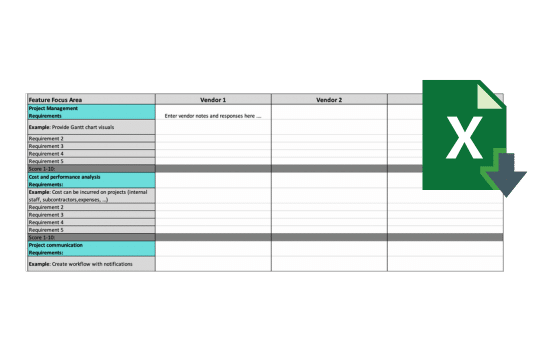
Download our benchmark template
Obtain a sample evaluation case and an overview of the aspects to be considered for the comparative evaluation.
What to do if you have chosen a tool that is not suitable for your use?
Unfortunately, there's not much you can do if you've chosen the wrong tool other than avoid repeating the same mistake. Test new tools on smaller projects before rolling them out to larger projects.
Always measure the effectiveness of the tool after it has been implemented and collect feedback from the team. Look for tools like Stafiz that offer robust features tailored to project-based industries, ensuring real-time cost tracking and efficient workload management from the start. This way, you can take control and avoid or correct your overruns from the start.
Cause n°5: unprovisioned hazards and risks
A project without reserve for the unexpected goes awry at the first hazard. A delay in a subcontractor, a price increase, changing specifications or the departure of a key consultant turn into additional costs when nothing has anticipated them.
Many overages are not due to a management error, but to unprovisioned events:
- External factors : inflation, increase in the cost of a license or provider, delay in delivery from a supplier;
- Human hazards : the departure of a key consultant during the course of a mission forces the emergency staff of a replacement, which is often more expensive;
- Specification errors : in IT, needs that are poorly framed at the outset generate rework that inflates the actual load.
How to avoid it: build a contingency reserve in the budget, keep an up-to-date risk register, and provision for recurring hazards identified on past projects rather than discovering them along the way.
Recognize and correct each cause of overshoot
| Change of scope creep | Out-of-contract requests accumulate without an amendment | Formalize the scope, validate each addition with an amendment |
| Unrealistic budget and late follow-up | Invisible non-billable hours, known month-end margin | Estimate from past projects, track costs in real time |
| Poor resource planning | Intercontract, over-qualified profile on a simple task | resource planning Scenario forecasting |
| Unsuitable tool | Spreadsheet, no cost/margin tracking, incorrect invoicing | Combine time, cost and margin tracking in one system |
| Unfunded contingencies and risks | No contingency reserve, absent risk register | Provision for a contingency, keep a risk register |
What to do when a consulting or IT project exceeds its budget?
When a project exceeds its budget, it is necessary to measure the real gap in relation to the remaining work to be done, re-estimate the margin at completion, and then arbitrate: amendment, reduction of scope or shutdown. The important thing is to act early, with reliable margin data. When a project has already started to get out of hand, the challenge is no longer to prevent but to arbitrate quickly, with up-to-date figures. Here are six actions, in order:
- Measure the real gap, not felt. Compare the consommé (man-days and fresh) to the budget, and especially to the rest to be done. A project that is 60% complete for 80% of the budget consumed is already overrun, even if no one has formalized it. This is the starting point for analyzing the gaps in a project.
- Re-estimate the rest to be done. The real risk is not what is spent, it is what remains to be produced. A margin projection at completion says whether the project will end up in the red or not.
- Renegotiate by means of an amendment. If the overrun comes from an enlargement of the perimeter, a quantified amendment brings the budget back to reality. Documenting every customer request from the beginning makes this conversation possible.
- Arbitrate the perimeter. If there is no amendment, decide what is removed or postponed to hold the envelope, with the customer's agreement.
- Detect weekly, not at the end of the month. Most overruns are seen too late because the time tracking is monthly. Real-time margin tracking turns an afterthought into an alert while the margin can still be defended. Structuring the project's budget monitoring makes it routine rather than a last-minute check.
- Slice go / no-go. On a structurally loss-making project, the best decision may be to stop the costs rather than dig deeper. This decision is made with reliable data, not with a wet finger.
Case study: the rest to be done managed at Colorado Groupe
Colorado Groupe, a marketing and customer relations consulting firm with around fifty employees, was in charge of its resource planning on manual processes, with separate absence management software. Management did not have to do anything else per project to calculate the projected margins, and utilization rates stagnated due to a lack of leverage.

❝
Before using Stafiz, we were unable to improve our resource planning. Thanks to Stafiz, we are managing our capacities much better and have improved our margins. We turned to Stafiz, which not only allowed us to digitize our resource planning, but also to automatically calculate the remaining work to be done on projects.
Isabelle Lalet
Director of Development and Support, Colorado Groupe
After the deployment of Stafiz, Colorado Groupe measured:
- +35% resource utilization rate;
- +15% project margins;
- 5 hours saved per week on resource planning.
How to avoid a cost overrun in a project?
Cost overruns are a significant challenge, but they can be mitigated through proactive planning, effective communication, and the right tools. Whether you are in a consulting firm, in IT Services or in an agency, the logic is the same: a cost overrun on a project is based on time sold that is consumed quietly. Seeing it early, when the forecast margin is still moving, makes the difference between a corrected project and a loss recorded at the end of the project. Solutions like Stafiz link time tracking, resource planning and the margin to make this drift visible as soon as it appears. Sustainable prevention also requires continuous optimization of project costs .
To keep the margin at the end of your projects in front of you and spot drift before it costs, discover Stafiz's real-time budget monitoring.
Frequently asked questions:
This is known as cost overrun, budget overrun or cost overrun. The term refers to a real cost that is higher than the initial budget, as distinct from cost growth, which is a decided and assumed increase in the budget.
The project manager is in charge of managing it, but the responsibility is shared: the management on the scoping and the means, the customer when he expands the scope, the sales team when the initial estimate was too optimistic. The challenge is less to point to a culprit than to react quickly.
Only if the exceedance comes from an enlargement of the perimeter, formalized by a signed amendment. An overrun due to an internal underestimation remains the responsibility of the service provider, especially for the fixed price. In the control room, the additional time actually ordered is invoiced.
Studies measure things that are similar but distinct. On budget alone, nearly 7 out of 10 IT projects exceed their budget (Flyvbjerg and Budzier). Of the three criteria at the same time, budget and scope, the Standish Group has only 31% of projects fully successful. Two angles, the same reality: keeping to the budget is the exception.