
Updated on June 18, 2026
The specifications formalize the need for a project (objectives, scope, constraints, deadlines, budget) and serve as a contractual reference between client and service provider. This guide details the typical structure, the 9-step writing method, and a complete example.
A real common thread, the specifications play a central role in the success of a project. The answer to the question "Do we need specifications for a project?" is indisputable: yes. This essential tool ensures that objectives, project scope, deadlines and budget are respected.
But then, what should a specification contain ? In this article, we explain why this document is strategic, what the challenges are for each stakeholder, and we propose a clear project specification structure , reusable as a template, for your future projects.
Below you will find a complete example, filled in from start to finish on a concrete case ofIT Services, whose plot you can use directly.
🔎 Key elements to remember
- The specifications formalize the need for a project (objectives, scope, constraints, deadlines, budget) and serve as a contractual reference between client and service provider.
- He describes the need (the "what"), never the technical solution (the "how"), which is the responsibility of the service provider.
- A comprehensive document covers ten headings, from the cover page to the appendices.
- He distinguishes between functional needs (what the solution must do) and non-functional requirements (performance, security, availability), which are often forgotten.
- As a service company, he secures the profitability of the mission: clear scope, RACI matrix, revenue criteria.
What Is A Project Specification?
Formalize needs
Any project is likely to require project specifications: from the redesign of a website to the deployment of software, including the organization of an event.
Indeed, it is an essential document because it formalizes all the essential elements for the smooth running of the project and its success:
- needs,
- objectives,
- the perimeter,
- constraints,
- features,
- deadlines,
- the provisional budget.
Plan and track
In this way, it forms a basis for project planning and facilitates its subsequent management. It condenses all elements into a single document, providing a uniform level of information for all stakeholders, both internal and external.
A contractual document
The project specifications are drawn up during the planning phase of the project, after the client has expressed their expectations.
Although the project manager is usually in charge of writing it, this task can be delegated to an external consultant. In all cases, the document produced must be officially approved and then signed by the client and the project team, thus constituting a contractual document. However, it does not represent a contract in its own right.
The Different Types of Project Specifications
The functional specifications
The functional specification details how the product or service will meet the needs. Thus, it specifies the uses, functionalities, characteristics and constraints. It serves as a basis for the technical specifications, but does not express a technical solution.
The technical specifications
The technical specifications reflect the functional needs from a technical point of view. Thus, he details:
- the technical solution used,
- the technical aspects to be taken into account,
- the standards to be respected,
- constraints,
- features with a technical perspective.
The mixed specifications
The mixed specifications are a combination of the functional and technical specifications. They can be drafted separately or integrated into a single document: the mixed specifications.
Beyond the functional and technical aspects, a complete specification also specifies non-functional requirements (performance, safety, availability), detailed in the standard structure below.
What should a specification contain? The typical structure
There is no imposed structure: specifications are adapted to the nature and size of the project. But a complete document almost always covers the same ten headings, from the cover page to the appendices. Here is the reference frame, illustrated below by a complete example filled in.
| 1. Cover Page and Versions | Title, Version, Status, Reviewers, Change History |
| 2. Context and challenges | The "why" of the project |
| 3. Targets and indicators | SMART objectives, MoSCoW prioritization, numerical targets |
| 4. Scope | Included/excluded, assumptions, dependencies |
| 5. Stakeholders and governance | RACI matrix, steering committees |
| 6. Functional Requirements | Features, Business Rules, Acceptance Criteria |
| 7. Non-functional requirements | Performance, Security, Availability, Accessibility |
| 8. Constraints | technical, regulatory, data recovery |
| 9. Planning, milestones and deliverables | macro-planning, milestones, acceptance methods |
| 10. Appendices | Glossary, traceability matrix |
Non-functional requirements: the reflex that is often lacking
Where the functional specification describes what the solution should do, the non-functional requirements set out how it should do it well. We forget about them because they don't show up on the screen. Make them measurable:
- Performance : target response time (less than 2 s for 95% of requests), volume, concurrent users.
- Security and compliance : authentication (SSO, two-factor), profile rights, traceability, GDPR.
- Availability : service level, maintenance windows, backup.
- Ergonomics and accessibility : interface standards, RGAA, languages, mobility.
- Compatibility : browsers, systems, integration with the existing information system.
For functional needs, formulate each requirement as a user story ("As a user story as well as a verifiable acceptance criterion." And banish vague formulations: "the system must be fast" does not commit anyone. Replace them with a metric, because a requirement that cannot be measured cannot be accepted.
An example of a completed specification (case IT Services)
To make the framework concrete, here are a set of specifications filled with a realistic case: a IT Services develops an industrial customer's extranet portal, i.e. the online space where the customer finds their orders and documents. Each section is summarized here; In a real set of specifications, it is developed further.
- Cover page : Project: Redesign of the customer extranet portal. Version 1.0. Status: Validated. Writer: Project Manager (IT Services). Validators: customer sponsor and business referent.
- Context and challenges : the current portal generates 40% of customer support tickets. The challenge: to reduce this burden and make it easier for customers to access their documents and orders.
- Objectives (SMART): reduce portal tickets by 30% in 6 months. Indicator: number of "portal" tickets per month.
- Scope : included: authentication, document space, order tracking. Excluded: Online billing (phase 2), data prior to 2022.
Functional requirements (excerpt). Priority follows the MoSCoW method (Must = Must, Should = Desirable); the acceptance criterion is concrete proof that the functionality works; SSO stands for single sign-on (the client logs in once and for all).
| E-001 | Secure connection | One account per customer contact | Must | Access via SSO in less than 3 clicks |
| E-002 | Order tracking | Status visible to only the customer concerned | Must | Real-time ERP-compliant status |
| E-003 | Document space | Documents filtered by account | Should | The customer finds an invoice in less than 10 seconds |
Non-functional requirements (excerpt). Not what the portal does, but how it should do it well.
| Performance | Page loading | less than 2 s for 95% of queries |
| Robust Security | Authentication | SSO and Two-Factor, GDPR Compliance |
| Availability | Service Level | 99.5% in working hours |
- Constraints : the portal must connect to the customer's ERP (its management software) via an API, i.e. an automatic link between the two tools; accommodation in Europe; resumption of active customer accounts since 2022.
- Planning, milestones and deliverables : scoping, design, development, acceptance, deployment. The acceptance test is the final test phase; Each anomaly is classified by severity (blocking, major, minor).
- Budget : cost items (development, integration, hosting, maintenance) monitored via a budget monitoring tool.
- Appendices : glossary (SSO, ERP, recipe) and traceability matrix linking each requirement to its purpose.
Why Are Project Specifications Crucial For Service Companies?
Specifications as a customer-supplier security tool
The specifications contribute to a healthy relationship between the customer and the service provider. Indeed, it clarifies the commercial relationship and provides a framework for commitments in order to avoid any dispute.
Thus, the project specifications serve as a reference, limiting misunderstandings, unspoken words and inaccuracies.
Clear, specific, unambiguous, it ensures that all elements are clear on both sides in order to maximize the quality delivered. It sets the limits by specifying the exclusions and constraints. In addition, it facilitates the creation of the quote by explaining the expectations.
The Challenges of Project Management Specifications
The challenges for the project manager and the project team
In the context of service companies, the project specifications represent a major challenge for the project team. Composed of the project manager who designs and manages the project, the consultants are responsible for respecting the constraints of execution, scope and priorities. Ideally, the project manager is responsible for the profitability of their projects and customer satisfaction.
Issues
Thus, for the project team, the project specifications allow:
- Have visibility on tasks, milestones, and programs thanks to the project schedule.
- to know by whom its elements will be produced and in how long,
- avoid misunderstandings and misunderstandings,
- anticipate friction points.
Risks
The project specifications limit:
- conflicts over priorities,
- Doubts about responsibilities and assignment: the project manager is responsible, his mission being to deliver the project in accordance with the rules and on time,
- The customer's disengagement: by signing, the customer acknowledges that he or she is informed and in agreement with the information provided.
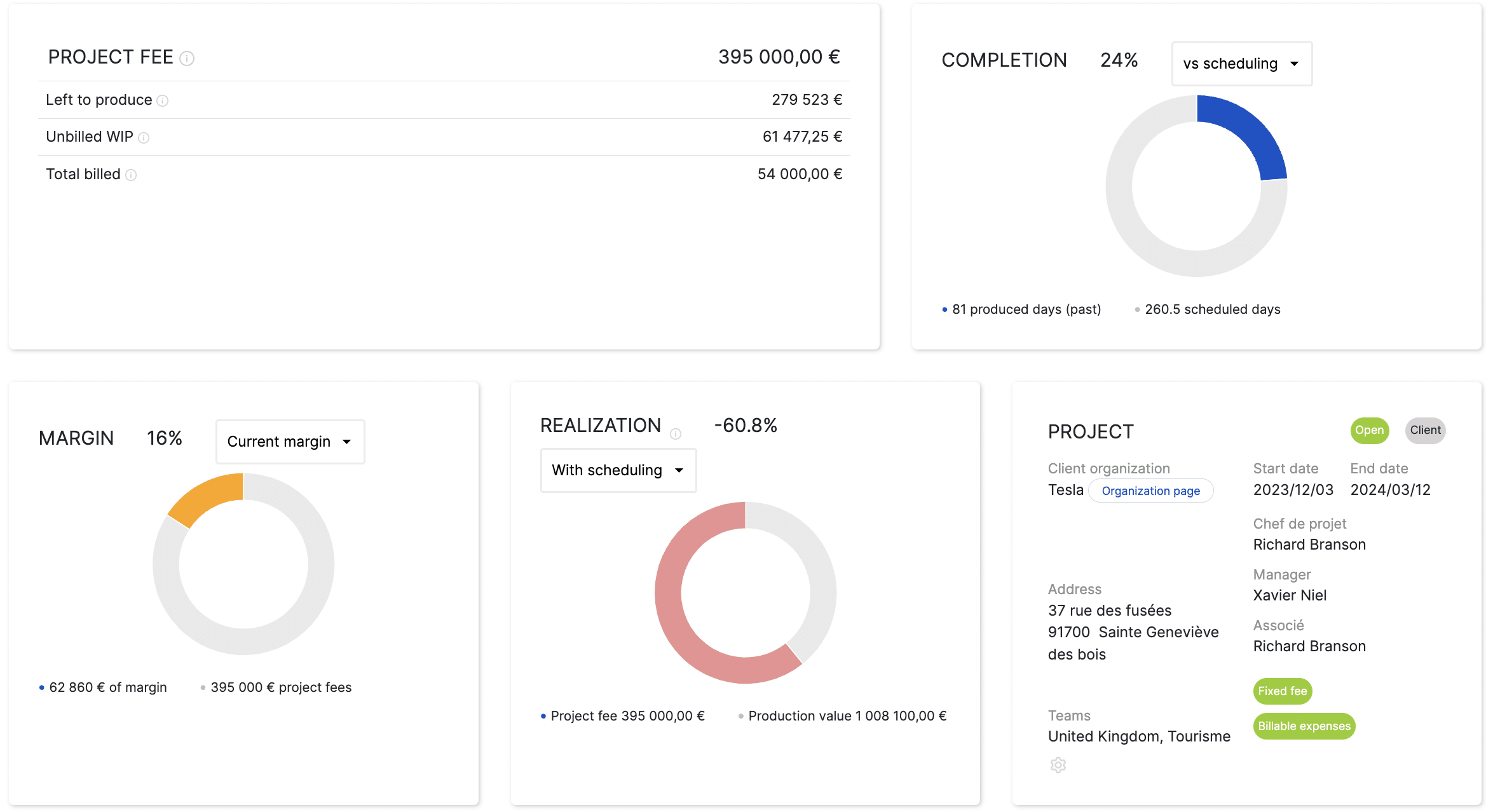
Need a financial tracking tool?
With Stafiz, you will decentralize, empower and equip your project managers. In result: they benefit from key forecasting indicators such as margin and can therefore react before overruns.
The challenges for management and top management
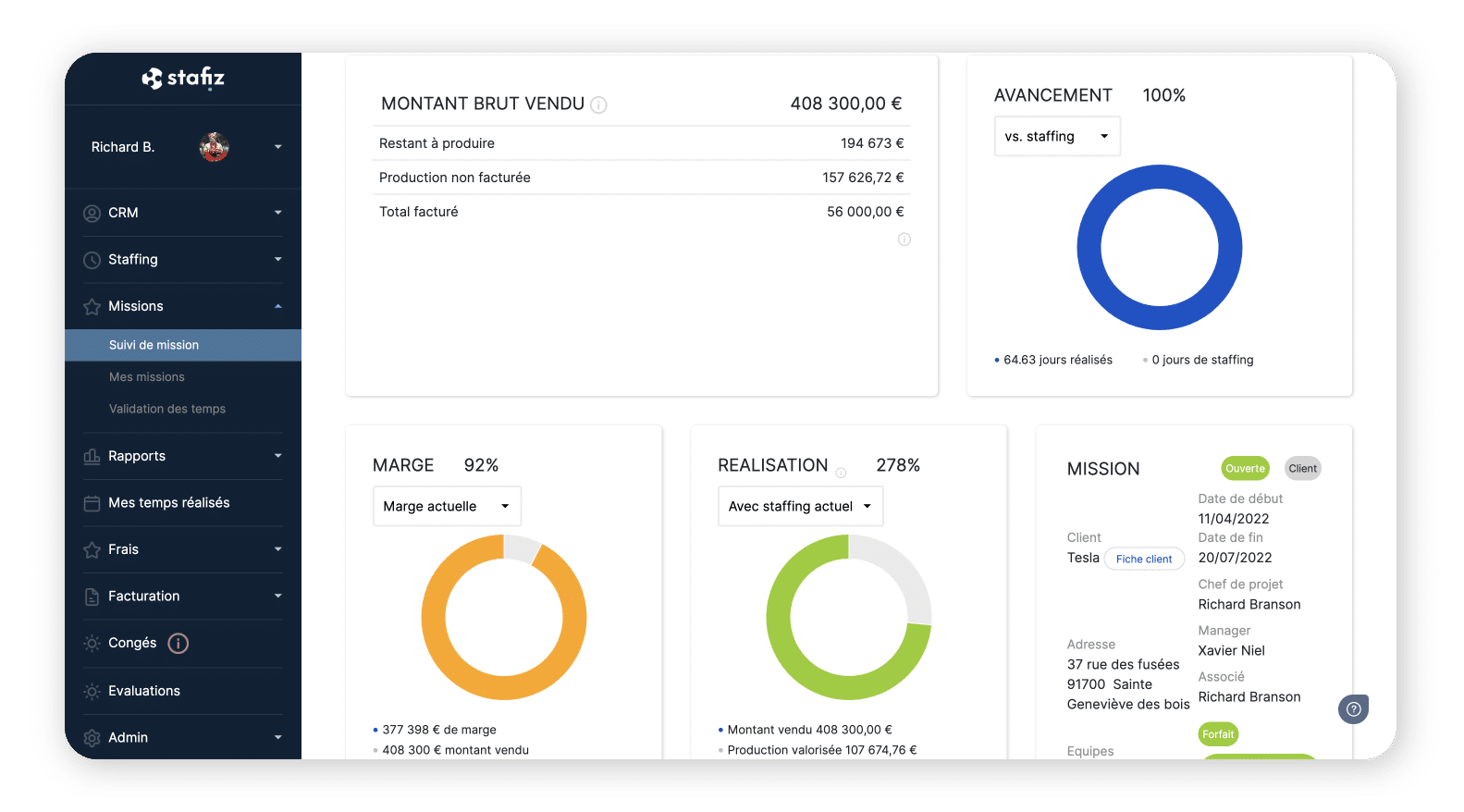
Management has different needs than the project team. Responsible for the strategic vision, her interest is to have visibility on the achievement of the objectives of the project portfolio : it is therefore a consolidated vision of the monitoring of compliance with specifications that she needs.
Issues
The specifications must guarantee the profitability of the projects and the satisfaction of the customers. The monitoring of project reports must make it possible to keep a portfolio aligned with strategic and financial objectives.
Risks
The project specifications thus provide a basis for monitoring consolidated performance : costs, deadlines, customer satisfaction.
The challenges for the project portfolio manager
In a service company, PPM managers (business unit manager, COO or director of operations), in conjunction with project managers, play a key role in managing production. Their attention is then focused on the management of resources through projects and their profitability. Together with the project managers, they establish the provisional budgets of the projects in the specifications in order to generate a given margin.
Issues
For portfolio managers, the specifications constitute a baseline. This will allow him to organize execution and plan resources, particularly during theresource planning meetings : organize profiles across projects, identify and staff the right profiles, at the right time, on the right mission.
Risks
Without precise specifications, portfolio managers are exposed to poor costing, a poor description of needs and therefore of the resource planning associate. This represents a risk for deadlines, the quality of deliverables and the availability of the right profile-project pairs, which ultimately impacts customer satisfaction.
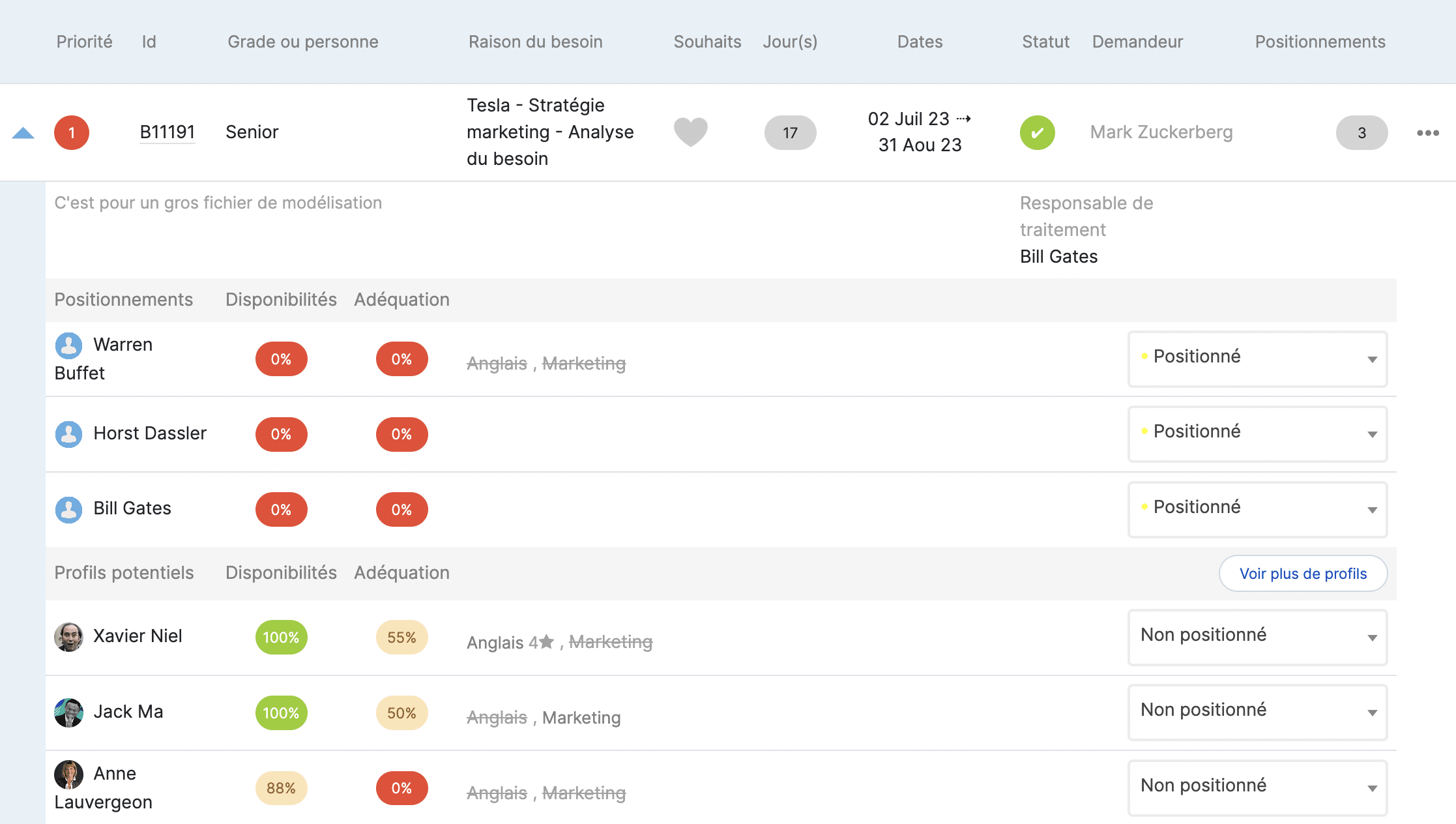
Profile selection
Stafiz centralises your profile requests and speeds up your decision-making with all the information you need to select and assign your profiles: skills match, availability and even appetites. Your resource planning are greatly easier and are faster.
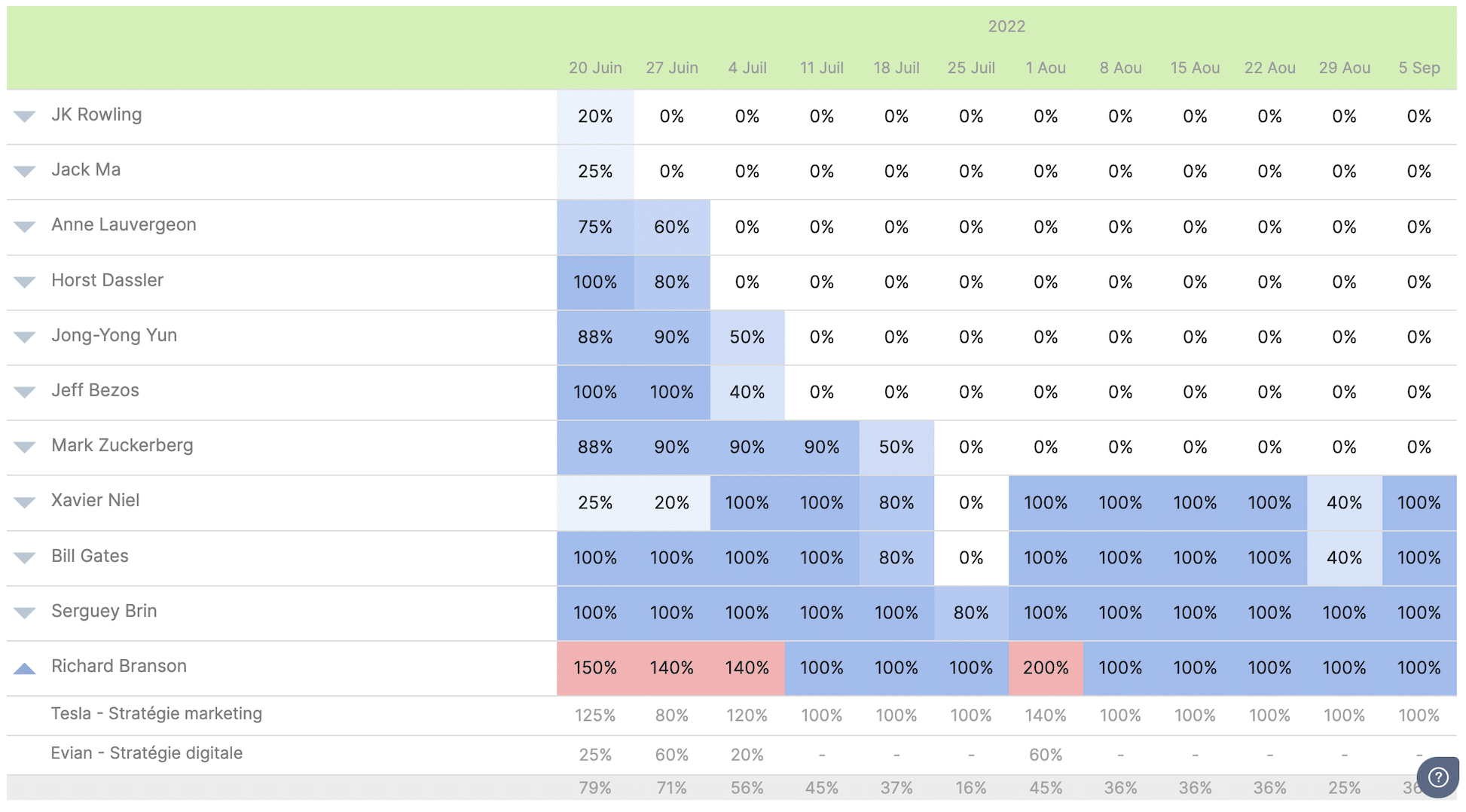
Predictive load visibility
Stafiz provides predictive visibility on the workload of the teams, thus avoiding under- or over-loading.
The challenges for CFOs and management controllers
These profiles are responsible for overseeing finances. They focus their attention on profitability and contractual risks.
Issues
Thus, he uses the specifications to monitor the budgets set, control costs, deadlines and margins. The project specifications allow him to precisely quantify the service and the cost of production.
Risks
For finance teams, incomplete or ill-defined specifications in terms of costs represent a financial risk, which can lead to budget overruns due to underestimation of costs, or overestimation of the resources needed for a project.
The challenges for sales teams
As direct interlocutors of the customer, sales representatives and Customer Successes focus on the relationship with the customer : follow up, support them and identify upsell opportunities.
Issues
For them, the project specifications represent a contractual reference point that allows them to manage expectations and formalize commitments.
Risks
The project specification helps to avoid poor framing, which could lead to customer dissatisfaction or a tunnel with no visibility on the project.
Clarifying who decides: the RACI matrix
On a service project, the confusion of roles is the first cause of dispute: everyone believes that someone else was validating. A RACI matrix removes ambiguity by assigning, for each key activity, who is responsible for execution, who approves, who is Consulted, and who is only Informed.
| Drafting of the specifications | C | R | I | C |
| Validation of the scope | HAS | R | C | I |
| Recipe for deliverables | R | C | HAS | I |
This distribution is coupled with governance: a project committee for operational monitoring (generally weekly) and a steering committee for substantive arbitrations (monthly), whose decision-maker is specified.
How To Write an Effective Project Specification?
The 9 steps to follow to write a specification
1. Collect information
The first step in drafting a relevant project specification is to gather information from the various stakeholders. This can take the form of individual interviews, group meetings or even benchmark analyses and user tests.
2. Set the context
Giving context to the project is essential for the teams working on it. Indeed, from an operational and strategic point of view, it is essential to understand the environment and the general issues. Thus, this first part consists of a quick presentation of the company and more specifically of the project.
3. Define the objectives
The definition of the objectives specifies the expected results, in a quantified way. The SMART method will be used to define specific, measurable, achievable, realistic and time-bound objectives.
For example: increase the site's organic traffic by 20% within 6 months.
4. Clarify the scope
Defining the perimeter allows you to avoid any overflow, or scope creep . Thus, it is essential to define the boundaries : the level of intervention, the people or services involved and those specifically not involved, the main beneficiaries, any geographical limits and the languages.
5. Specify the constraints
In addition to the limitations, the project may contain constraints: technical (software, network, technology), regulatory, time, budgetary. The definition of constraints can also be accompanied by risk management : what to do in case of delay? How do you manage dependencies?
6. Clarify expected deliverables
Determining the expected deliverables helps avoid ambiguity, conflict, or disappointment. By specifying what will be delivered and in what form, you limit the risk of frustration for the customer. This step must therefore specify the conditions that must be met for the deliverables to be considered validated.
7. Clarify timelines and milestones
Any successful project requires a clear definition of the schedule. So, after estimating the time needed for preparation, fulfillment, and testing, come up with a realistic delivery date . Also include intermediate deliverables, this will reassure the customer and mark the highlights for the operational teams. You can use a Gantt chart to visualize key dates, milestones, and delivery date. As a reminder, the specifications do not have the value of a contract; But the delivery date included in an invoice or estimate will become contractual.
8. Set a budget
To define the projected project budget and monitor its consumption, use project management software such as Stafiz. Consider all the items of expenditure; Stafiz, for example, allows you to enter all the costs and manage your different sales models: human (internal or subcontracting), hardware (software, infrastructure, licenses), maintenance.
9. Have the rendering validated
Once the project specifications have been drafted, you must make sure that they are suitable for the project sponsor. This will avoid changes during the course of the project that could jeopardize its success. Once signed and approved, the project brief can be shared with the rest of the team so that everyone has the same level of information.
Also remember to define, from the specifications, the acceptance methods : who tests, on what perimeter, within what time frame to report anomalies, and how the criticality of a defect (blocking, major, minor) is qualified. This transforms "accepted deliverable" into an enforceable criterion, on which the client and the service provider agree in advance.
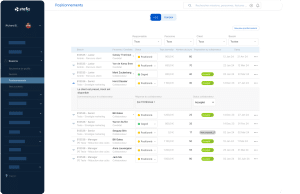
Stafiz allows you to develop skills files to present to your client, thus validating the specifications on the employee component to be mobilized in the project.
Best practices for writing project specifications
Here are some best practices for establishing relevant project specifications.
- Express themselves in clear and accessible language : the document is read by a variety of profiles; Banish unnecessary jargon and define ambiguous terms, so that there is no room for interpretation.
- Communicate realistic expectations : Advertise sustainable features, timelines, and budget. Promising the unrealistic disappoints the customer and exhausts the teams.
- Take safety margins : allow a margin on the schedule and budget to absorb contingencies, without artificially inflating the estimate.
- Keep in mind that the document can evolve : a specification is not set in stone; Track every change and reflect its impact on scope, time, and cost.
- Illustrate with visuals : tables, diagrams and layouts make the document clearer and quicker to read than a long text.
- Keep track of changes : precise versioning (version number, date, author) allows everyone to know which version is authentic.
Common mistakes to avoid in your specifications
Some common mistakes should be avoided when writing your project specifications.
- Being too technical or too precise : the specifications are aimed at a heterogeneous audience (business, management, service provider, sometimes legal). Writing that is too technical loses non-specialist readers; An excess of precision freezes choices that should remain open to the service provider's proposal. Aim for a level of detail that expresses the need without imposing the solution.
- Not framing the perimeter sufficiently and generating perimeter drift. In the event of a change, remember to adapt the schedule or budget accordingly; Unattainable goals would create team overload and frustration.
- Confusing the need and the solution : imposing a technology or architecture from the outset means responding to the service provider and depriving it of its added value. Describe what the project needs to accomplish (the "what"); How to do this (the "how") is up to his proposal.
- Ignoring the existing : a project almost always fits into an environment that is already in place (information system, tools, processes, data). Not auditing this existing system and its interfaces exposes you to unpleasant surprises, often costly, at the time of integration.
- Underestimating data recovery : Migration is often the most complex phase of a project, and the most forgotten in the framing. Specify who extracts, cleans, and reintegrates the data, and how they verify that no information has been lost.
- Forgetting to have the document validated and signed : without formal validation from the client, the specifications have no reference value in the event of disagreement. The signature commits both parties to the scope, deliverables and deadlines.
Writing a precise project specification is essential to guarantee the success of a project. Like a roadmap, it clarifies responsibilities, determines priorities and limits the risks of drift and ambiguity between all stakeholders.
However, it is still essential to make the difference between a project charter and a specification : the charter sets out the main lines and focuses on the official validation of the project launch, while the specifications detail what needs to be done, when and by whom. Upstream, the framework note specifies the initial operational scope.
By structuring your specifications in a clear and exhaustive way, as in the example we offer, you put all the chances on your side to manage your projects effectively, strengthen customer satisfaction and ensure the profitability of your missions.
Frequently asked questions:
The functional specifications (CoF) describe the needs expressed by users: what the product or service must do. The technical specifications (CdCT), on the other hand, translate these needs into concrete technical requirements (infrastructure, architecture, languages, etc.). The first answers the "what", the second the "how".
Yes, in agile methodology, you can write a specification in the form of a product backlog, prioritizing needs in the form of evolving user stories . This document is more flexible and adjusts to each iteration according to user feedback and the progress of the project.
The specifications may be annexed to the contract to set out the mutual commitments. It defines the services, deliverables, deadlines, acceptance criteria, and can thus serve as a reference in the event of a dispute. It is recommended to back it up with a schedule and a acceptance plan.
A specification is not legally mandatory, but it is highly recommended in any project involving third parties. It guarantees a common understanding of expectations and a clear framework for the implementation, management and contracting of the project.
A complete set of specifications covers ten sections: cover page, context, objectives, scope, stakeholders, functional needs, non-functional requirements, constraints, schedule and deliverables, annexes. Not all of them are mandatory on a small project, but each one deserves to be asked and then discarded in conscience.
Most often the project manager, who centralizes the needs. Depending on the organization, the writing can be carried out by the project owner (the profession that expresses the need), by the project manager (who will carry it out) or entrusted to an external consultant. The main thing is that the document is proofread and validated by the sponsor before starting the project.