Updated July 21, 2026 · Reading time: 13 min
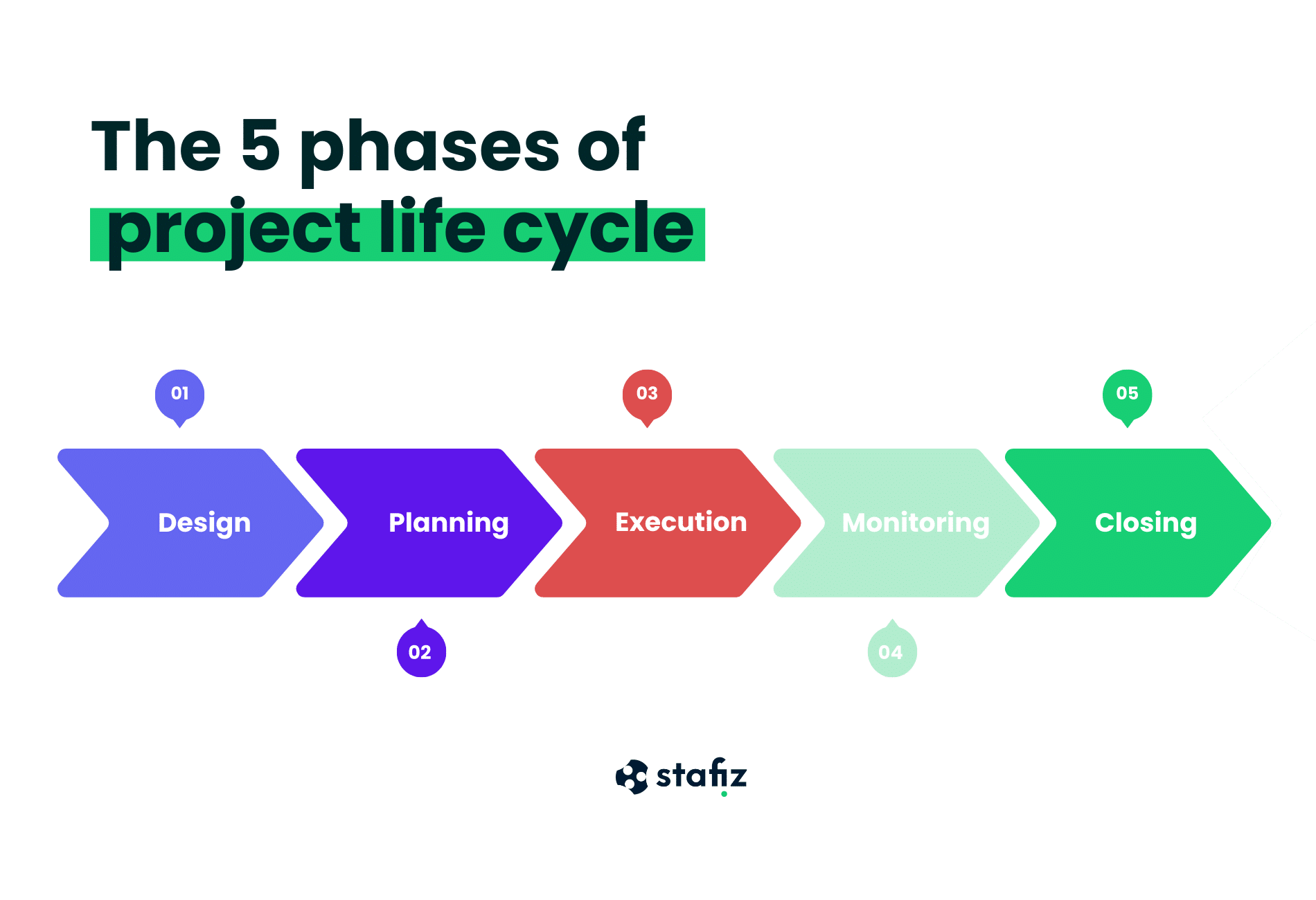
Project management follows 5 phases (initiation, planning, execution, monitoring, closure) which structure the life cycle of a project, from its scoping to its evaluation, to deliver on time while maintaining the margin.
In a consulting firm, a IT Services Whether it's an agency or an agency, every project sold is a promise: to deliver the expected result, on time, without losing profit. But a poorly defined scope from the outset, resources allocated without visibility into the actual workload, or a deviation detected too late can quickly transform a profitable project into a loss-making one. And the discrepancy is discovered at the end of the accounting period, when it's already too late to correct it.
To maintain control at each stage, project management is structured into phases. These phases make up the project lifecycle: five main phases, sometimes grouped into four or extended to six depending on the methodology. Each phase has its own deliverables, key considerations, and specific management challenges, from the initial scoping to the final evaluation.
This guide details the 5 phases of project management one by one: what is produced, and how to keep deadlines, budget and margin under control at each stage, especially when managing projects billed by time spent.
🔎 Key takeaways about the 5 phases of project management
- The project lifecycle is divided into 5 phases : initiation (or design), planning, execution, monitoring, and closure. Some methodologies group these into 4 or extend them to 6.
- Each phase has its own deliverables and management challenges : defining the scope, ensuring the reliability of the provisional budget, staffing the right resources, detecting a deviation before it becomes costly, and capitalizing on the results at the close.
- For a service company ( IT Services (consulting firm, agency), the challenge is not just to finish on time: it is to keep profitability visible at each phase, not just at the accounting close.
How does a project unfold, from idea to completion?

All phases of a project's lifecycle need to be planned in advance, so that you can build its foundation. This gives you greater visibility over the course of the project, making it easier to monitor and manage any risks or unforeseen events.
| 1. Initiation / Design | Define the project scope and decide whether to launch it | Feasibility study, project charter, scope, business plan | Calculate the correct scope and budget to avoid starting from a false premise |
| 2. Planning | Build the plan that the whole team will follow | Task planning, resource plan, budget forecast, risk plan | Staffing the right resources and ensuring the reliability of the budget forecast |
| 3. Execution | Produce the deliverables | Project deliverables, progress reports | Follow the utilization rate and real-time actual production |
| 4. Monitoring & Control | Check that the project stays on track | Indicators, dashboards, deviation alerts | Detect margin or delay deviations before closing |
| 5. Closure | Deliver, take stock, capitalize | Project review, documentation, budget revision | Measure the actual margin and learn lessons for future projects |
For the progress monitoring phase, it is then imperative to ensure that all objectives are met. Create a work structure for each phase, make sure the requirements are met, conduct a review at each stage of the project. To simplify the task, you need to use software. A project management tool like Stafiz can make your job a lot easier, thanks to its intuitive interface, automation and collaborative features!
Once the project has launched , always work directly with the team involved before moving on to the next phase. This will allow you to reassess their performance. The project team and the project manager share the same motivation: achieving the project objectives.
Stafiz is the operational management system for IT consulting and service companies: it connects resource planning Projects and finance are integrated into a single system, from pre-sales to invoicing. Where a traditional project management tool plans tasks, Stafiz makes the profitability of each project visible in real time, phase by phase.
Budget monitoring of projects, in anticipation
See Stafiz in action in 2 minutes
Phase 1: Project Design
The initiation (or design) phase serves to define the project's scope and determine whether it is worth launching. It involves defining the scope, objectives, expected deliverables, and an initial budget estimate, often formalized in a project charter.
At this stage, the project begins to take a conceptual form. It is also the time to formalize the framing in a project charter. It is at this point that it is necessary to define its properties and the scope of action. The first step is to create an overview of the project, in order to decide what strategies should be adopted to achieve the expected results.
The project manager should engage with stakeholders and customers to understand the importance of the project's goals.
After this meeting, you can already start creating a project dashboard. The idea is to create something similar to a project map, which will make it easier to understand the fundamental objectives.
Just as a task can be broken down into several sub-tasks, each phase of a project is itself organized into several stages. In the case of project planning , the following four areas can guide you.
- Conducting a feasibility study: This step involves evaluating the project's objectives, timeline, and cost to determine if they are achievable. To reach the project's expected results, it is crucial to strike a balance between requirements and available resources.
- Define the scope of the project: this involves knowing how to identify the project objectives, the expected deliverables, the deadlines (which timeboxing helps to meet), the tasks as well as the cost analysis. Find out what needs to be done to accomplish this project and what still needs to be done. By doing this, you will be able to define – or discover – the boundaries of the project.
- Project deliverables: This section involves identifying the scope of the work required and its form. Based on the statement of work (which describes the project's work requirements, schedule, invoice schedule, and what is and isn't acceptable), the guidelines for supporting deliverables and their quantities will then be clearly defined for each implementation phase.
- Create a business case: once all the above steps have been completed, start creating your business case. This can serve as a Proof of Concept: it demonstrates why the project is essential, and what financial benefits can be acquired from the outset.
Where does the profit margin lie from the very first phase? For a service company, everything hinges on the scope: an inaccurately defined scope, and the margin is eroded before launch. Formalizing the scope and the projected budget in a project charter and a clear scoping document prevents starting on the wrong foot.
Phase 2: Project planning
Planning transforms the framework into an operational plan: task scheduling, allocated resources, budget forecasting, and risk anticipation. This phase is crucial for the success of all subsequent phases.
Once you've got the investors' approval, create a plan that everyone can follow. Build a tasks schedule, and assign them to team members, setting deadlines for each tasks.
« Failure to plan is planning to fail. » Therefore, planning is the most important phase in the project life cycle. It's not the most exciting part of the project, and it's true that planning can be a bit daunting. However, it is crucial to your project's success.
Again, this phase can itself be divided into several stages.
Create a project plan
It should serve as a guide for project managers on how to produce quality results, manage risk, but also to help them keep the cost within budget.
It also helps to assess the value of the project, and to help teams complete their tasks within a given time frame.
Create a resource plan
This plan should provide you with the necessary number of resources required to complete this project. That is:
- the number of project managers;
- the number of workers;
- the number of raw materials.
This also includes essential project management techniques and information technology (IT).
Gathering the necessary resources
After creating the plan, gather all the other resources such as capital, equipment, workspace, etc. Have someone monitor resources and replenish them if needed.
One Solution of resource planning can take over a lot of these tasks and help you better allocate your resources.
Plan the financial budget
Based on the resources required, you can then forecast your financial costs budget. Create a detailed cost analysis with:
- the performing cost of each task;
- the cost for the whole team to carry out a task;
- provide a safety margin for any unforeseeable expenses.
Risks and obstacles
Even when a great deal of planning is done, risks are part of the mix. Try to take a proactive approach by thinking about the different types of obstacles and risks you may face during the project so that you are ready when they arise.
Putting a percentage of your risk in the financial budget as an expense, this provides you with security and will prevent the failure of your project.
Why does the budget forecast fall short of reality? In a service company, resources are measured in billable time. Planning the budget without visibility into team workloads is like flying blind. Beyond about twenty employees, tracking in Excel quickly becomes unmanageable: availability changes, assignments overlap, and the forecast diverges from reality.
Phase 3: Project execution
Execution is the phase where the plan becomes concrete: tasks are distributed, resources are mobilized, and progress is monitored continuously. The quality of the planning directly determines the smoothness of this phase.
This is the moment when everything that has been planned takes shape and becomes concrete. During this phase, project managers distribute project tasks to teams and allocate resources.
But remember: success depends on how well the planning phase has been structured! For even more efficiency, project managers can keep a checklist to ensure that stakeholder requests are taken into account and respected, as agreed in the business case.
It's important to learn from your mistakes, but also from your successes. A vital aspect of the project execution phase is tracking what caused the project to fail or succeed. This way, you can move forward.
To do this, different metrics must be tracked:
- objectives;
- performance reports;
- project status updates;
- the need for human resources.
Project Progress Report
During the execution phase, there are a series of data updates as the project progresses and the expenditures to the resources committed. This is why it is necessary to maintain regular updates on what is happening and identify critical issues in the project.
How a consulting firm manages its projects with Stafiz
Greenworking, a consulting firm and training organization with 40 employees (France), supports business transformations. Like many service companies, its activity tracking relied on Excel files that were manipulated in every possible way.

❝
This makes a real difference compared to Excel files that require constant manipulation. The data is accessible in real time and instantly within the tool. Florentin Seux, COO, Greenworking
With Stafiz, Greenworking now manages the availability of its employees in real time, the utilization rate , invoicing for missions and tracking of purchase orders, without going back to spreadsheets.
Schedule regular interviews with stakeholders and the project team
We recommend that you update your reports for stakeholders and customers. See with them if the project is still moving in the right direction, and communicate with your team to give them your feedback and suggestions for improvements, especially on topics such as understanding customer needs or moving the trajectory forward to ensure that objectives will be met.
What should you really be monitoring during execution? Tracking task progress isn't enough. Team utilization rate (the proportion of their time actually dedicated to tasks) and output already consumed indicate whether the project is on track financially. A progress report that combines progress with budget spent is more valuable than simply a percentage of tasks completed.
Phase 4: Project monitoring
Monitoring (or control) takes place in parallel with execution. It consists of continuously comparing what is achieved with what is planned (budget, deadlines, scope) in order to detect discrepancies and correct the trajectory before a deviation becomes irreversible.
This phase of the project takes place concurrently with the execution phase. It can be easily managed using ERP software or a project management tool .
This step aims to measure that all parameters, such as budget, plans, and timelines, align with the project plan.
The project manager must ensure that the quality of the output, scope deviations, and resources always remain within the project's budget . If everything has been planned as agreed, the project manager should be able to anticipate potential risks and prevent them from occurring. Keep the project moving forward, despite the obstacles!
How can you detect that a project is heading for a loss before it's too late? By comparing, in real time, the budget spent and the output achieved to what was planned. Most budget overruns are discovered too late, at the end of the accounting period, when the profit margin is already lost. Monitoring the margin at completion (the projected margin at the end of the project, recalculated at each progress stage) allows time to react before the gap widens. To learn more: avoid target drift and the 12 financial indicators for project management .

Transition from imposed margin to managed margin
Download our free white paper on project margin management
Phase 5: Project Close-Out
The project closure delivers the completed project to the client, followed by internal review: team debriefing, documentation, and revision of the actual budget. This phase transforms a finished project into lessons learned for future ones.
After the successful completion of the project, communicate the results to the stakeholders and hand over the project to them.
On the internal side, take stock with your team members and learn from any mistakes that may have been made. Learn how to make adjustments for future projects (better manage your teams, allocate your resources wisely, plan better, etc.).
Don't forget to congratulate your team and show them appreciation for the hard work they've done. This will motivate the team to achieve better results in future projects.
Analyze team performance
- Check the quality of the work and the results obtained.
- Suggest room for improvement.
- Compare performance with previous projects to see how it has been able to increase.
Write project documentation
Write a detailed document describing how stakeholder expectations were met. Explaining the strategies and different phases implemented to achieve these objectives provides you with material for reflection and allows for a retrospective understanding of how events unfolded.
Review the budget
Finally, see if the project was carried out in accordance with the allocated budget. Evaluate whether the costs and benefits are in line with the original plan. Look for opportunity costs that might have been overlooked during the project.
What does the closing reveal about the margin? The closing is the moment of truth for profitability. Comparing the actual budget to the forecast, project by project, feeds into a project balance sheet and a project review , which serve as a benchmark for better estimating the costs of subsequent projects.
How can we ensure that no phase of the project is overlooked?
Phase 1: Initiation
- Feasibility study (objectives, timeline, cost) validated
- Scope and objectives formalized in a project charter
- Expected deliverables identified
- Business case study written
Phase 2: Planning
- Task schedule established and assigned
- Resource plan defined (who, how many, when)
- Projected budget figures, including safety margin
- Identified and provisioned risks
Phase 3: Execution
- Tasks distributed to the teams
- Progress metrics tracked (objectives, performance, resources)
- Regular progress reports produced
Phase 4: Monitoring & Control
- Budget/schedule/scope variances measured continuously
- The margin at completion is recalculated at each milestone.
- Drift alerts addressed before impact
Phase 5: Closure
- Project delivered and approved by the client
- Team review and documentation completed
- Actual budget compared to the forecast
Project management can sometimes feel overwhelming. There are a lot of tasks that include risks, problems, and failures. To succeed in your projects, it is essential to follow the five steps mentioned above.
To take your project to the next level, you can also equip yourself with an IT tool that takes care of each phase of the project life cycle. This ensures that you save time, better manage your resources, and make the complexity of projects easier to organize.
For a consulting firm or a IT Services The challenge goes beyond deadlines: maintaining the profitability of each project is visible at every stage, not just at the end of the accounting period. A project management tool like Stafiz connects the resource planning execution and margin in the same system, to act on each phase without waiting for the assessment.
Frequently asked questions:
The five phases are initiation (or design), planning, execution, monitoring (or control), and closure. They form the project lifecycle, from the initial scoping to the final assessment. Each phase produces its own deliverables and prepares the ground for the next.
Planning is often considered the most crucial step: it determines execution, budget, and monitoring. A reliable budget forecast and well-allocated resources from this early stage significantly reduce the risk of cost overruns.
By carrying out the 5 phases in order: defining the scope and budget (initiation), building the plan and allocating resources (planning), producing deliverables (execution), continuously monitoring deviations (monitoring), then delivering and taking stock (closure).
By continuously comparing the budget consumed and the output achieved with the forecast, right from the planning stage, a management tool recalculates the margin at completion with each progress update, making it possible to detect deviations during the project rather than at the accounting close.
By monitoring, phase by phase, the gap between planned and actual results in terms of budget, deadlines, and team workload, regular checkpoints and alerts regarding the margin for error at completion allow for course correction before the gap becomes irreversible.