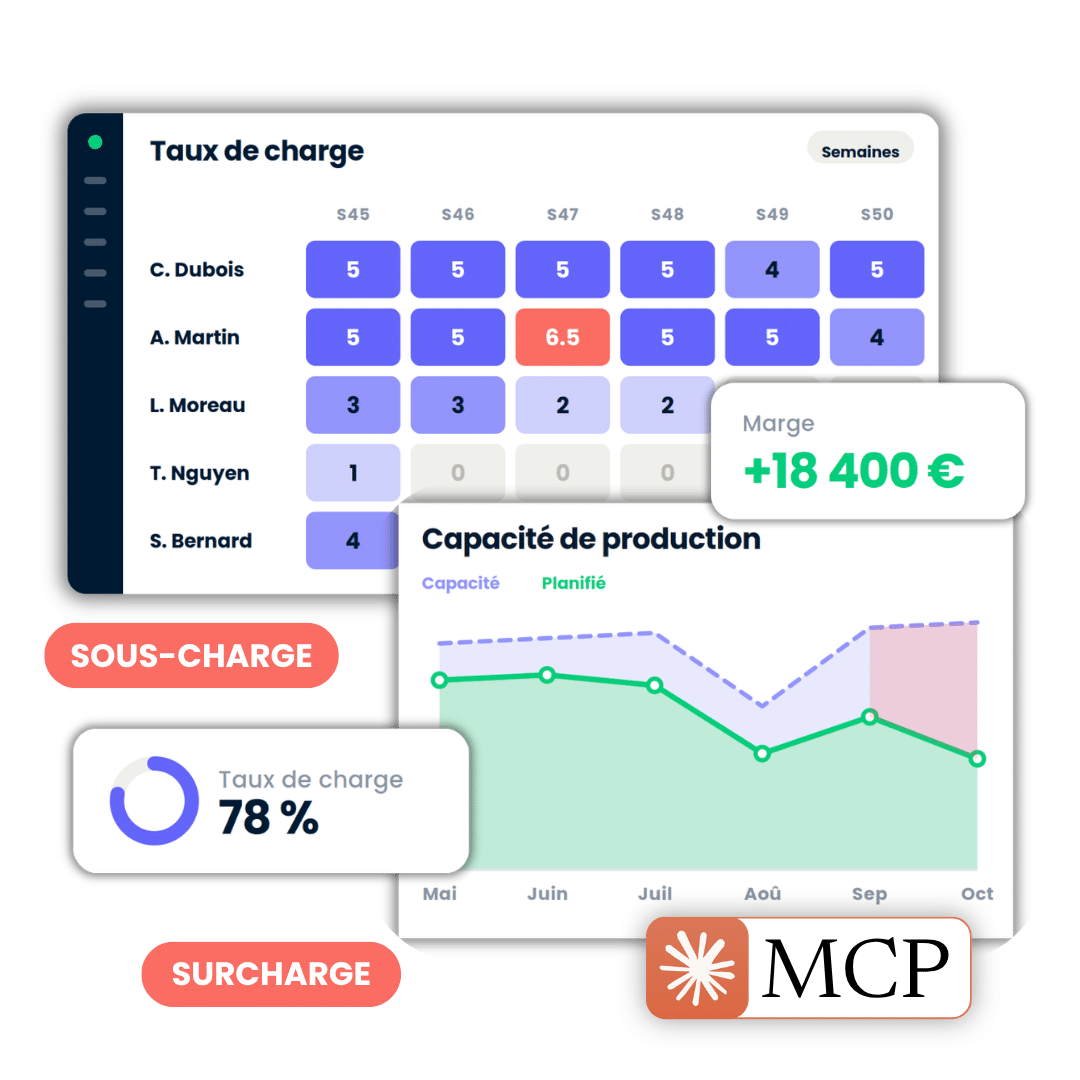
Project planning software is particularly useful in this case. For example, Stafiz offers dedicated features in order to:
- establish a provisional project budget,
- Carry out a strategic review of the project through the study of deviations by day and by cost,
- Establish a financial analysis by period or in comparison with other projects.
Our project planning tool
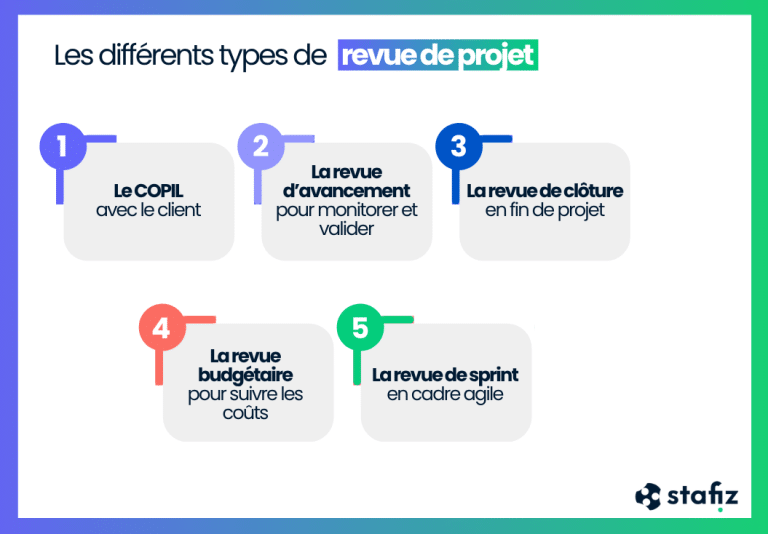
Sprint Review
Sprint review is for agile projects that are organized into sprint phases.
Organized at the end of each sprint, it reports what has been achieved, clarifies what needs to be changed, and validates the move to the next sprint.
Manufacturing Review
The manufacturing review is mainly about products.
It takes place at each stage to validate manufacturing, design, compliance, or propose adjustments to move on to further development.
Who Participates in a Project Review?
The project review should only include members whose presence is essential.
The more participants there are, the longer the meeting is likely to last.
The project sponsor is the one who allocates the budgets, ensures that the budget is respected and that the project is profitable.
It is the government that will intervene if other budgets need to be released.
The Client's Representative
The client or their representative attends the project review in order to have a transparent visibility on the progress of the project.
Their participation is essential in order to validate important decisions and to be clear on the turns that the project is taking.
The Project Manager
The project manager organizes, leads and follows up on the project review.
Thus, he is responsible for its preparation, ensures its smooth running and its relevance.
The Project Team
The project team is involved in the preparation of the meeting.
He or she does not attend the project review directly but assists his or her representative, the project manager, so that he or she has all the necessary information. It communicates the progress of tasks, problems encountered or risks.
The Experts
Some deliverables require a technical point of view, thus requiring the presence of experts to answer technical questions and provide a realistic point of view.
Step 1: Defining Goals
The first step is to define the type of project review. Thus, you must identify the objectives to be achieved by planning this project review: take stock, validate a step, review the budget, etc.
By clearly defining a framework, you will save time and increase efficiency.
Step 2: Set the Agenda
Preparing for the project review is one of the most important phases. Indeed, it is at this stage that you will have to define:
- The agenda and the expected objectives.
- The participants. Call them well in advance to ensure their availability.
- The calendar. Try to estimate the time needed for each step.
To facilitate the project review, prepare a presentation that you will take care to have validated by the sponsor before the big day. It must include:
- a dashboard presenting the actions carried out so far as well as the key indicators for project monitoring.
- what has been achieved, what remains to be done, the problems encountered and the risks.
- the expectations for the project review, the decisions that need to be made.
- an appendix giving access to the history of the project and all the information in detail.
Step 3: Guiding the Meeting
The project review opens with a reminder of the objectives and the milestone to be validated.
Here are some tips for organizing and hosting a project review.
- List the members present for maximum transparency.
- Identify a "time master" and a person responsible for note-taking.
- Focus on information that concerns the whole group and not spread yourself too thin on aspects that are too specific.
- To act on decisions.
- Encourage open discussion and constructive exchanges.
- Allow time for questions.
- Call back the next project review.
Step 4: Approving the Decisions Made and Next Steps
The project review must make it possible to validate key decisions for the rest of the project.
Make sure the next steps and actions are clear to everyone. In addition, all participants must approve the move to the next stage, otherwise the project will be put on stand-by.
Record the findings, clarify the tasks expected for each with specific deadlines.
Step 5: Rigorously Following-up the Project Review
The follow-up stage ensures that all members are aligned on the same vision.
Following the project review, the project manager sends a report, which has been validated beforehand by the sponsor. Concise and precise, this report lists what was present, what was discussed and what decisions were taken.
Following the project review, it is necessary to ensure that the actions have been put in place and the decisions taken have been recorded. You can group all project review reports in a folder to facilitate project monitoring.
In addition, we recommend that you establish a project review template that includes a standard format, a schedule and a checklist. However, it is important to remain flexible in the event of changing needs.
The project review is not very complex to set up but requires careful preparation. The more efficient the preparation phase , the smoother the meeting can be and the more quickly the meeting will allow you to respond to the objectives and validate the passage to the next step.
Using project management software is a great help in preparing for a project review. Some tools such as Stafiz offer features not only dedicated to project planning, but also to project monitoring, thus offering reliable and usable data.
Frequently asked questions:
A project review serves to assess the progress of a project at a key stage: verifying what has been accomplished, measuring discrepancies (deadlines, budget, quality), addressing risks, and validating the transition to the next milestone. It is also a time for synchronization that strengthens collaboration between teams, the client, and decision-makers.
Define the objectives and type of review, prepare the agenda, and invite the right participants in advance. On the day of the review, remind everyone of the milestone to be validated, formalize the decisions, and set the next steps with deadlines. A report distributed afterward ensures follow-up on the actions.
1) Define the objectives and type of review; 2) prepare the agenda, participants and materials; 3) facilitate the meeting focusing on the essentials; 4) validate the decisions and next steps; 5) ensure follow-up via a report distributed to all.
Begin by reviewing the objectives and the milestone to be achieved, designate a timekeeper and a person responsible for taking minutes, focus on topics common to the group, and clearly document each decision. Conclude by outlining the next steps and the date of the next review.
The steering committee (COPIL) is a strategic project review that brings together decision-makers to define the project scope and validate its main directions. The term "project review" is a broader term encompassing all steering committee meetings at each milestone (progress, budget, sprint, closure), of which the COPIL is a part. See our article dedicated to the steering committee .
A project review is a periodic evaluation conducted during the project, at each key stage, to adjust the project's trajectory. A project assessment is a retrospective analysis carried out at the end to evaluate overall performance and draw lessons for future projects.