
Updated on May 4, 2026
In short: the 10 main causes of project failure deciphered by Stafiz: unclear objectives, lack of visibility on the resource planning, poor communication, rigid organization, absent management, poor risk management, uncoordinated team, underqualified leadership, irregular follow-up, and underestimation of costs.
"Life is 10% what happens to you and 90% how you react to it," Charles R. Swindoll once said. This is just as true for project management, where 10% of the time is spent on the execution of the project itself. The remaining 90% is for project planning and troubleshooting issues encountered during production.
No matter what industry you operate in, projects are essential for companies to test their ideas, meet customer needs, and solve problems. This article reviews the various management issues that prevent projects from finding success. This introspective approach helps to take a step back from project organization methods to understand how to achieve higher performance through good practices.
🔎 What you need to know about the 10 causes of project failure
- Ten causes structure the failure of a project : unclear objectives, resource planning Invisible, poor communication, rigid organization, absent management, poor risk management, uncoordinated team, underqualified leadership, irregular follow-up and underestimation of costs.
- For IT Services and consulting firms, the margin is played out on three fronts : invisible under-invoicing (hours not entered, ancillary services forgotten), drift of resource planning (under-allocation or hidden overload), and underestimation of costs from the scoping.
- The root cause is rarely technical : it's the lack of shared visibility between the project manager, production management and CFO — a piece of data known by a single role remains invisible to the other two until the breaking point.
- Scope creep is the first cause of missed deadlines: it is set in by an accumulation of one-off requests accepted without an amendment, rather than by a major identifiable change.
- Three indicators anticipate drift : forecast vs. realized margin, utilization rate forecast, cumulative calendar gap. Beyond a 5-point difference between the forecast margin and the actual margin, the status quo costs more than a change in management tool.
The project drifts away from the objectives
In the project management industry, this is referred to as goal creep. But before you can even talk about it, you have to make sure that objectives are well set. Without this, the project will not be able to move forward properly.
Project managers and organizations should focus on 3 main characteristics: schedule, budget, and quality. These characteristics must have a numerical value in order to analyze the performance of the project. This can only succeed if stakeholders understand the value they can get in exchange for their contribution. Yet, only 58% of organizations fully understand the value of their project.
It is therefore imperative to develop a provisional project budget. Without a very accurate representation of the benefits that their projects can represent, companies can lose a lot of revenue, and employee satisfaction decreases and ultimately leads to disengagement from the project. One of the first mistakes is during project planning: companies often focus on their profit margin rather than how to deliver value to their customers.
It is also necessary to ensure that the objectives are aligned with the company's strategy in order to define a certain order of priority for projects. Those who are most closely linked to the overall strategy are given priority. Finally, to prioritize customer satisfaction.
A lack of visibility resource capacity
For a IT Services or a consulting firm, the invisibility of the resource planning is a direct cause of margin loss: an underallocated consultant will cost the same as a full-time billed consultant, and an overbooked consultant generates cascading delays across multiple projects. The view of the availability of resources, their actual load and the progress of deliverables conditions both the respect of customer commitments and the utilization rate global.
The visibility that project management software provides on the resource planning resources is essential. By integrating information about their skills or experience, it becomes possible to assign employees to the various project tasks, where they will be most effective. This visibility also offers a better view of everyone's performance, an essential aspect during project management: the resources bring the project to life and move forward.
A resource planning like Stafiz , it allows you to visualize the skills of employees to assign them effectively, to have a vision of the future margin generated by progress and turnover, and to make a Follow-up of utilization rate for better performance. In addition, the resource planning automated by a tool ensures that resources are managed even more appropriately to meet customer demand.
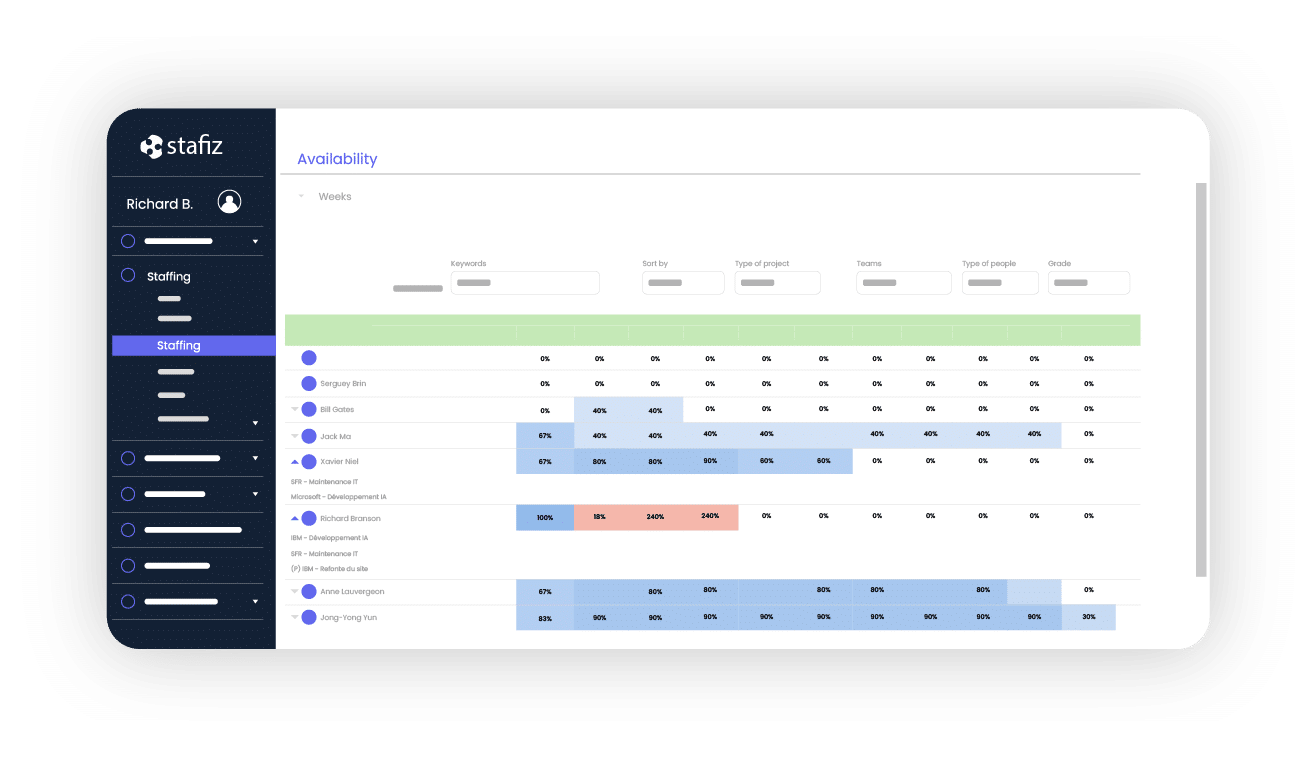
Digitize your resource planning
Gain visibility into occupancy, build the best teams & optimize your utilization rate.
The best practices of a consolidated workload plan are based on three pillars: real-time visibility, man-day granularity, threshold alerts.
For a service company with 50 consultants, a point of utilization rate represents several hundred thousand euros in annual turnover: visibility resource planning is not a question of organization, it is a question of the income statement.
A lack of communication
According to Bullhorn Research, 57% of projects fail due to a lack of communication. And according to a study by the Project Management Institute, ineffective communication is responsible for about one in three project failures, with a risk of $75 million for every billion spent on projects. When a project takes place on a global level, the lack of communication between project managers and other stakeholders located around the world can affect overall performance and lead to delays.
For example, a communication issue regarding supplier payment can cause shipping delays if not handled correctly. If communication is not smooth and clear, there can be big financial consequences.
It is also important to remember that frequent communication to employees about their performance can help them work more efficiently. Good feedback on their accomplishments leads to better engagement on their part.
For better communication, a resource planning or project management software improves the interaction between team members, leaders, and stakeholders. The goal: to provide everyone with the right information in the right place at the right time, and to allow everyone to know the progress of the project, the obstacles, and to offer suggestions.
A lack of flexibility in the organization
Today, working together is becoming more complex. Teams work remotely and many companies do not have access to the digital tools that allow them to coordinate their tasks and schedule. As mentioned earlier, this is related to the lack of communication or visibility about the project. It also refers to the inability of some employees to adapt to changes, to different time zones when they are in contact with other countries, or to different ways of working.
Keeping methods that are too static and old can no longer work in a world where adapting to change is mandatory to remain efficient. Whether it's in leadership or team organization, flexibility is the key to continuing to innovate.
Three business situations illustrate how a project management ERP absorbs these challenges without going back to Excel.
Case #1 — Flexibility in the resource planning
Are schedule adjustment done by email or chat time-consuming?
Reshuffle your schedules easily: postpone, cancel, reallocate to other employees easily.
Case #2 — Flexibility in invoicing
Do you have different types of fixed-price, time-spent or subscription-based projects?
Manage and automate these different types of invoicing directly in Stafiz.

Case #3 — Flexibility in the use of your tools
Do your teams use various project management software that doesn't communicate with each other?
Stop double entry and errors: Stafiz integrates with many tools and presents a comprehensive API library.

Insufficient leadership from the leaders
Three-quarters of projects fail because of a lack of senior management involvement . The Standish Group identifies management support as one of the top five factors for a project's success, ahead of the quality of requirements or planning. Conversely, the lack of executive support is in the top 5 causes of failure.
Because senior managers play an important role as project sponsors, they should support project managers and give their final opinion on some important decisions.
Senior managers brief the project manager on the objectives and on the overall strategy. A study by Project Smart UK surveyed 1000 project managers to ask them whether roles, responsibilities and levels of authority were clear in the projects they work in. Here are their answers:
- Strongly agree: 2.8%
- Agree: 34.3%
- Disagree: 51%
- Strongly opposed: 9.7%
- Don't know: 2.3%
Nearly 63% of them do not know their role or have not received specific instructions from their superiors.
A poor risk management
Micro-projects are simpler to manage than macro-projects: projects with budgets greater than $1 million have a failure rate of 50% higher than projects with budgets of less than $350,000. Each project is unique and has its own uncertainties in terms of risk. In any case, it is always preferable to quantify the risk.
When planning a financial budget, you should always plan for a percentage of risk and cost overruns that could create tension with sponsors or customers. Project managers should also be prepared by providing them with a guide on how to respond to specific project risks. It is also necessary to equip yourself with the right tools to monitor the progress of the project and the financial performance compared to that of the budget.
Tools like project management software provide this long-term visibility and alert when a project deviates from budget.
A structured project risk management approach is based on three indicators that are continuously monitored:
- Forecast vs. realized margin,
- utilization rate forecast,
- Cumulative calendar gap.
For IT Services, the most useful alert is not "the project is going to overtake" but "the project is overtaking" — even more so when it is spotted ahead of the consolidated income statement.
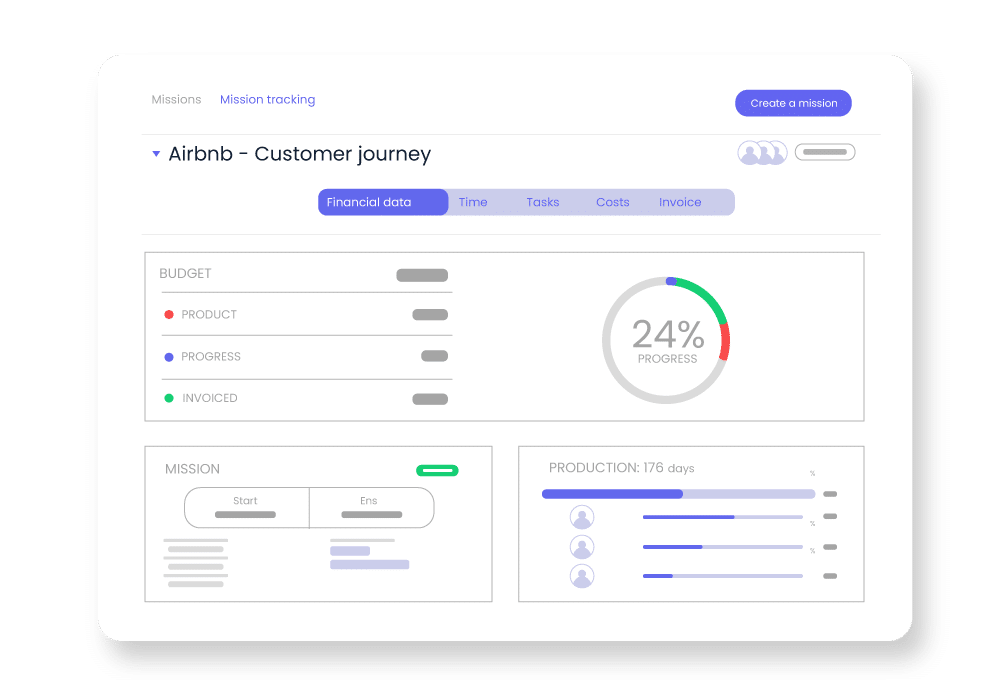
Visualize the performance of your projects in forecasting
Variance analysis : Compare the planned activity with the one that has been completed and scheduled. Visualize the financial impacts of your scenarios (resource planning, purchases, etc.) and be alerted.
A lack of team coordination
Not planning as a team with the project manager and with the management inevitably leads to failure. When all three levels of management do not have access to information that is updated in real time, the project is headed for failure.
Coordination sessions should be set up regularly within organizations to discuss issues, review performance metrics and monitor progress. It is also an opportunity to share visibility on the performance of each task.
Additionally, bringing team members together makes it easier to brainstorm and brainstorm ideas to reach consensus. This has a big impact on the performance of the project.
Be careful: a blockage in project management is not always an open conflict. More often, it is a piece of data that has not circulated between the project manager, the production manager and the CFO. On three levels of management, it is the latency of information that creates failure, not the unwillingness of the project actors.
An underqualified leadership
A lot of problems surface when managing a project, and the solutions don't just come out on their own. To solve these problems, organizations need effective project managers who are dedicated to guiding the project in the right direction. 80% of "high performing" projects are led by a certified project manager. That's why choosing the right person to lead the project — someone with the necessary skills — reduces the chances of failure.
One of the recurring reasons for a project failure is that the project manager does not have the experience and technical training to manage certain tools. Some also lack the social skills to manage a project as a whole, and at a global level in some cases.
Another problem could simply be a lack of involvement from the leaders. To ensure the success of a project, leaders must be present and listening. They need to give the necessary information to their team and customers to move forward and resolve any issues that arise. Being a good leader requires a lot of skills, but also many soft skills such as communication, conflict resolution and organization.
An irregular follow-up
Once they are halfway through the project, the production manager and project manager may miss some weak signals such as problems with money coming in and out, delays in schedule, or budget overruns. The managers, who are very busy, do not have time to follow all the red flags, and the alert is only triggered at the next project steering committee — several weeks after the moment when the project could still have been turned around.
The only way to solve this situation is to use project management software that provides the level of automation needed to track red flags. Stafiz software, ERP for project management, offers this total automation for your project management.
You can track progress, budget adjustments, and time spent on each activity. This software helps managers work on other aspects of the project without wasting time.
Budget monitoring of projects, in anticipation
See Stafiz in action in 2 minutes
Please note: the quality of the data entered will determine the quality of the project management. The stakes of time tracking determine what a project management dashboard can actually display. Without consolidated input, the dashboard steers decisions in the wrong direction.
Underestimating costs
The Pulse of the Profession 2024 PMI estimates the average project performance rate at 73.8%, i.e. one in four projects that does not meet its business objectives. Organizations that set up support programs for project teams gain +8.3 performance points, according to the same report.
This situation occurs when objectives are not achieved as planned and the project manager is no longer able to find his or her way around the order of priorities. Project progress can be affected when one team has to wait for another team to complete their tasks before they can begin theirs. This leads to delay, and it also happens when the organization focuses too much on project margin and tries to cut costs thinking that they can deliver with fewer expenses and resources.
For a IT Services, underestimation is often coupled with under-invoicing: days started without being entered, overtime hours not re-invoiced, additional services forgotten on the final invoice. Structuring the steps of project cost management limits this risk. The gap between theoretical margin sold and margin actually achieved is widening project after project, without any consolidated figure making it visible before the quarter close.
This specific mechanism (distinct from production overruns) is discussed in our dedicated article The main causes of cost overruns, and its quantified stake in how to calculate the profitability of a project.
How to avoid project failure?
When a project becomes more complex, the manager realizes the difficulties in analyzing certain data. You need to go further than Excel spreadsheets and other basic tools can offer to plan, execute, and track other project management processes.
It's much more efficient to work with tools that bring together graphical representations such as Gantt, time tracking, planning, and budget in one place. This is possible with Stafiz.
One of the main reasons for a project's success is that 77% of high-performing projects use the right project management software. There is a high risk of failure when 44% of project managers do not use an appropriate tool to work with their team.
How much does a project failure cost? 8-point checklist
- Frame scope, budget, and quality with a numerical value for each dimension.
- Maintain a consolidated workload plan in real-time, not weekly.
- Designate an executive sponsor with a formalized arbitration deadline (48 hours or 72 hours).
- Maintain a risk register reviewed at each milestone.
- Centralize project communication on a single dated feed.
- Follow the forecast margin vs made by the week, not at the monthly committee.
- Set automatic alert thresholds to utilization rate, margin and calendar.
- Immediately re-invoice any excess validated by an amendment.
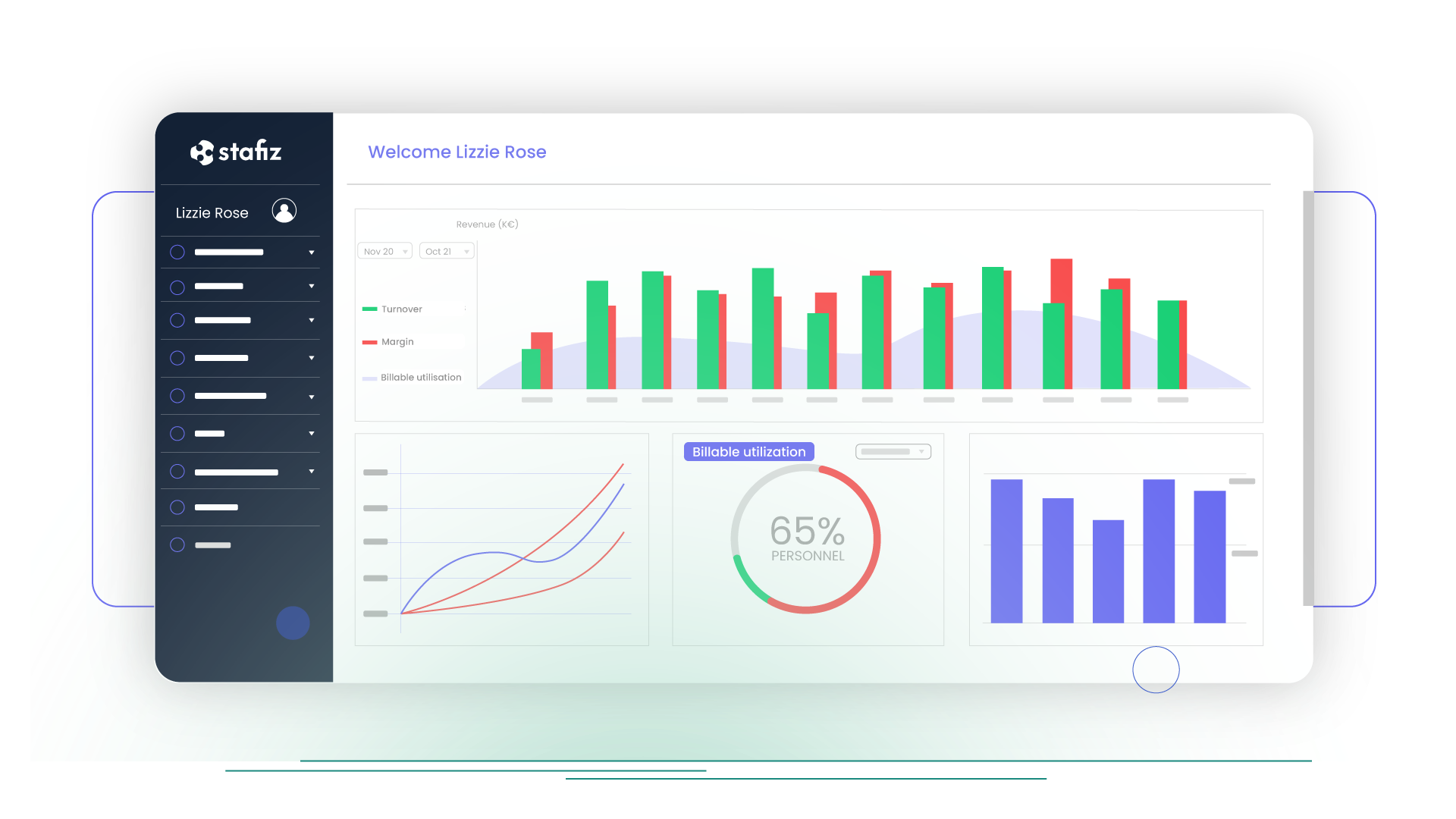
To obtain this level of visibility (initial budget, monitoring of variances, still to be done, forecast margin), Stafiz offers a module dedicated to budget monitoring. You will be able to create and script budgets, be alerted in case of overruns and identify corrective actions to preserve margins.
Stafiz helps service companies gain visibility, optimize teams, and boost profitability.
- Be alerted when deviation happens
- Anticipate your activity
- Understand your data
- Stay flexible
Frequently asked questions about project failures
The ten recurring causes are goal drift, lack of visibility on the resource planning, poor communication, rigid organization, absent leadership, poor risk management, insufficient team coordination, underqualified leadership, inconsistent follow-up and underestimation of costs. For IT Services, resource planning, monitoring and costs weigh directly on the project margin.
The Standish Group CHAOS Report estimates that 83.9% of IT projects are partially or completely unsuccessful. Three levels are distinguished: 16.2% of complete success, 52.7% of projects delivered "challenged" (delay, overrun, missing features) and 31.1% of pure failures. The key factors are incomplete requirements, lack of user involvement, and lack of executive support.
The root cause is rarely technical. It's the lack of shared visibility between the project manager, production management, and CFO — something known by one role remains invisible to the other two, until the gap is too big to make up.
A problem in project management is a discrepancy between the planned and the actual on three axes: scope, deadline, cost. As long as the gap remains below the threshold defined in the framework, it is a drift to be monitored. Beyond the threshold, it is a difficulty that requires explicit arbitration: readjustment of the scope, re-invoicing, or decision to stop.
The most frequent obstacles are organizational rather than technical: unavailability of a key resource, late customer validation, missing financial data from the committee, deadlock between two teams due to the lack of a common channel. A project management ERP reduces this friction by consolidating data and automating alerts.
Four early signs: the workload plan is kept on Excel and out of sync, the steering committee is cancelled more than twice in a row, the financial reporting arrives after the monthly closing, the actual margin is unknown before the project closes. While three of these signs are present, the project has already begun to get out of hand.