EPPM, or Enterprise Project Portfolio Management, is a management approach that consolidates all of a company's projects and resources into a single view, to align resource planning, margin and strategy at the portfolio level rather than mission by mission.
The more a consulting firm or IT services company grows, the more difficult it is to manage projects and the margin they generate. After 20 employees, Excel becomes unmanageable between the number of tabs and file versions that have to be juggled. After 30 to 50 employees, the missions are structured into portfolios and conflicts of resource planning emerging. The company needs a PPM tool that consolidates all of its KPIs to be able to effectively manage its project portfolio.
But what happens when the firm grows even further? That we arrive at multi-site companies, where each Business Unit (BU), i.e. a department, a practice, a subsidiary or a geographical area depending on the firm, manages its own portfolio and competes with the others? Here again, a paradigm shift, and a change in tool, must be made.
Between managing a project and managing all the projects of a firm, the scale changes (one project, several projects, all projects). But it is above all the questions arbitrated, the decision-makers concerned and the KPIs to be monitored that change. Each size of company corresponds to a type of tool, with its own functionalities.
This article explores the use of Enterprise Project Portfolio Management (EPPM) software to manage all of a company's projects, when it includes multiple BUs or multiple locations.
🔎 Key elements to remember
- A PPM tool manages the portfolio of a single BU; EPPM software consolidates all portfolios across the group.
- The transition from PPM to EPPM corresponds to the jump from Tier 3 to Tier 4 of the Gartner ITScore PPM model.
- There are six symptoms that signal that a practice or a IT Services must be equipped: Excel with resource planning unmanageable, known margins at closing, invisible intercontract, rare skills not shared.
- The EPPM produces the data; the EPMO, a team attached to the general management, uses it to arbitrate in the portfolio committee.
- Eight functions distinguish an EPPM aligned services (margin on landing, billable utilization rate, multi-mode of sale, intercompany re-invoicing) of a generalist tool.
EPPM: definition, scope and difference with traditional project management
What is EPPM software?
EPPM, or enterprise project portfolio management, is the process of managing all of an organization's projects as a single consolidated portfolio. It allows managers to arbitrate between projects and between BUs according to their margin, their strategy and their consumption of resources. In concrete terms, it relies on EPPM software that consolidates this data continuously.
Why switch from a PPM tool to an EPPM tool?
Where a PPM tool stops at the perimeter of an entity, the EPPM tool answers the strategic questions that an Executive Committee asks: where to place a senior consultant between two sites that request it, what consolidated margin to project in 3-6 months, where to invest and recruit according to the profitability of the group portfolio.
Indeed, as long as a consulting firm or a IT Services works with compartmentalized PPM tools, management does not have a consolidated view of the group portfolio on KPIs such as:
- the aggregate landing margins of all BUs;
- The resource planning and the billable utilization rate between the different entities;
- the overall projected turnover.
All this information is reconstructed by hand, once the projects have been closed. Switching to EPPM software makes it possible to manage these indicators at the level of all entities, which several PPM software operating in silos cannot manage.
This transition corresponds to the jump from level 3 to level 4 in the Gartner ITScore PPM model, detailed below.
3 levels of project management: the project, the portfolio and the company
The Project Management Office (PMO) is the team that manages the project portfolio of a single entity: it standardizes monitoring methods, monitors the margin of each mission and alerts on abuses.
The Enterprise Project Management Office (EPMO) is the team attached to senior management that drives the company-wide project portfolio. Where a PMO is a single-BU organization, the EPMO consolidates the data of all entities and prepares the strategic decisions of the portfolio committee.
Each level corresponds to a different reading of the activity. The project manager, the BU director and the management of the firm do not share the same issues: the decisions to be arbitrated and the indicators to be monitored change with the size of the structure.
| Project (PM) | Project manager or project director | Excel or project management tool (Asana, Notion, Trello, Monday) | Are we staying within the framework promised to the customer? |
| Portfolio (PPM) | BU Director with the support of a dedicated PMO | Dedicated PPM tool for each department | Which projects should be accelerated, slowed down, prioritized in the local area? |
| Enterprise (EPPM) | COMEX and EPMO | Multi-entity EPPM tool | Which entity to invest in, what scarce resources to allocate between them? |
The Gartner ITScore PPM Maturity Model
ITScore for Program and Portfolio Management is a framework created by the analyst firm Gartner. It evaluates the management of a company's project portfolio on five levels, from a reactive approach using Excel (with exchange of versions by email), to the implementation of a mature EPPM software that dialogues with the entire company's Information System: CRM, ERP, HRIS.
In this model, the transition from level 3 to level 4 corresponds exactly to the transition from classic PPM to EPPM: the moment when portfolio management stops stopping at the BU and extends to the entire company.
| 1. Reactive | A unique team led by a leader | Excel Shares and Email Chains |
|
| 2. Disciplined | A first entity is structured and equipped; The other teams remain in craft mode. | Implementation of a first PPM tool |
|
| 3. Effective integration (frequent ceiling) | 2 to 4 specialized and autonomous BUs. | One PPM tool per department (operating in silos) |
|
| 4. Coordinated (EPPM input) | Several specialized entities, managed in a coordinated manner with a portfolio committee at management level. | EPPM tool + monthly consolidated portfolio review |
|
| 5. Effective innovation (scarce in services) | BU conglomerate, mature EPMO reporting to the general management | EPPM software integrated with ERP, CRM and HRIS |
|
Sources: Gartner, ITScore for Program and Portfolio Management (paid access); PMI, Project Portfolio Management Maturity Model (free alternative).
Level 1: Reactive
In a consulting firm or a IT Services The small management of the missions is managed by the Director General. There is no dedicated PPM tool: the resource planning is managed by Excel file and email chains. Arbitrations are therefore made according to customer emergencies, and margins by assignment (and at the global level) are only calculated at closing, when the CFO reconciles the invoices issued with the costs incurred.
As soon as the firm organizes itself into several separate teams of consultants, but does not equip itself with an EPPM tool, several hidden costs will start to pile up:
- the start of the missions will be postponed by several weeks because the firm does not know which consultant is available at any given time;
- consultants are therefore alternately over-employed or inter-contracted, which causes an increase in turnover and absenteeism or a drop in revenue;
- Project drifts are only seen at the end of the month, when it is too late to re-staff the mission or negotiate an amendment.
Level 2: Disciplined (or why an Excel file is no longer enough)
The firm is entering a phase of structuring its processes, and has several teams. A first practice, generally the one with the largest volume of assignments, installs a dedicated PPM tool and standardizes the monitoring methodology.
The problem is the asymmetry between this entity newly equipped with a PPM tool and the others. While the KPIs are consolidated on this BU, this is not the case for the others, and even less so at the overall level of the company. Only its director gains a consistent view of all his missions, knows at all times where his consultants are assigned, and can monitor the real margin of each project without waiting for the monthly closing.
With a PPM approach, this director began to ask himself the questions of portfolio management, which Excel and mission-by-mission management could not decide:
- Of all the current assignments, which ones generate margins, which ones are drifting, which ones deserve to be turned around?
- Which priority projects would benefit from being strengthened by a senior consultant, or even by replacing a junior with a senior?
- Should we de-prioritize a mission to free up a consultant with rare skills, refuse the new opportunity that requires this skill, subcontract, or recruit?
As long as the rest of the firm continues to operate as it did at Tier 1, strategic information about the portfolio remains in the hands of a few key people: if one of them leaves the firm, the operational knowledge goes with them.
Level 3: Effective integration (where the majority of firms plateau)
The firm is structured into 2 to 4 specialized BUs. Each is autonomous with its own PPM tool and dashboard. Each director manages his or her scope on his or her margin, billable utilization rate and its resource planning. The Executive Committee receives reports on an entity-by-entity basis, and the CFO spends several days a month gathering the files by hand to produce the quarterly consolidation.
This is the most common level in consulting firms and IT services companies, and the one where the hidden cost becomes structural. The discrepancies between the expected margin and the landing margin go back several weeks after the close, when it is too late to react. The decisions of resource planning global solutions are taken in a hurry due to a lack of shared visibility on the real availability of consultants. Scarce resources (partners, specialized expertise) remain underused in one practice while another is looking for the same profile without knowing it.
Level 4: Coordinated (where the firm implements an EPPM tool)
The firm deploys an EPPM tool that continuously consolidates data from all its portfolios. Operational management is based on a network of cross-functional PMOs, which arbitrate conflicts between resource planning inter-BU on a daily basis.
Once a month, a portfolio committee brings together the CEO, CFO and directors of each entity to review the consolidated margins, the billable utilization rate across the company and the turnover forecast based on shared metrics. This pace is led by an EPMO, the team dedicated to managing the portfolio at the group level, reporting to the general management. At this stage, the EPMO is either already constituted or still in the process of being structured.
The EPPM tool unlocks trade-offs that the single-BU PPM was unable to decide:
- Which entity should you invest in this year in terms of recruitment or training, given the projected landing margins for the entire company?
- What recruitment strategy should be adopted, individually or through a cross-functional approach to certain rare skills?
- When a strategic customer is served by several departments, who manages the overall relationship and what is its consolidated margin on all ongoing projects?
These questions do not arise at the level of a single department. They assume that the company has a portfolio committee at the executive level and a consolidated view that only EPPM software can produce.
Tier 5: Effective Innovation (rarely achieved in services)
In a conglomerate of specialized BUs and sometimes several legal entities, the EPPM module is integrated with the financial ERP (Sage, Cegid), the CRM (Salesforce, HubSpot) and the HRIS (Lucca, Silae). A mature EPMO oversees strategic execution at senior management level. The consolidated turnover forecast and the group margin are refreshed in almost real time from the operational data flows.
The hidden cost at this stage depends on the ongoing need to keep ERP/CRM/HRIS integrations up to date as tools evolve, and on data governance (quality, freshness, access rights) becoming a topic in itself at this scale.
4 questions to determine your level of maturity
6 symptoms to watch out for to know if your firm or IT services company should equip itself with an EPPM tool
Changing tools is necessary when certain incidents start to cost more than changing tools: margins that drop at the end without warning, resource planning decided to co-opt for lack of portfolio view, senior consultants underemployed in one entity while another is looking for the same profile. Six symptoms of this type recur in consulting firms and IT service companies at the stage where PPM no longer holds the group perimeter.
Symptom 1: The Excel file of resource planning has become unmanageable
When a consulting firm or IT services company has more than 20 to 30 employees and structures its first portfolios, the Excel file of resource planning often remains the tool for cross-functional consolidation. Several versions circulate in parallel, no one knows which one is authentic, and each department enters its information according to its own logic. Excel becomes a point of manual aggregation between CRM, resource planning and invoicing software, without ever converging in a single repository.
A PPM tool, even if it is well installed in a given department, is not intended to consolidate portfolios between the different departments. It is this transversal consolidation, which neither Excel nor a PPM tool can produce, that is the specific function of EPPM software. As long as it remains done by hand, teams lose several hours per week, and the time that project managers and managers spend rebuilding up-to-date information becomes a direct cost to their production capacity.
Symptom 2: resource planning are not based on data from all ongoing missions
When each department has its own PPM, each decision-maker makes decisions locally, based on customer emergencies and direct knowledge of the team, never on a consolidated view of target margins or the pipe commercial to come in the other entities.
As a result, when pre-staffing a new assignment, or assigning a consultant to an ongoing project, no one has a consolidated view of the real availability of each profile in the firm: who is free, with what skills, and on which mission to mobilize them as a priority.
Symptom 3: The difference between the expected margin and the landing margin is recurrent on one or two services
When each department uses a separate PPM tool and operates in silos, management only discovers project drifts too late, sometimes several months after the start of the mission. The problem comes from cost management that is uncorrelated with the actual progress of the project, and the information is only reported when it is too late to turn the project around. Cumulative losses can weigh several points in the annual result of a portfolio.
If this problem is recurrent, it means that project managers do not have an automatic calculation of the remaining work to be done or an alert system on the costs incurred in relation to progress. The director concerned manages his profitability a posteriori, on the basis of reports that the management control department carries out by hand. Without an EPPM tool, the general management only receives the group's consolidated margin at the end of the quarter, based on figures that are already outdated, and arbitrates strategic decisions (recruitment, pricing, portfolio mix) blindly.
PMP case study: the landing margin monitored in real time on 250 employees
PMP is an international consulting firm with 250 employees, present in France, Spain, Canada, the United Kingdom and the Benelux region.
Before Stafiz, project load and margin data lived in spreadsheets shared between offices: files that were never updated, collaboration between countries limited, and budgetary risks detected only after the fact, at the end of the day.

❝
Stafiz has allowed us to grow our teams more efficiently. The structure that Stafiz provides us with allows us to manage more and more projects while maintaining the expected level of reliability.
Frédéric Jover
Co-founding Partner
After the deployment of Stafiz, the meetings of resource planning PMP now relies on a consolidated multi-country view, and portfolio arbitrage is based on up-to-date data.
Symptom 4: More than three entities have margins that are not consolidating
With separate PPM tools and a firm structured into several specialized entities, the CFO spends several days a month aggregating the figures by hand before each Executive Committee. The task is further complicated when the departments do not manage the same types of missions (fixed-price, management, managed services) and therefore do not follow the same performance indicators.
Without EPPM software, the consolidated portfolio forecast systematically lags behind the actual one.
Symptom 5: the intercontract is not visible in the tools
Without an EPPM tool, the Executive Committee never receives billable utilization rate consolidated multi-BU and ignores the underemployment that is taking hold. External recruitment decisions are made on a site-by-site basis, or branch by branch, without a group view of the profiles already available at a high level ADR who would remain underemployed in another entity. The firm thus finances an additional workforce in a given department while an equivalent skill remains inactive in another, due to the lack of a consolidated view that only EPPM software can produce.
Symptom 6: Rare skills are not visible from one entity to another
A senior consultant with expertise in a rare skill (cybersecurity, cloud, regulated financial sector) is recruited in BU A for a given mission, then underused between two missions. At the same time, BU B receives an opportunity that requires exactly this skill, but is unaware that a profile is already available in the company.
When services operate in silos, there is no up-to-date competency framework at the group level. As a result, business opportunities cannot be met, or force each manager to increase his or her recruitment or subcontracting locally, while inter-contract is exploding at the same time.
EPPM, EPM and PPM: don't confuse the three
Google search partially confuses EPPM with EPM (Enterprise Performance Management), which refers to the management of the company's financial performance. A manager who is looking for a tool to manage his project portfolios regularly comes across content dedicated to group accounting close or budget reporting.
| EPM | Enterprise Performance Management (sometimes CPM, Corporate Performance Management) | Overall management of the company's performance: strategic, operational and financial planning and forecasts (budget, forecast), monitoring of results against objectives, reporting and analysis. Target: CFO, CFO. | Build the annual budget, monitor the actual results against the objectives each month and revise the group profit forecast before the board. |
| PPM | Project Portfolio Management | Management of a portfolio of projects in a team, a department or a BU. Prioritization and allocation of resources within this perimeter. Target: PMO, Project Manager, Project Management. | Arbitrating between 12 projects in an IT BU of 30 people: which ones to staff first this quarter, which ones to deprioritize? |
| EPPM | Enterprise Project Portfolio Management | Enterprise-wide PPM with multi-BU strategic alignment and consolidated vision. Target: General management, COMEX, portfolio management (EPMO). | Consolidate the project portfolios of the 4 BUs of a consulting firm to decide which ones to strengthen in 2026 and which to slow down. |
Why a consulting firm or IT services company needs an EPMO to manage its portfolio
The EPPM tool produces the data, but it still needs a body that uses it to decide. This is the role of the EPMO, a cross-functional team attached to general management or operations. Without it, the consolidated dashboard remains a reporting that no one translates into arbitration.
EPMO vs Classic PMO
What is an EPMO Enterprise Project Management Office?
An EPMO is a team of 1 to 3 people depending on the size of the firm, reporting to the CEO or the DirOps. It is positioned above all BU PMOs. Its mission is not to steer a project or an entity, but to arbitrate between them. The distinction is clearer when you look at the concrete work of each person, compared to the role of a PMO in the field.
The typical week of an EPMO is structured around five activities, which do not cross those of the BU PMO on any point:
- consolidate portfolio data from all entities into a single view (projected margins, billable utilization rate, forecast turnover, sales mix of sales methods);
- produce the group indicators that the Executive Committee reads to manage the company;
- detect drifts invisible to a PMO (conflict of resource planning inter-BU, under-use of a rare skill, gap between the entities' cumulative forecast and the group's annual objective);
- instruct strategic decisions (investment by site, cross-functional recruitment, opening of practices) by costing the options for the committee;
- lead the monthly portfolio committee (preparation of the agenda, presentation of arbitrations, traceability of decisions).
The EPMO provides the decision-making tools to the Executive Committee.
The 4 missions of the EPMO as a service company
In a consulting firm or an IT service company, the EPMO fulfils 4 missions:
- Governance of the project portfolio : define the rules of arbitration (on what criteria we prioritise, deprioritise, accelerate a project), keep the project reference framework up to date. Finally, the Executive Committee has a common framework for deciding, instead of replaying each arbitration by co-optation.
- Holding a monthly portfolio committee : Organizing a meeting with senior management, CFO, and site managers.
- Resolve inter-BU conflicts on the basis of shared indicators and the strategy validated by the Executive Committee. Identical conflicts lead to consistent decisions from one week to the next, and the consolidated margin ceases to be subject to the argument of the most convincing.
- Create multi-BU dashboards : define portfolio KPIs, configure the EPMO dashboard, and guarantee the quality of the data reported. Anyone can read all the data in real time, without re-keying or consolidation delays.
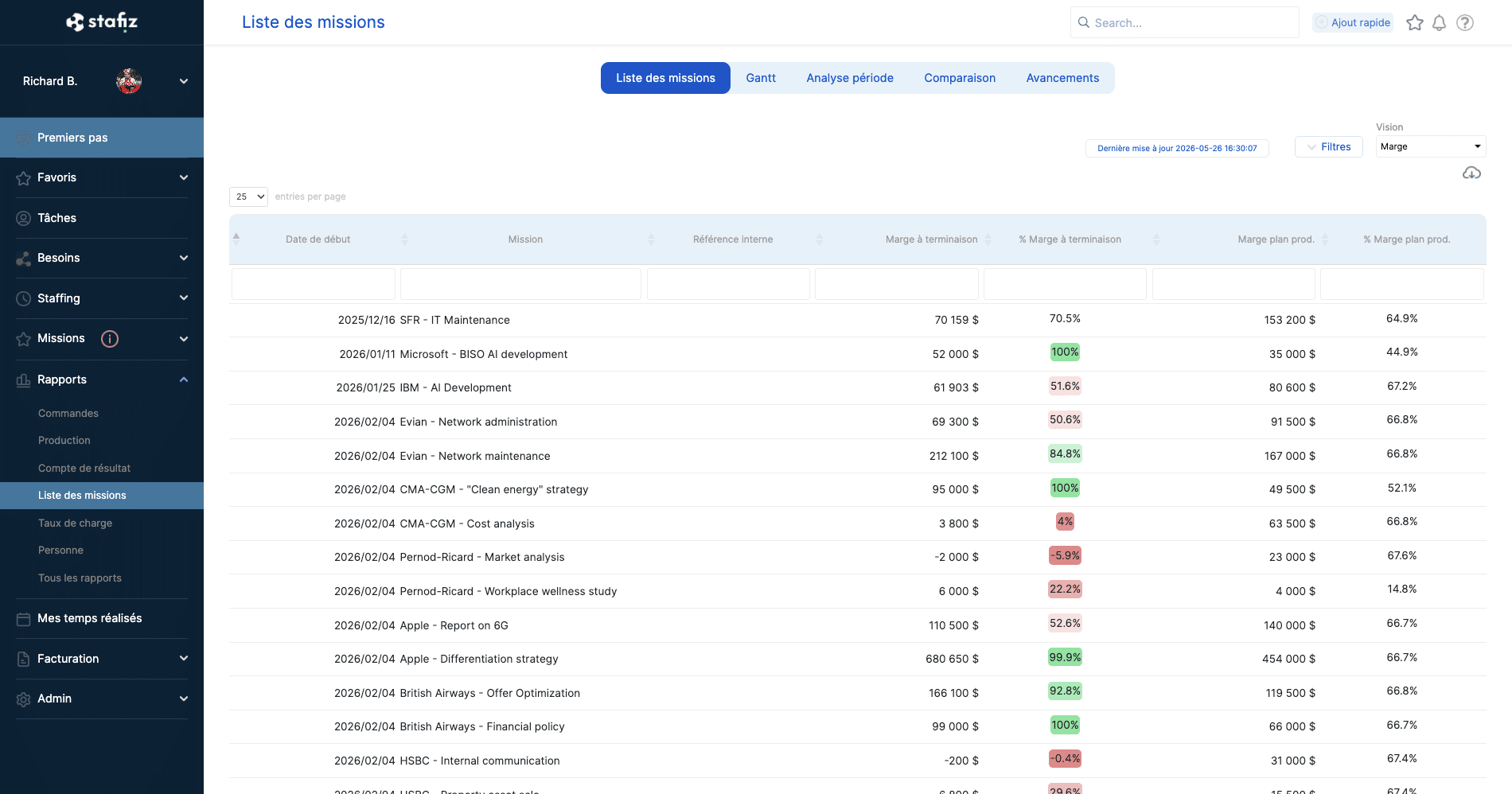
The 8 Critical Functions of an EPPM Tool for a Consulting Firm or IT Services Company
A generic EPPM tool manages industrial projects, CAPEX, milestones. A consulting firm or an IT services company manages a different portfolio: billable assignments, consultants, heterogeneous sales methods. Eight functions separate an EPPM software aligned services from a corporate tool.
| 1. resource planning Forecast | Anticipate who to staff where over several months | Reports profile gaps from pipe Commercial | Resources seen as interchangeable FTEs |
| 2. Landing margin | See where the overall margin will land | Individually find the projects that contribute to the mismatch | No cross-referencing Activity Reports (CRA), progress, costs charged |
| 3. Forecast turnover and margin by BU | Anticipate multi-BU revenue and margin over several rolling months | Detect a BU under annual budget in time | Does not distinguish between control room and fixed price |
| 4. billable utilization rate Consolidated | Calculate actual billable time across the company | Alert when an entity breaks even | Doesn't know how to calculate the billable utilization rate |
| 5. Multi-sales methods | Manage multi-billing engagements | Separate the fixed-price promotion from the management to detect where the discrepancies are located | Models projects on a single mode (usually fixed-price) |
| 6. Pre-accounting and integrations | Project management of the pre-resource planning invoicing | Anticipating the resource planning as soon as a business opportunity is created | No upstream (CRM) or downstream (billing) connection |
| 7. Multi-subsidiary chargeback | Internal re-invoicing between subsidiaries of the group | Man-day loaned, inter-company bill, consumer neutralization | No intra-group flows or native consolidation |
| 8. Ability to Cross | Cross-referencing the 7 functions to script | Provide information for the Executive Committee's decision-making | Doesn't know how to process previous data, and produces incomplete scenarios |
To compare solutions on the market, see our PPM tools review.
Function 1: Multi-mission, multi-skill capacity planning, integrated availability
The provisional capacity planning is anticipated several months in advance, based on data collected and reported in real time by the tool. From pipe sales and current assignments, the tool flags profile gaps and suggests pre-assignments. It is the forecast of project resources at the level of the consolidated portfolio. In concrete terms, the director of operations sees in June which profiles will be missing in September, launches recruitment or subcontracting in time, and makes it possible to secure the start of the mission in time.
Specialized EPPM software for service companies also optimizes the utilization rate between BUs:
- visible imbalances between an over-crowded practice and another under-loaded on the same profiles;
- inter-BU loans on poolable skills, a pre-established rule for the distribution of margins between the originating entity and the beneficiary.
The allocation of resources is then decided at the level of the consolidated portfolio: when two managers of the resource planning want the same senior consultant, the arbitration is done in the portfolio committee before the signing, on the basis of the projected margins and the actual availability, and not during the course of the mission under pressure. Resource management is managed at the group level and no longer locally.
Function 2: Consolidated Landing Margin Portfolio
The tool displays, for each entity, the projected landing margin and the deviation from the target set by the COMEX. When one drops, it becomes possible to go down to the list of projects that contribute to the discrepancy, to precisely identify those that are drifting. If the margin drifts several points from the target, the alert comes before the quarter close, when there is still time to negotiate a client amendment, reallocate consultants between assignments, or adjust the mix of sales methods on new signings.
This view requires cross-referencing four data sources:
- the CRAs (Activity Reports) of the consultants;
- the actual progress of each project;
- the actual contracted sales prices;
- actual costs charged (salary, charges, fees).
A generalist EPPM tool stops at project progress and the initial budget, without including invoicing or CRAs. On the financial management side, the weekly Excel consolidation disappears: the Executive Committee and the operations read the same view, updated continuously.
Altai Consulting case study: real-time project P&L for 105 consultants
Altai Consulting is a consulting firm with 105 employees based in France.
Before Stafiz, the team managed with two separate systems (time tracking on the one hand, project indicators on the other). To obtain a margin and burn rate view by mission, management control reconsolidated the data in Excel at each closing: duplication of efforts and slowed down decisions on the management side.

❝
Stafiz is very project-oriented and particularly suitable for consulting firms, as it breaks down information by task and man-days.
Giang Huong Huynh
Operations & Financial Manager
Thanks to Stafiz, Altai centralizes time, resource planning and project financial indicators in a single platform. Project managers have a real-time reading of margin and burn rate, and management no longer waits for the close to see discrepancies.
Function 3: Forecast of revenue (turnover) and margin by BU over several rolling months
A generalist EPPM tool does not distinguish between a flat-rate income (recognised in proportion to the progress of the deliverable) and a revenue in a time-based basis (recognised on the basis of the time invoiced to the ADR contract). The forecast he produces therefore adds two different income recognition logics without restating them, and does not give a reliable figure for the portfolio committee.
In addition, over a rolling horizon of several months recalculated each month, the specialized EPPM tool for services projects the expected turnover and margin of each entity. During the year, it identifies those that will not reach their annual target, which gives the local manager time to recharge the pipe or to reallocate its consultants to more profitable missions. If he sees his trajectory deviate in July, he can immediately launch a corrective commercial action, rather than noting the lack of turnover at the annual closing.
Function 4: billable utilization rate Consolidated leave excluded at local level
The EPPM tool specialized in services measures in real time the activity rate excluding leave (billable utilization rate) BU by BU. When one falls below the break-even point set by management, the tool triggers an alert. The COO immediately sees which consultants in sub-charge can switch to a billable assignment on another entity, without waiting for the quarterly review.
A generalist EPPM software calculates a gross utilization rate, without removing the paid leave or RTT provided for by French law. The figure obtained does not reflect the real operating profitability of a French firm and cannot be used as an indicator of management by the Executive Committee.
Function 5: Multi-channel tracking
A consulting or IT services mission often mixes several billing methods. Each mode has its own revenue recognition logic, margin calculation, and risk profile.
On a mixed mission, an EPPM software specialized in services breaks down the overall margin according to these different financial flows (fixed cost, ADR invoices, fees) and allows the BU director to know which project is profitable, which is not, and what actions to put in place to turn it around.
The different sales models that exist in consulting and IT services companies:
- Lump sum : price set at the time of signature, recognised as the deliverable progresses;
- Time and Materials (T&M): invoicing based on the time actually spent, ADR contractual;
- TMA (Third-Party Application Maintenance): maintenance of a customer application by a service provider, invoiced monthly;
- On-call duty: availability outside working hours, flat-rate or incidental remuneration;
- UO (Unit of Work): a contractually defined billable volume (1 ticket resolved, 1 user trained, etc.);
- Points contracts : pre-purchased portfolio of man-days to be consumed.
EPPM software does not know how to model a project with a mixed mode of operation. These multi-mode contracts are common in IT services companies, and particularly for large accounts and multi-year assignments.
Function 6: API integrations (CRM, HR software, accounting)
EPPM software specialized in services connects the complete project management chain. When a business opportunity is noted as signed in the CRM, the tool triggers a pre-assignment of the prospective consultants and creates the project sheet with team and budget. Consultant availability is continuously synchronized with the HR software (validated leave, training periods). Pre-accounting prepares accounting entries and invoices before sending them to the accounting software, without manual re-entry. On the financial management side, there is no need for weekly entry.
A generalist EPPM software stops at the project phase: no connection to the CRM upstream (so no pre-resource planning as soon as the opportunity arises), no synchronization with the HR software (therefore no taking into account validated leave), no pre-accounting by sales method (therefore manual re-entry of invoices). Each interface is re-entered by hand, and the reliability of the data degrades with each transfer between tools.
Function 7: Multi-entity chargeback and consolidation
The EPPM tool manages intercompany flows from the resource planning Actual: Each man-day entered generates an intercompany invoice at ADR validated internal, with group consolidation and neutralization of intra-group flows. The group's CFO closes in a few hours a cycle that took several days to the spreadsheet, and the general management has a reliable consolidated turnover without restatement.
A generalist EPPM software does not natively include these intra-group flows or consolidation. The distribution of turnover between entities is done on a spreadsheet, and the CFO loses several days at each closing.
Function 8: Ability to cross-reference the previous 7 functions
The seven previous functions take on their full value when the tool knows how to cross-reference them to answer the questions asked by a portfolio committee:
- Can we staff a new opportunity without carrying out another mission?
- What quantified levers should be mobilized when a site drifts below its annual objective?
- Is it better to recruit a rare skill in a cross-functional way?
To answer these questions, the EPPM tool must cross-reference the pipe the competency framework, the multi-BU availability, the billable utilization rate, the margin on landing, and the forecast in the same query. A generalist tool is unable to collect, process and correctly report some of this information, and its results will therefore not be usable by a portfolio committee in a consulting firm or in the IT Services.
How to set up an EPPM tool in a consulting firm or IT services company
Before even comparing the tools, three conditions must be met. Without them, the EPPM will have no visible effect on the bound margin or the resource planning inter-BU.
The prerequisite before any deployment: base yourself on a documented company strategy
EPPM software helps management to arbitrate between its different projects. To arbitrate, you need to know where the firm wants to go. This is the role of the documented corporate strategy: sales roadmap per site in 12 or 18 months, annual turnover and margin targets, target package/management mix, recruitment and skills development plan.
Small structures can do without it, but a company without a formalized strategy will not be able to manage EPPM software, because the project selection must derive from the strategy.
The 5 steps to deploying EPPM software
| 1. Map the existing portfolio by BU, by sales model (Package / Advertising / TMA / subscriptions / OU), by projected landing margin. | How many projects are active today in each entity? How many pre-staffed opportunities in the pipe Commercial? What mix Package / Management / TMA per BU? Which missions are already outside the scope (amendments in progress, margin below the threshold)? | Unified project repository + segmentation + first exploratory dashboard. | Director of Operations |
| 2. Define the method of prioritization of projects. | Priority to target margin, strategic alignment, strategic customer (renewal, referrals), optimization of the resource planning Senior, at risk on the forfeit? How do we weigh these criteria together? A consulting firm weights differently than an IT services company (the margin weighs more when you mainly charge on a flat rate). | Portfolio scoring grid validated by the Executive Committee, applicable to resource planning and prioritization. | Executive Committee |
| 3. Frame EPMO governance. | Who manages the portfolio at the management level (an appointed EPMO, a COO + CFO pair, other)? How often does the portfolio management body meet (monthly for routine arbitrages, quarterly for strategy)? On which 5 or 6 shared indicators does the EPMO make its decisions? How does he decide in the event of disagreement between directors? | EPMO charter + portfolio committee ritual + standardised agenda. | Executive Committee + Finance Department |
| 4. Choose and deploy an EPPM tool aligned with services. | Does the tool know how to do the critical functions? | Tool in production as a pilot, then generalized to the other BUs. | Operations Department + Finance Department + CIO |
| 5. Instrument portfolio indicators. | Which portfolio indicators go back to the COMEX on a monthly basis? What are the alert thresholds? Who is responsible for the quality of the data? How do we deal with differences between entities in the calculation methods? | EPMO dashboard operational and fed with reliable data, shared in the portfolio committee. | EPMO + Finance Department |
The total duration of the implementation of an EPPM tool depends too much on the specificities of the firm (size, number of BUs, quality of pre-existing data, maturity of governance), but will take at least 6 months to:
- formalize the strategy internally and put in place the prerequisites (conditions everything else);
- Test the tool with a driver.
- generalize to other entities;
- Observe the visible effects of new arbitration processes at the company level.
Allow an additional 3 to 6 months of learning before EPMO trade-offs produce visible effects in the consolidated margin.
Indicators monitored by the EPPM in a consulting firm or an IT services company
| 1. billable utilization rate Consolidated excluding leave | Excluding Leave Activity Rate: percentage of the consultants' time actually invoiced to the client, minus leave and RTT. | See if a BU has consultants in hidden intercontract. If the billable utilization rate fall, we pay people not to produce. |
| 2. Margin on Landing Portfolio | Expected margin at the end of the project, including the variances observed to date, to be distinguished from the expected margin (commitment) and the forecast margin (forecast at T-X). | Alert on BUs that are slipping before the quarterly close, to have time to react. |
| 3. ADR BU weighted real average | ADR = Average Daily Rate: average price of a day of consultants sold to the client, weighted by the volume sold on each profile. | Manage the average price sold taking into account the junior/senior mix and the BU's pricing policy. |
| 4. Endorsement rate | Share of projects that have been the subject of an amendment (document that modifies a current customer contract, often to invoice a change in scope) over the period. | Report the scope of project drift and the need to renegotiate packages. A high amendment rate can be positive (ability to monetize developments) or negative (poor initial framing). |
| 5. Ratio of T&M vs Flat Rate Turnover | Share of revenue invoiced in Contract Management (T&M) versus part invoiced in Package. | Balance the risk sales model: Governance = more stable revenue but margin capped by the ADR ; Flat rate = higher potential margin but risk of overrun. |
| 6. Consolidated Intercontract | Total volume of consultant days not assigned to a billable assignment over the period, accumulated over the entire company. | Report to the Executive Committee a direct cost that is often invisible to each entity. Identify profiles with structural overstaffing. |
| 7. Pre-resource planning of the pipe Commercial | Share of CRM opportunities with identified prospective consultants and estimated margins. | Anticipate recruitment needs and profile shortages before the missions are signed. |
| 8. Customer NPS × CSAT consultants | NPS = Net Promoter Score (score from 0 to 10 on the customer recommendation). CSAT = Customer Satisfaction Score (usually score 1 to 5). To be cross-referenced to measure the satisfaction of both sides of the assignment contract. | Triangulating refereeing resource planning × margin × satisfaction. A BU that pushes the margin to the detriment of the resource planning sees its CSAT consultants drop, then the customer NPS follows. |
To see all the KPIs, download the full list of KPIs for an EPPM.
Frequently asked questions:
EPPM, or enterprise project portfolio management, is an approach that consolidates all of an organization's projects into a single view at the executive level, instrumented by dedicated EPPM software. It is used by managers to arbitrate between projects and between BUs according to their margin, their strategy and their consumption of resources, whereas a traditional project management tool remains limited to the management of an isolated mission.
An ERP (unified business management software) can integrate a PPM (Project Portfolio Management) module that manages project portfolios, separate from the finance, HR or sales modules. In a consulting or IT services company, this PPM module must be natively connected to CRM, invoicing and HR. Without this integration, project data does not communicate with sales or payroll, and management falls back on manual re-entry.
The PPM (Project Portfolio Management) tool manages a portfolio of projects at the level of a BU or a department. In an IT services company, this is typically the management of the projects of a cloud or cybersecurity practice. The EPPM consolidates all portfolios at the executive level and allows for the arbitration of the resource planning between competing departments as well as the revenue forecast by practice. To go further, see how to choose the right PPM tool.
There are four key EPPM indicators for consulting firms or IT services companies: billable utilization rate (excluding leave activity rate) by site, the projected landing margin for the entire portfolio, the ADR (Average Daily Rate) contracted by mission, and the amendment rate by entity. These indicators, cross-referenced in real time, give management a group view of operating profitability. To download all the KPIs used by an EPPM software. The full grid can be found in the EPPM Indicators section.
A PMO (Project Management Office) manages projects in a BU or a department: standardization of methods, monitoring of project margins, alert on abuses. An EPMO (Enterprise PMO) arbitrates between the entities at management level: selection of priority projects, allocation of scarce resources, animation of the portfolio committee. In most IT service companies and consulting firms, the PMO exists (sometimes under the name of operations management) but the EPMO remains to be formalized. The role of the EPMO is detailed in the section dedicated to the EPMO.