In a consulting company or IT ServicesThe project charter is an internal document of 1 to 3 pages written by the project manager and signed by the client sponsor before the kick-off, which sets out the scope, milestones, assumptions and amendment mechanism to secure the margin of a fixed-price or time-based assignment.
On a fixed-price project in a consulting company or in IT Services (digital services company), the planned margin is decided from the framing stage, well before the teams are mobilized.
When management control reports a drift three months after the kick-off, the scope has already expanded, the initial assumptions no longer hold, the deliverables are commented on without ever being validated. The levers for recovery are then limited: an amendment that is difficult to impose during the mission, revenues that stretch, cash flow that is stretched.
The project charter, a concise internal document (1 to 3 pages) signed by the sponsor, defuses these abuses before the kick-off. It sets the scope sold, the operational assumptions, the invoicing milestones and the amendment mechanism.
🔎 Key elements to remember
- The project charter secures the margin from the framing stage: without it, the perimeter sold and the scope delivered diverge without any warning signal.
- 7 out of 10 clauses directly manage the margin: raison d'être, SMART KPIs, IN/OUT scope, assumptions, milestones, dated deliverables, structured budget.
- 3 signals announce the drift before the kick-off: sponsor not validated, perimeter unclear, deliverables without dated acceptance criteria.
- The amendment mechanism must be provided for in the charter: trigger threshold, validation trio, mandatory post-signature reforecast.
- Without a consolidating management tool (PSA) resource planning, margin and landing, the drifts go back three months too late, at the close.
Project charter: definition and place in the project cycle in consulting companies and IT Services
What is a project charter?
The project charter is a formal document that formalizes the launch of a project, sets its initial scope, identifies its sponsor and gives authority to the project manager. For a consulting firm or a IT Services, its role goes beyond that of an academic project management deliverable: the charter secures the perimeter sold to the client in fixed price mode, or frames the planned consumption in time-based mode, before the teams are deployed on the mission.
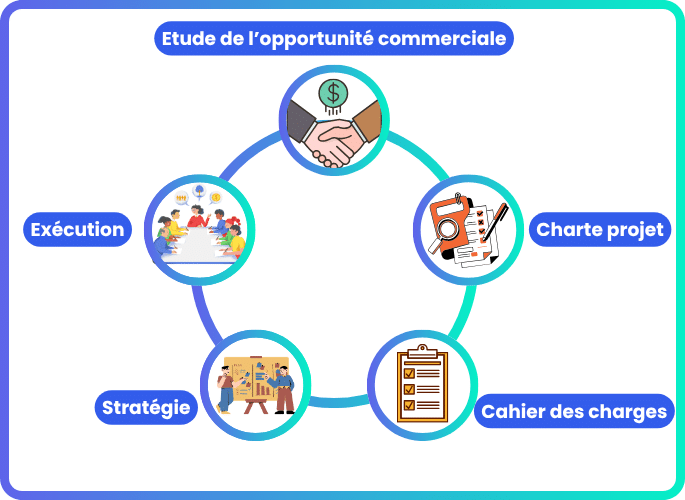
In the cycle of a consulting or integration project, the charter arrives after the business opportunity study and before the specifications. It articulates the signed commercial proposal and the execution phase, appearing as an operational pivot between the two.
Each role (pre-sales admin, project manager, manager resource planning, admin invoicing) intervenes at the right time without manual reminders.
Who drafts the project charter, who validates it, and what is it legally worth?
The project manager is responsible for drafting the project charter, in collaboration with the sponsor (on the client side) and the sales manager (on the consulting firm or IT Services). The validation of the charter is the exclusive responsibility of the client sponsor: without a sponsor's signature, the charter is not enforceable in the event of a request outside the scope.
Legally, the charter does not bind the parties in the sense of a commercial contract. It formalizes an internal engagement agreement between the sponsor, the project manager and the project stakeholders. Once signed by the sponsor, it becomes the arbitration reference that decides any request outside the scope, without recourse to the commercial contract.
Project charter, framework note, specifications, business case: which document to use when?
On a consulting or integration project, four documents structure the upstream order take:
- business case study;
- the project charter;
- the framing note ;
- the specifications.
Each one answers a different question, but their articulation often remains unclear on the operational teams' side.
| Objective | Justify the project to the decision-maker | Formalize the launch and give authority to the project manager | Specify the initial operational scope | Detail the technical and functional requirements |
| Contents | Expected benefits, ROI, alternatives | IN/OUT scope, sponsor, milestones, budget | Context, challenges, expected deliverables | Functional specs, technical constraints |
| Public | Customer Management Committee | Sponsor, Project Manager, Stakeholders | Customer project team + consulting company or IT Services | Project management and project management |
| Editor | Sponsor or customer sales representative | Project manager (sponsor validation) | Customer project management or consulting project management/IT Services | Customer project management (with consulting assistance or IT Services) |
| Level of detail | Synthetic (5-10 pages) | Concise (1-3 pages) | Intermediate (5-10 pages) | Exhaustive (10-50 pages) |
| When to write it | Before launch arbitration | Before kick-off, post-commercial signing | Scoping phase (D+0 to D+30) | Before or during technical design |
At what point in the project cycle does the charter arrive? Ideally, before the kick-off, in the short window that separates the commercial signature, and the mobilization of the consultants. It consolidates what the commercial proposal has contracted in its broad outline, specifying:
- the operational scope;
- dated deliverables;
- and billing milestones.
The difference between the project charter and the specifications
For a consulting firm or a IT Services, the information contained in the specifications and the project charter depend on the contractual method negotiated with the client:
- In fixed-price mode, the project charter is completed by specifications. The first secures the scope sold and the operational assumptions. The second involves the consulting firm or theIT Services on the expected technical result. Together, the two documents serve as arbitration in the event of a request outside the scope;
- In time-based mode, the project charter is sufficient: there is no commitment to a precise technical deliverable, but a commitment to the consumption of man-days. The charter then sets the reporting milestones and the overrun ceilings;
- In mixed mode (short management followed by a fixed price deliverable), the charter is coupled with a project plan to specify the phases of the contractual changeover.
3 signs that announce a drift even before the signing of the project charter
Margin drift on landing never forms all at once. Three operational signals precede it during the first weeks of the mission, and go unnoticed by the project manager. The signed charter defuses them from the kick-off, provided it was written in time.
Signal 1: The client-side sponsor is not formally validated
The designated sponsor on the customer side is often the business manager who submitted the call for tenders. During the mission, his N+1 takes over the arbitrations, without having signed the charter, and changes his mind. The consulting firm or theIT Services then cashes the arbitrations as free amendments, with no possibility of recourse because the initial interlocutor did not have the required mandate to sign.
A project charter signed by an explicitly designated sponsor resolves this vagueness. The signatory is identified by name, his decisions are therefore enforceable, and any change of mind reported by another actor on the client side triggers the amendment mechanism provided for by the charter.
Signal 2: The scope of the project is unclear
Some peripheral elements will be decided and refined during the mission, which is the characteristic of a project that evolves. However, these excess requests can also be outside the scope of the process, and constitute a request that should have been invoiced. The more the scope of the project expands without anyone noticing it, the more the margin ends up eroding.
A good project charter requires you to explicitly declare what is outside the scope. In flat-rate mode, the out-of-scope prevents free amendments. When you know precisely what is (and especially what is not) part of the project scope, you protect the commitment of means made by your consultants.
Without this list drawn up in advance, each client request becomes a grey area: reclassifying the request as a paid amendment during the assignment risks straining the commercial relationship between the consulting firm and its client, while an out-of-scope agreement signed in the charter makes the requalification mechanical.
Signal 3: Deliverables are neither dated nor formally accepted
This is when the deliverables have been defined in the business proposal, but without an issue date or contractual acceptance criteria. On the project manager's side, we produce them. On the customer side, they are commented on without ever validating them.
As a result, the outstanding project is swelling and the cash flow is suffering. The CFO of the consulting firm orIT Services will see its working capital requirement explode without prior signal and will discover the drift in the next monthly report, without short-term leverage to correct it.
The 10 elements of a project charter (including 7 critical clauses to manage the margin)
The purpose of the project
The project charter must specify the business issue to be solved by the customer: replacing an ERP at the end of its life, deploying a new sales tool, launching into a new market, redesigning a supply chain, etc.
On the consulting firm or IT Services, this purpose of the mission specifies the commercial layer of the project: scope sold, target forecast margin, BU carrying the project, resource planning, etc.
The charter then serves as a bridge between the two readings: the internal indicators for managing the mission are aligned with the business value that the client expects, rather than remaining compartmentalized in separate tools.
Objectives and KPIs (SMART method)
The objectives of the charter are twofold:
- the business objectives committed to the customer;
- and the internal targets that the consulting firm or theIT Services is fixed on the mission.
The two levels must be quantified in the charter to allow enforceable monitoring during the project.
The business objectives on the project charter are defined with the customer according to the SMART method. From these objectives derive the internal KPIs (key performance indicators) to be monitored by the consulting firm or IT Services : target gross margin, man-days sold completion rate, resource planning planned over time.
Specifying the objective to be achieved and how it is measured is essential to calculating the profitability of a project. The practical rule: at least one customer objective and one internal KPI per project phase. Without this double monitoring (client objectives + internal KPIs), a mission can achieve the expected result while being loss-making; This is a frequent case when profitability indicators are not measured at the same rate as the milestones delivered.
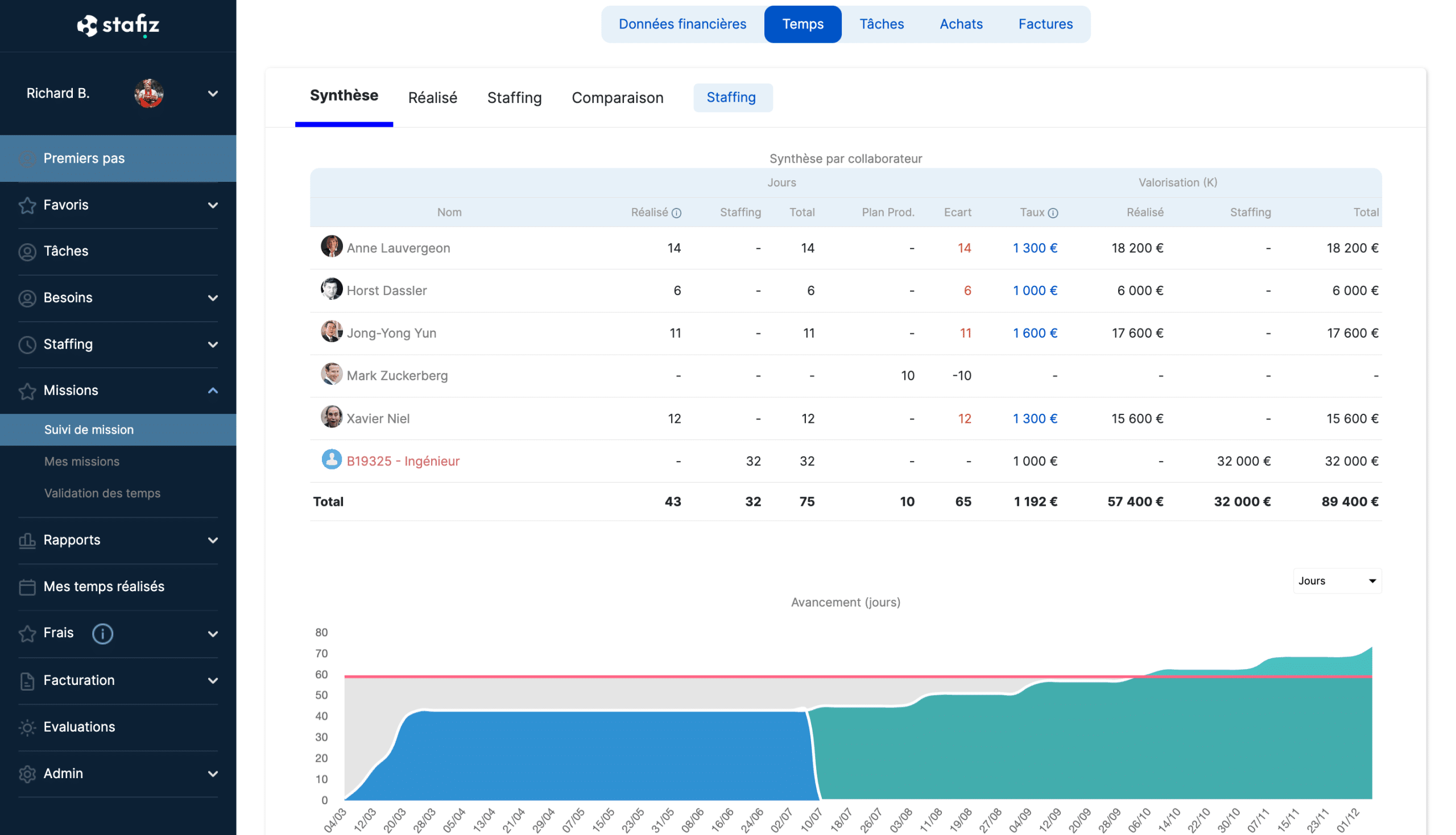
Mission follow-up in Stafiz with days completed, resource planning Committed and variance vs. production plan, consolidated by employee and valued in euros. The progress curve signals the budget overrun in forecast and real time (with alerts) allowing the project margin to be restored before it is too late.
The IN perimeter and the OUT perimeter
The IN perimeter lists the deliverables sold : modules to be configured, workshops to be facilitated, recipes to be validated. It is written spontaneously from the commercial proposal.
The OUT perimeter lists what the mission does not cover : additional developments, additional training days, extension of user acceptance, etc. Setting the limits of the out-of-scope secures the margin: any customer request that falls within the OUT must normally trigger a paid amendment, never a free execution. Without a clear OUT perimeter, the client may assume that their requests are included and the consulting firm or theIT Services absorbs them on its margin.
Assumptions and constraints (focus on availability, customer resources)
When a consulting firm or a IT Services signs a fixed-price project, it commits to a budget and a deadline. But it calculates this budget and this deadline based on assumptions about the collaboration on the client side: that it will take so many days to execute the mission, that the deliverables will be validated in X days, that the key users will be present at the workshops, that technical access will be given at the right time...
Defining these working hypotheses in the charter makes it possible to automatically trigger the amendment clause or the switch to the management contract, without the consulting firm or theIT Services absorbs drift. For example, if the consultant has been delayed on the project because he was waiting for a client response, the charter defines who absorbs the cost of the time not worked, and when these times will be invoiced to the client.
Milestones
The charter distinguishes between two types of milestone:
- Internal milestones structure the output of the consulting firm orIT Services (architecture review, technical acceptance, freeze of specs).
- Contractual milestones trigger customer-side invoicing (signature functional specifications, pilot delivery, production launch, end of warranty).
In fixed-price mode, each contractual milestone must be equivalent to a recognized percentage of turnover, and be subject to specific invoicing. Thus, the client is automatically invoiced for each milestone reached, which spreads the receipts over the duration of the mission and holds the project cash flow.
In the control mode, invoicing is based on the man-days actually consumed× ADR (average daily rate), validated via the activity reports (CRA) signed by the customer at the end of the month. Here, the project milestones set the pace for reporting, making it possible to trace the approach to the budget overrun ceiling.
Without milestones, a time-management mission can slip several months beyond the planned consumption, and management control only measures the gap at the end, too late to tighten the scope or remobilize resources.
Dated deliverables with acceptance criteria
Each project deliverable defined in the charter must include the following information:
- Its name and what it is for,
- Its date of issue,
- Customer-side acceptance criteria,
- The name of the signatory on the client side (often the sponsor).
Without this data, the deliverable is not enforceable, which means that in the event of non-validation on the customer side, the advance invoice is blocked.
The project budget: structuring the envelopes to secure invoicing
Depending on the contractual method negotiated with the client, the nature of the commitment differs:
- Fixed-price : commitment to results. The consulting firm or theIT Services delivers the perimeter sold on the scheduled date, for the fixed price. Any slippage that is not contractualized goes out of its margin.
- In direct management : commitment of resources. The customer pays for each day consumed at the ADR (average daily rate) agreed, in compliance with a ceiling, without commitment on a specific deliverable on a fixed date.
- In mixed mode : a single project charter is sufficient, declined in parallel for its fixed rate scope and its management perimeter.
- Costs that can be rebilled on an actual basis (cross-functional envelope for the three modes): travel, software licenses, hosting committed to the mission, re-invoiced to the client at the cost incurred, with no added margin.
For the two main contractual modes (fixed price and time management), 5 budgetary elements of the project charter must be framed at the time of signing:
| Budget construction | Overall fixed price, broken down as % by phase | ADR × volume of days allowed + overrun limit. CJM with differentiation by role (senior consultant, manager, mission director) |
| Billing method | By contractual milestone (% of turnover recognized on promotion) |
Per days consumed validated on CRA (activity report) |
| Triggering Billing | Acceptance of the Deliverable by the Sponsor | Monthly ARC validation by the client |
| Budgetary protection | Tight OUT perimeter + strict amendment clause on any perimeter exceedance | Contractual day cap + consumption alert at X% of the cap |
| Financial Reporting | Assessment at each milestone crossed, invoice issued immediately | Weekly consumption reporting, monthly billing of validated days |
Without this structuring in the framework, invoicing and revenue recognition cannot be set at the right pace: flat-rate milestones become blurred, man-days are mixed with rebillable costs, and project KPIs lose their measurement benchmark.
How do I update the budget landing after an amendment?
Each signed amendment triggers an update of the projected budget landing (reforecast). This update allows controlling to switch from the initial contract tracking to the adjusted contract tracking, without losing track of the original expected margin.
On an isolated mission, this reforecast is contained in an Excel file maintained by management control. On a portfolio of 50 to 200 missions in parallel, the exercise becomes impractical manually: each signed amendment triggers its reforecast, each steering committee expects an up-to-date margin, and management control switches a month late to the operational reality of the projects. Beyond a certain size of portfolio, the tools of the reforecast cease to be an operational comfort: without automatic consolidation, the margin on landing can no longer be measured, it can be seen at the close.
Client-side stakeholders
The project charter identifies four roles on the client side:
- the sponsor, who signs the charter and commits the project;
- business referents, who validate functional deliverables throughout the mission;
- Operational contacts : customer project team for a consulting mission, MOA (project management) and MOE (project management) contacts for an integration project IT Services ;
- the signatory of the amendment, which may be different from the sponsor (for amendments above a certain amount, the mandate to sign often goes back to the finance department or the general management).
End users (business employees impacted by the project) can be included in the project charter: they do not have signing power, but have the right to alert on discrepancies between the promise and their daily operational life.
The most likely risks (and how to anticipate them)
Five risks recur in fixed-price assignments:
- Poorly defined customer scope or evolution over the course of the mission.
- Unavailability of stakeholders for workshops and validations, on the client side as well as on the consulting firm side or IT Services. Anticipating these tensions requires an up-to-date capacity planning , which projects the workload of the teams month by month and flags assignment conflicts before they block progress.
- Perimeter drift (creep perimeter) not contractualized (amendments absorbed internally on the margin).
- Sponsor replaced during the mission, with referees revised downwards.
- Restrictive payment terms (late penalties on deliverables, extended payment terms) which weaken the project cash flow.
To manage the risks upstream of the project, the charter must indicate the estimated impact on the expected margin and the response strategy chosen: eliminate, mitigate, transfer, accept.
Governance and steering bodies
The project charter sets three levels of steering bodies that are articulated in escalation: what cannot be settled at the operational level (project operational committee or COPROJ), goes up to the tactical level (steering committee or COPIL), what cannot be settled at the tactical level goes up to the strategic level (strategic committee or COSTRA).
Greenworking case study
Greenworking, a consulting firm and training organization with 40 employees supporting large CAC40 and SBF120 companies, structured its mission management with Stafiz to produce Excel files that fragmented the vision on the management side.

❝
Stafiz provides a quick and accurate view of several key indicators of the management of a consulting firm: the availability of employees, the availability of employees, the availability of employees, the availability of the utilization rate, invoicing of missions and follow-up of purchase orders. This is a real difference compared to Excel files that have to be manipulated in all directions, and the data can be consulted in real time and instantly on the tool.
Florentin Seux
COO
This consolidation of indicators in real time feeds the COPROJ, COPIL and COSTRA described above: each body arbitrates on reliable data, without waiting for Excel consolidation between committees.
The amendment mechanism: the clause to avoid losing your margins
No project is carried out strictly according to the initial project charter. Needs evolve, the customer specifies his expectations, and technical constraints are revealed during implementation. Without a clear endorsement clause, these changes are absorbed by the consulting firm or theIT Services on its margin. With an amendment clause framed in the charter, they become an opportunity for additional invoicing or a point of negotiated arbitration.
When to trigger an amendment to the contract?
The threshold for triggering an amendment is defined in the project charter. It combines two criteria:
- The nature of the change (new need, change in scope, assumption not met on the customer's side),
- Its quantified impact (man-days or additional amount beyond the floor defined in the charter).
It will also be necessary to distinguish between minor deviations (around 5% of the initial budget) which go through a simple amendment validated by COPROJ, and major deviations (beyond 15 to 20% of the initial budget, or modification of a critical milestone) which go through a heavy amendment validated by the COPIL and revising if necessary governance, milestones and margin provided at landing.
What happens if the customer refuses the amendment?
The consulting firm or theIT Services The arbitrator is then between three options:
- Refuse to make the change and stick to the initial project charter
- To make the change at a loss by absorbing it on the margin, but by explicitly tracing it as a commercial concession in the budget management. The margin is falling, but the cause is documented and actionable in the next negotiation.
- Find a compromise in the form of a partial amendment or an adjustment mechanism (extension of the timetable, different prioritization of the remaining perimeter).
We advise you not to make the change at a loss without tracing it. Otherwise, the margin melts away without any identified cause, management control does not include landing, and the next customer negotiation is done without data.
Frequently asked questions:
The project cycle is broken down into 4 main phases: initiation, planning, execution and closure. The project charter is drafted and signed during the launch phase, after the business case validates the commitment and before the operational mobilization of the consultants. It articulates the decision to launch the project and the start-up of the teams on the mission.
This document is also called, depending on the company:
- project charter;
- project master plan;
- mission letter;
- launch note;
- Project summary note.
In Anglo-Saxon methodology, the equivalent is project charter. All these terms refer to the same document: a short text that formalizes the start of a project and commits the sponsor to the scope, budget and milestones. It remains separate from the information systems master plan, which covers a multi-year IT strategy on the client side.
The agile methodology structures the execution of the project (sprints, iterations, retrospectives) and leaves the scoping issues intact. On the time side, timeboxing sets a non-negotiable duration per task to protect the margin. A charter remains useful for framing the contractual commitment, identifying the signatory sponsor, setting the macro scope and the budget. The agile charter deals more briefly with detailed deliverables (which emerge sprint after sprint) and more densely with prioritization principles, for example the MoSCoW (Must have, Should have, Could have, Won't have this time) matrix.
For a consulting assignment or a project IT Services Writing a standard size takes between half a day and two days of actual work on the project manager's side. This time includes interviews with the sponsor and business users of reference, drafting the document and going back and forth for validation. For complex projects (ERP deployment, business process redesign), a 5 to 10-day scoping phase is necessary beforehand, for which the charter is the final deliverable.
The project charter is by nature a stable document. Changes remain rare and go through the amendment mechanism signed by the sponsor (change of scope, budget or deadline). The current operational adjustments (detailed planning, allocation of resources, technical choices) are included in the project plan, without touching the charter. A charter updated more than two or three times during the course of the project indicates a faulty initial framing.
A signed charter is only valid if it is read and understood by the people involved in the project. The best time to broadcast it is the kick-off meeting, just after the sponsor's signature. A synthetic format (slide or one-page PDF) is presented to the consulting team as well as to the client-side business users. Sending it by email alone loses most of the value: the team treats the charter as an administrative document to be archived and forgets about it in the event of a disagreement during the mission.
An amendment takes up the initial project charter and rewrites the paragraphs affected by the variance (scope, budget, milestones, assumptions or governance as the case may be). The other sections are carried over as they are and remain contractually enforceable.
The amendment must bear the signature of the client sponsor (or the business department above a threshold defined in the charter) on the client side, and that of the mission director or the sales director on the consulting firm or IT Services.