Updated on July 20, 2026
A skills matrix is a table that cross-references your employees with the expected skills, and indicates the level of mastery of each.
In a growing organization, no one person has a complete overview of the available skills. We know roughly who does what, but without knowing precisely who masters which skill, at what level, or where the weaknesses lie.
This gray area has consequences when it comes to decision-making: training launched without targeting those who need it, a project staffed based on intuition, strategic expertise relying on a single person whose departure no one anticipated. Beyond thirty employees, these blind spots multiply, and a spreadsheet updated from memory is no longer sufficient to keep track of them.
The skills matrix addresses this need for visibility. It makes clear, at any given moment, what the organization is capable of and where it is vulnerable, thus supporting decisions regarding training, recruitment, internal mobility, and resource planning .
It is still necessary to build it on the right skills, structure it according to your needs and keep it up to date so that it remains a reliable skills map .
🔎 Key takeaways about the skills matrix
- A table that cross-references your employees, placed in rows, and the expected skills, placed in columns. Each cell represents a level of mastery , on a scale defined in advance, for example from 1 (basic knowledge) to 4 (complete mastery, ability to transmit knowledge).
- Read in columns, the matrix counts how many employees reach the expected level in a given skill. When the answer is "only one," you have a critical dependency : if they go on leave, change clients, or leave the firm, the skill is lost with them.
- Five types coexist, distinguished by what they intersect: individual (a person × their skills) · by team or project (a team × the skills required by a mission) · by profession (positions × expected levels) · of evolution (seniority levels × transition criteria) · of versatility (employees × interchangeable roles).
- A skills matrix is a valuable asset: it inventories, at a given point in time, who is proficient in what and at what level. Its limitation lies in resource planning : it indicates skill levels, whereas assigning a task also requires knowing who is available. A spreadsheet shows who can manage a task; cross-referencing this with the workload plan shows who is free to take it on.
- The combination of interest × availability × assignment transforms the matrix from an HR assessment tool into a resource planning tool, capable of answering the real question of a mission director: "Who can take on this mission in September, with the right level, and who wants to?"
What is a Skills Matrix?
Skills matrix: Definition
🔎 Synonym: skills mapping, skills grid.
A skills matrix is a visual representation of the skills within a company or project. Often presented as a table or grid, it provides an overview of the skills available as well as those required to complete the tasks assigned by clients.
What Are the Challenges of a Skills Matrix?
A true strategic planning tool, it presents:
- the necessary expertise,
- the current level of performance of employees,
- the requirements to be met.
The skills matrix assesses both technical and behavioral skills . It ensures that these skills are aligned with the company's strategic objectives and needs. Constantly evolving, this tool is essential for effective skills management .
💡 Note that a skills matrix is distinct from a skills framework . The latter establishes the ideal to be achieved to guarantee the success of a project.
The skills framework defines which skills are needed, while the skills matrix shows who has which skills and at what level.
The Benefits of a Skills Matrix in Project Management
The skills matrix provides an overview of what your teams can do, and at what level. It then informs four concrete decisions: who to recruit, who to train, who to assign to which role, and which skills to secure before someone leaves.
Better Visibility on Available Skills
The skills matrix provides a clear view of all the skills available within the company. This then serves three objectives.
- Highlighting strengths and weaknesses : skills mapping reveals existing skills and those requiring investment. Furthermore, it helps identify expert profiles within the company who can act as trainers.
- Assessing employee performance levels is essential for identifying available skills . It reveals potential versatility and suitability for higher-level positions. Skills assessment is crucial for developing an effective training plan.
- Securing the company's skills : by precisely identifying who masters what, the skills matrix makes it possible to pinpoint critical dependencies . A rare skill, held by only one person, can be considered as such. Therefore, it is essential to limit this type of situation and also to anticipate solutions.
Eased Recruitment
Clarify expectations for each position
The skills matrix helps to facilitate recruitment by mapping the company's jobs while clarifying the requirements for each position.
Thus, it helps to streamline recruitment processes because it facilitates the selection of candidates, which is then based on objective criteria.
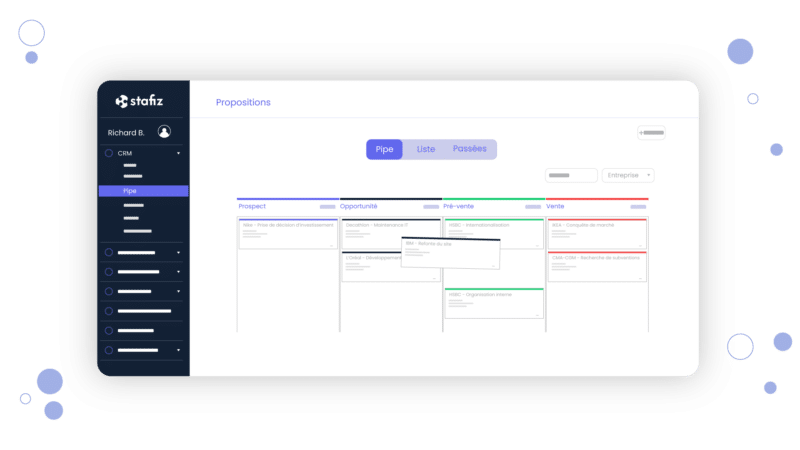
You too, speed up your recruitment processes!
Identify skills gaps and shortages
The skills matrix reveals skills gaps and shortages , thus enabling better anticipation of recruitment needs . Rigorous and proactive resource planning , both at the project level and at the company level as a whole, is therefore essential.
Optimized Talent Management
By identifying key skills , the skills matrix facilitates talent management. The visibility it provides makes it easier to compare actual skills with those required, thus highlighting training needs .
Setting up adapted training plans
Once skills gaps have been identified, it becomes necessary to implement strategic skills development plans . This can take the form of training or mentoring, which will enable employees to develop their skills . The idea is also to offer training programs aligned with the company's strategic objectives.
Furthermore, well-designed training plans help to limit dependencies in the event of the departure of key elements, thus constituting an effective backup strategy.
Allocate resources as needed
The skills matrix proves relevant for resource management as it provides insight into potential gaps and future needs. This facilitates resource allocation through increased visibility into skills and resource availability .
Furthermore, a clear view of the company's skills provides reliable and actionable data, useful to management and PMOs, which are responsible for managing resources .
Improved Performance and Service Quality
The skills matrix is a strategic lever for the company. Indeed, it improves work organization . For example, it reduces delays due to skills gaps and increases the quality of deliverables through more strategic resource allocation.
Contribute to the Employees' Professional Development
Skills mapping also offers numerous advantages for employees. It contributes to their professional development in three ways.
- It offers an objective structure for assessing skills by defining specific evaluation criteria; this clear structure, which allows for uniform assessment, guarantees objectivity.
- It facilitates the comparison of employee levels , which, when evaluated on an objective basis, allows for a more transparent and accessible allocation of promotions.
- Finally, it helps to reveal potential . By comparing actual and expected skills, discrepancies can be observed, and this can work in both directions. Thus, employees with more skills than those required for their position could be offered a role more aligned with their abilities. In this way, the skills matrix can help identify the leaders of tomorrow.
What are the Different Types of Skills Mapping?
Five matrices coexist. "Table," "map," and "matrix" refer to the same object here: what distinguishes them is what they intersect in rows and columns, and therefore the question they answer. The table below separates them before detailing each one individually.
The five types of skills matrices at a glance
| Individual skills table | An employee × their skills | Where is this person at, and what do they need to improve on? | Annual review, development plan |
| Mapping by team or by project | Team members × skills required by the mission | Is my team covering the mission, and where is the gap? | Project launch, team building |
| Job Matrix | The positions × the required skills | What exactly is expected of this position? | Recruitment, job description, internal mobility |
| Evolution Matrix | Seniority levels × passing criteria | What do you need to master to move to the next level? | Progression grid, promotion |
| Versatility Matrix | The employees × interchangeable tasks or positions | Who can replace whom? | Capacity management, succession planning, business continuity |
The Individual Skills Chart
The individual skills matrix serves several functions:
- evaluate the different profiles to organize and optimize resources on projects,
- compare current skills with those required,
- build development plans and identify training needs.
Example of an individual skills table
An Excel spreadsheet with employee names in the rows and expected skills in the columns. Each cell then contains the level, the scale of which must be determined beforehand. A completed example, for a consulting firm, is included in the section dedicated to the skills matrix template .
Need a more visual representation? The radar chart (or Kiviat chart) might also be suitable. It's a spider-like graph: each branch represents a skill, and the employee's level is positioned more or less far from the center. Two lines are then superimposed: the actual level and the expected level. The gaps between the two curves show at a glance the areas that need to be addressed.

Skills Mapping by Team or Project
The skills matrix for teams or projects allows for the evaluation of a team's available skills . It highlights strengths and areas for improvement.
This matrix proves indispensable at the start of a project to ensure that the team has all the necessary skills to successfully complete the project.
Example of skills mapping by team or project
This can also take the form of a table, this time listing the expected tasks and available expertise. In the table below, we have a team of three consultants facing the skills required for a task.
| Managing a project | 3 | 4 | 3 | 1 | Two people at the level |
| Collect and utilize information related to the project | 2 | 3 | 3 | 3 | The entire team at the level |
| Conducting and utilizing a strategic analysis | 3 | 2 | 3 | 1 | A single person, critically dependent |
| Create and maintain a positive customer relationship | 3 | 3 | 2 | 1 | A single person, critically dependent |
| Influence and persuade | 2 | 3 | 2 | 1 | Two people at the level |
Skills range from 1 (basic knowledge) to 4 (complete mastery, ability to teach). The "Required Level" column indicates the mission's threshold; "Team Coverage" counts the number of consultants who meet this threshold.
In the example, we see that the team covers the mission, but two skills are held by only one person. If Claire is reassigned or leaves the firm, the mission is no longer fulfilled. This columnar analysis is what distinguishes team mapping from individual assessment, and we will return to this in detail below .
Job and Skills Matrix
This type of job and skills mapping lists the skills expected for a specific position.
Once established, it allows for a comparison between employee expectations and actual skills . This can then contribute to improving internal mobility , recruitment, and training needs.
Example of a competency matrix by position
Still in the form of a table, the skills matrix lists, by position, the expected skills, both technical and behavioral.
| Managing the production of deliverables | 1 | 2 | 3 | 4 |
| Collect and utilize information related to the project | 2 | 3 | 3 | 3 |
| Managing a project | 1 | 2 | 3 | 4 |
| Conducting and utilizing a strategic analysis | 1 | 1 | 2 | 3 |
| Create and maintain a positive customer relationship | 1 | 2 | 3 | 4 |
| Influence and persuade | 1 | 1 | 2 | 3 |
Here, each cell gives the expected level per position from 1 (basic knowledge) to 4 (complete mastery, ability to transmit).
This table describes the skills expected for the position. It serves as the benchmark against which you then compare the actual skill levels of employees, making it a valuable tool for recruitment , job descriptions, and internal mobility . In a consulting firm, the same framework is also broken down by type of project (strategy, organization, information systems, transformation), not just by grade.
The Evolution Skills Matrix
The skills development matrix indicates the stages of progression based on seniority level . This scale can be graded using terms or numbers, thus providing a precise framework for objective assessment .
Example of an evolution skills matrix
| 1 | Initial | Less than 6 months | Performs simple tasks under supervision |
| 2 | Autonomous | 6 months to 2 years | Partial autonomy, taking initiative on familiar topics |
| 3 | Referent | 2 to 5 years | Autonomous management, ability to supervise a small team |
| 4 | Leader | – | Strong leadership, management of complex projects, mentoring role |
| 5 | Strategic | – | Strategic vision, innovation, management of large-scale projects, knowledge transfer |
The last two levels do not have a seniority limit: beyond the reference level, it is the responsibility held that is graded, plus the number of years.
The Versatility Matrix
In reality, this tool differs from the skills matrix, but the two are complementary. The versatility matrix assesses each employee's ability to perform different tasks. Thus, it measures employee flexibility and helps identify those capable of performing interchangeable roles. The versatility matrix is part of a capacity management and succession planning approach. This is also referred to as multi-skilling .
Example of a versatility matrix
A table with the employee's name, the skills expected for his position, and the expertise he or she has.
| Clear | Yes | Yes | Yes | Yes | 4 |
| Marc | No | Yes | Yes | Yes | 3 |
| Léa | No | Yes | Yes | No | 2 |
| Yann | No | No | Yes | No | 1 |
| People who can be mobilized | 1 | 3 | 4 | 2 |
Reading : "Yes" = the employee can perform the role independently. The "Available Personnel" line counts, for each role, how many people can perform it.
The last line is the only one that matters for a succession plan: pre-sales relies solely on Claire. One absence, and the firm will no longer respond to calls for tenders. Where the skills matrix asks "at what level?", the versatility matrix asks "who can take over?". The two complement each other, but they are not replacements.
These are three ways of reading the same grid. Competence is read in the box: a person, an activity, a level. Versatility is read in the row: how many skills a single person masters. Resilience is read in the column: how many people cover a skill, and therefore, how well the team holds together when one of them leaves.
How To Create an Effective Skills Matrix and Update It?
Creating a skills matrix involves four steps: listing essential skills, defining proficiency levels, cataloging what each person can do, and then building development plans. Everything then hinges on updates, which is where most matrices fail.
Skills mapping is only truly useful when it is regularly updated and maintained. Therefore, it's essential to integrate its use into your processes to avoid errors due to outdated information.
What is a skills matrix model?
A skills matrix template is a ready-to-use table that cross-references your employees, listed in rows, with the expected skills, listed in columns. Each cell is assigned a proficiency level , according to a predefined scale. One column indicates the expected level for the position, highlighting the skills gap to be filled.
Example of a skills matrix for a consulting firm
The skills listed below and their expected levels are taken from the job description "Management Consultant" by OPIIEC , the industry observatory for the consulting sector. The scale has 4 cumulative levels: 1 (basic knowledge) to 4 (complete mastery, ability to teach).
| Managing the production of deliverables | 3 | 4 | 3 | 2 | 1 |
| Collect and utilize information related to the project | 3 | 3 | 3 | 3 | 2 |
| Managing a project | 2 | 4 | 3 | 2 | 1 |
| Conducting and utilizing a strategic analysis | 1 | 3 | 2 | 1 | 1 |
| Create and maintain a positive customer relationship | 2 | 3 | 2 | 2 | 1 |
| Influence and persuade | 2 | 3 | 2 | 1 | 1 |
| Declared appetite | – | pre-sales | project management | data analysis | delivery |
| Availability | – | 50% available | mission until Dec. | from September 1st. | from September 1st. |
The last two lines change the nature of the tool. " Appetite " refers to the employee's stated interest: the topics they want to work on, or the skills they want to develop. With only proficiency levels , you can assess. With both interest and availability , you can staff the team: the table answers the question a project manager asks, "Who can take on this project in September, with the right skill level, and who wants to?"
How to read a skills matrix
The same table can be read in three directions, and each direction answers a different question.
- Each box contains : a person, a skill, a level. This is the individual assessment, the one that feeds into the annual review.
- Online : how many skills a single person possesses. This is their versatility , and therefore the number of different tasks you can assign them to.
- In the column : how many employees reach the expected level in a given skill. This reflects the team's strength .
Reading the matrix in columns makes it a sizing tool. It tells you how many experts and how many autonomous profiles you need for each skill to cover your portfolio of projects without any gaps. A column where only one consultant reaches level 3 or 4 indicates a critical dependency : if they go on leave, change clients, or leave the firm, the skill goes with them. This is a critical skill without backup : plan for a replacement pair to avoid relying on a single expert. This is what links the matrix to the recruitment and training plan, rather than just the annual performance review.
The gap between the actual and expected skill levels will allow you to prioritize your HR actions. A two-level gap in a skill held by only one person should be addressed before a one-level gap in a skill already mastered by three consultants. The former puts a project at risk, while the latter can wait for the next training plan.
Should you build your skills matrix in Excel?
Most models are built using Excel or Google Sheets, or a radar chart when a profile is visually compared to an expected level . An Excel model has the advantage of being free and immediate. Its limitations become apparent with growth: manual updates become time-consuming, versions multiply, and the matrix ceases to reflect the skills actually available. The levels are based on the last interview, while the tasks themselves have continued.
This limitation is precisely where the matrix is most useful. Reading the columns revealed a critical dependency : a skill held by a single consultant at the expected level . The day this consultant is assigned to another project, the column becomes inaccurate: the table continues to show that they have mastered the skill, without indicating that they are no longer available to use it. The displayed level remains correct; what is missing is the availability. A skills matrix provides a reliable overview of expertise, and by linking it to the workload plan, it also indicates who is available to use those skills.
For a service company, a consulting firm or a IT Services The matrix therefore becomes truly valuable when linked to the allocation of employees to projects . A resource planning tool keeps the matrix up-to-date based on evaluations and completed assignments, and cross-references skills with availability and preferences to suggest suitable profiles for assignment: this is the assignment/profile matching , which combines skill level and availability to assign the right consultant to the right project. It is this combination of preference, availability, and assignment that makes it a resource planning tool : it complements the skills inventory with the information missing from the table alone—availability—and answers the question of who is available on Monday.
Develop an Adopting Strategy
Adopting a skills matrix for your resource management will take more or less time to implement depending on the size of your company . A new company will find it easier to undertake than a larger, more established one.
The Stafiz team recommends the following adoption process to ensure regular updates .

In Stafiz, you can integrate skills acquired during the period or mission into your monthly or end-of-project evaluation forms . Then, assign a deadline to each team leader, who will in turn organize these employee interviews.
This process is effective because it allows for assessments to be made at specific times: past and ongoing work is then freshly kept in memory for more objective evaluations .
Furthermore, the database automatically updates each employee's CV. As a result, the skills developed and/or acquired are then taken into account in your resource allocation, once the evaluation is validated.
To make this exercise a recurring activity, all you have to do is :
- create notification reminders directly in Stafiz,
- or opt for an invitation in the calendar app of your choice.
This method invites collaboration by mobilizing and empowering teams. For managers, capacity monitoring is made easier, and data more reliable.
Please note that it will also be necessary to adapt the requirements of the matrix! As the market is constantly evolving, you must regularly monitor the new skills and technologies required to continue meeting customer needs.
Define a Usage Strategy
To fully benefit from the advantages of the skills matrix , it is essential to understand why and for what purpose you are using it.
There are three main objectives related to the use of a competency matrix:
- the assessment of the level of competences,
- identification of resource needs,
- facilitate and optimize the allocation of resources.
Assess the level
As mentioned above, it initially allows us to situate the level of skills of an employee in comparison to the expected level.
It then allows us to track the evolution and skills development over the long term, but also to integrate new objectives.
Identify a skills gap
By having a comprehensive view of the skills needed within the company, it becomes easier to identify gaps or shortages. This strategy aims to plan for the long term, thereby minimizing the risks associated with resource planning.

Anticipation of profile needs by seniority level in Stafiz.
This representation helps to make the right decisions to fill the gaps identified, either through recruitment or training.
It is also a good analytical tool. Maybe the capacity itself is sufficient, but its use is not optimal.
Maximize resource allocation
In the event that your resource planning Indeed, it lacks efficiency, so the Matrix skill is a good way to better organize the load.
By choosing Stafiz for your management of resource planning You benefit from a dynamic integration of your skills map into your work environment. As a result, all updates to an employee's CV are taken into account in project planning.
Thus, schedule data, availability but also KPIs such as the utilization rate are automatically recalculated.
The allocation of resources is then facilitated. There is no need to refer to an external document to look for the right people to position or replace.
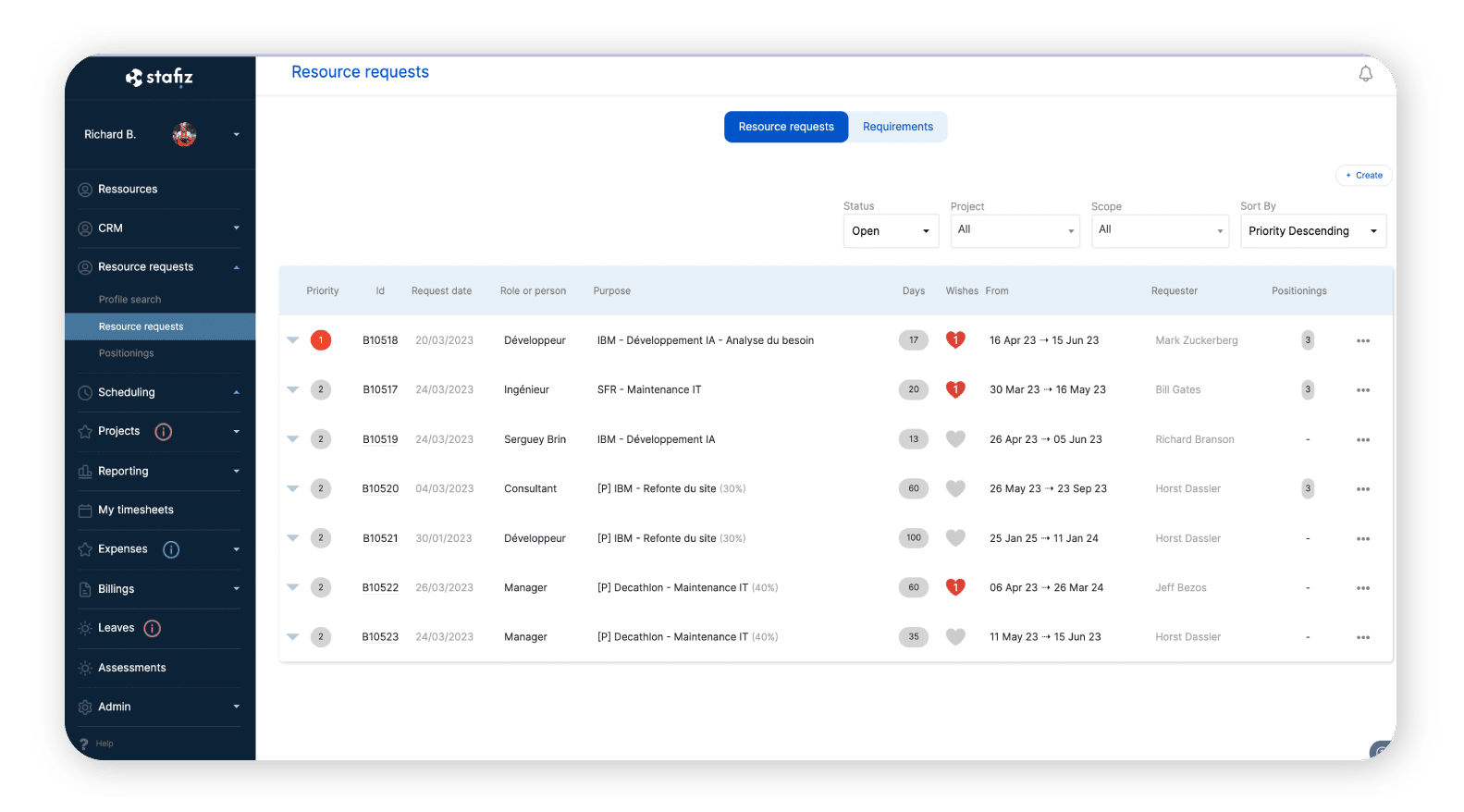
In Stafiz, the matrix is updated based on evaluations and missions, then cross-referenced with availability to suggest profiles to be placed on each mission.
How to design a skills matrix in practice?
Once you have identified the appropriate strategy, all that remains is for you to embark on the creation phase! You can use a simple spreadsheet, or discuss with the Stafiz team how to structure your skills management directly within your management tool.
Step 1: Identify essential skills.
Create a comprehensive inventory of the skills required for your business using several approaches:
- by trade,
- by team,
- per employee,
- by hierarchical role,
- by tasks, or types of projects.
Don't hesitate to consult with managers to identify truly strategic skills and define realistic expectations that meet the needs on the ground.
Step 2: Set skill levels.
Defining the different skill levels corresponding to each competency can be linked to seniority or the position in question. These are the levels of mastery , from novice to expert , mentioned earlier. It is important to clearly define the measurement criteria to eliminate bias .
However, the skill scale can be punctuated by descriptive criteria to take into account aptitudes that are difficult to measure, such as soft skills . For example, one could speak of a curious novice or a seasoned expert, passing through intermediate levels.
Step 3: Identify the skills available.
The time has come to map, but also to evaluate the company's skills.
To do this, the mobilization of managers and employees is requested by various means:
- individual interviews,
- performance interviews,
- skills tests,
- evaluation by the manager,
- or self-assessment.
Favor several methods to obtain a clear and as objective picture as possible by cross-referencing figures and perceptions.
From here, you can then assign a corresponding skill level to each key skill identified in the matrix.
Step 4: Develop development plans.
Once skills have been mapped and assessed, skills gaps are identified. Strategies must now be adopted to address these gaps, such as:
- training plans,
- a mentoring system,
- specific projects,
- professional development activities.
So many solutions that help you maximize the impact of your investments!
The matrix format highlights talent: high potential, as well as employees in difficulty. It becomes easier for you to prioritize priorities and needs.
Don't skip the skills matrix! It is a simple tool to adopt, and the benefits will have a positive impact on your project management, and consequently, your productivity and profitability.
A matrix's value lies in its freshness. A highly detailed grid updated only once a year will force you to make decisions based on outdated levels, whereas a simple grid, updated at the end of each mission , will tell you exactly who to position next Monday. So start small: one team, six skills, a four-level scale , and a fixed time to update it. You can then expand it.
If you are an agency, a IT Services or a consulting firm, Stafiz will be able to meet your needs through a dynamic integration of your resource planning into your project management.
Frequently Asked Questions about the Skills Matrix
The competency matrix is a great tool, but it still has some limitations.
- A static tool: without continuous updates via software like Stafiz, the matrix becomes obsolete. In the worst-case scenario, it leads to misleading strategic decision-making.
- Subjectivity: Competency levels can be assessed in a biased way, especially if the assessment is based solely on self-evaluation or if it is poorly calibrated by managers. It is therefore necessary to use several methods.
- An administrative burden: time-consuming, it can be difficult to maintain on a large, or even very large, scale.
- Closed doors: limiting expectations per position can be arbitrary and stifle employee learning and potential.
To remain useful, the matrix must be constantly updated.
To map available skills, you can use tools such as Notion, Excel, or Google Sheets for a spreadsheet format, or Miro for more visual representations. However, for seamless project management, we recommend the Stafiz solution to centralize your activity.
- Involve the teams from the start: define together the key skills and the expected level.
- Communicate the objective of the approach: it is not about control or punishment, but about optimizing workload and creating opportunities for growth. Furthermore, the matrix is also useful for employees to identify the appropriate contact person for specific topics.
- Include the matrix in project management: particularly in project allocation and annual reviews. The more it is used, the less likely it is to be neglected or perceived as a burdensome administrative task.
- Promote feedback: through two-way evaluations and individual as well as collective approaches.
A skills matrix template is a standard table that cross-references employees (in rows) and expected skills (in columns), with each cell representing a proficiency level . It can be created using Excel, Google Sheets, or a resource planning tool. The template serves as a starting point, to be adapted to the roles and skill levels specific to your business.
Most scales have four or five levels, from novice to expert. The consulting industry reference framework (OPIIEC) uses four levels, cumulative, with a description for each level and skill. The key is not the number of levels, but rather describing each level with an observable criterion to ensure unbiased evaluation.
Skills are commonly categorized as cognitive, behavioral, technical, and sectoral. A skills matrix primarily assesses the latter two, which are more easily observable, but it does not exclude behavioral skills when descriptive criteria are established. For the complete framework, see our article on skills management .
The ideal frequency is that of your existing assessments: end-of-assignment reviews or monthly meetings, rather than a dedicated annual review that no one conducts. A matrix updated immediately reflects the skills actually acquired. After six months without an update, it will base your resource planning decisions on outdated levels.