PRINCE2 governs a project through tolerances: a quantified threshold for cost and time, beyond which the project manager escalates the matter to the steering committee. For a IT Services or a firm, it is this threshold that decides whether you discover a margin drift in time or at the time of landing.
For a IT Services In a consulting firm, a poorly managed client project doesn't just cost in terms of delays; it costs in margins. Roles remain unclear, decisions await arbitration, the scope expands without amendments, and the business case is never revisited after signing. These deviations all come at the same price: the budget discrepancy you discover at the end, when it's too late to react.
PRINCE2 establishes governance for these deviations: clear roles, decision milestones, and above all, tolerances. A tolerance is the threshold of deviation that a project manager can absorb alone; beyond that, they refer the matter to the steering committee.
The question remains that these principles do not resolve in a service company : how does this governance change the profitability of your missions?
What is the PRINCE2 methodology?
PRINCE2 is a generic and structured project management methodology focused on organization, management, and control. Adaptable to any project regardless of size, it is distinguished by its milestone-based governance and its flexibility. It is not primarily a certification, but a methodology.
The method originated in the British public sector: PROMPT in 1975, PRINCE in 1989, then PRINCE2 in 1996, this time extended to all types of projects. Its latest revision, PRINCE2 7 in 2023, renames the "themes" to "practices" and treats project management as an ongoing activity rather than a series of fixed milestones.
The 3 building blocks of PRINCE2: 7 principles, 7 practices, and 7 processes
PRINCE2 is based on three pillars: 7 principles (the non-negotiable foundation), 7 practices (what is addressed continuously throughout the project), and 7 processes (the lifecycle, from pre-project to closure). If even one principle is missing, it's no longer PRINCE2.
The difference between a principle, a practice and a process in PRINCE2
While principles define the management philosophy you should adopt, practices constitute your operational toolbox.
- The PRINCE2 principles are non-negotiable rules that must be respected in order for the project to reach its completion.
- PRINCE2 practices are tools, documents and indicators to be followed continuously to comply with the principles.
- PRINCE2 processes describe the steps to complete the project: who does what action at what point in the project.
The principles dictate why it is important to implement these elements in your project management; the practices give you the means to manage them effectively on a daily basis.
The 7 principles of PRINCE2
Not all principles have the same impact on a service mission. Continuous justification, sequence-based management, and management by exception determine your margin of error: they dictate when you reopen the business case, when you validate the profitability of a sequence, and at what threshold you raise the alarm. The other four principles contribute to the quality of management.
| Continuing justification | A project must remain profitable throughout its cycle. | Margin: We check at each milestone that the margin remains aligned with the initial financial objective (by completing the business case), in order not to discover project deviations too late. |
| Learning by experience | Capitalize on what has worked (or failed). | Productivity: Continuous improvement prevents the repetition of errors from one mission to another, thus improving the overall performance of the firm. |
| Roles and responsibilities defined | Clarify who decides, who approves, who implements. | Governance: each stakeholder (client/service provider) knows their decision-making scope, which avoids delays in decision-making and scope drift. |
| Management by sequences | Divide the project into control phases. | Project management: Each sequence is a project milestone. The profitability of the previous sequence is validated before starting the next one. |
| Management by exception | Delegating authority with tolerance thresholds. | Smooth operation: The project manager handles unforeseen events as long as they remain within tolerances (e.g., +/- 10% of budget). Escalation to the steering committee is only necessary in case of major deviations. |
| Product Focus | Clearly define expectations before production. | Cost savings: By clearly defining the deliverable acceptance criteria before starting, you eliminate requests for free changes from the client ( scope creep ). |
| Adaptation to the context | Tailor the method to the actual needs of the project. | Agility: The Prince2 method adapts to the size and risk of the project. It's important to know when to streamline the framework to improve the mission's productivity. |
Ultimately, the success of a service project lies not in the quantity of documents produced, but in your ability to detect the slightest deviation before it erodes your utilization rate By combining an agile methodology with a real-time financial vision, you transform your client engagements into growth drivers for your firm.
The 7 practices of PRINCE2: your project management toolkit
These are the 7 best practices for project management and leadership. The principles explain why a project should be structured this way. The question remains: what should be used? That's where the practices come in. These are generally elements already present in the documents that formalize the project: project charter , project plan, etc.
| Business Case | Verify economic viability | Tool: Profitability sheet (Excel or SaaS tool). KPI: Projected margin vs. landing margin. |
| Organization | Define roles and responsibilities | Tool: Project charter, Scoping document or RACI matrix KPI: Average time to validate customer decisions. |
| Quality | Set and verify the requirements | Tool: Acceptance criteria (quote, purchase order or project charter) KPI: Recovery rate or % of out-of-scope requests (Scope creep). |
| Plans | Adjust planning and resources | Tool: Planning (Gantt) + Workload plan. KPI: Resource utilization rate and utilization rate . |
| Risk | Identify threats and opportunities | Tool: dedicated space in Excel or the project tracking tool KPI: Financial value of the risk (estimated budgetary impact). |
| Change | Addressing discrepancies and requests | Tool: dedicated space in Excel or the project tracking tool KPI: % of change requests billed vs. offered. |
| Progression | Monitor profitability and performance continuously | Tool: dedicated space in Excel or the project tracking tool KPI: Budget progress rate (actual vs. planned). |
These dashboards are for decision-making, not reporting. As long as the data is reliable, you can alert users to deviations before they are consumed, you bill based on actual usage, and you can make adjustments when the scope expands.
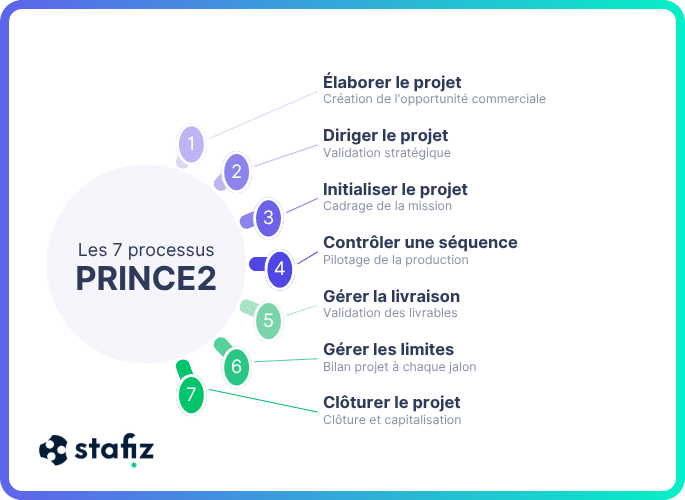
The 7 PRINCE2 processes
The 7 processes describe your project's lifecycle , from the initial business contact to the final assessment. They answer the question: "What steps should be taken and in what order?" to structure a project, from pre-project planning to closure. Each process defines specific activities, deliverables, and responsibilities.
| Develop the project | Creating a business opportunity | The pre-sales team assesses the financial viability and feasibility of the resource planning via the CRM. |
| Lead the project | Strategic validation | The Steering Committee (COPIL) approves the Business Case and authorises the launch of the mission. |
| Initiate the project | Mission framework | The Project Manager drafts the Scoping Note and defines the reference bases (budget, schedule, deliverables). |
| Control a sequence | Production management | The Project Manager oversees daily delivery, validates times (CRA) and monitors margin in real time. |
| Manage delivery | Validation of deliverables | The Client or the Product Owner validates the deliverables according to the contractual acceptance criteria. |
| Managing limits | Project review at each milestone | The Project Manager compares the budget outcome with the forecasts and requests arbitration from the Steering Committee for the next steps. |
| Close the project | Project closure and capitalization of lessons learned | The Project Manager finalizes the financial statement, releases resources and archives the lessons learned for future missions. |
PRINCE2 can be understood here as the structure of a project from start to finish, from pre-sales to invoicing. By clarifying roles and establishing decision milestones, PRINCE2 provides the necessary framework to ensure successful delivery and, ultimately, protect the profit margin of each project.
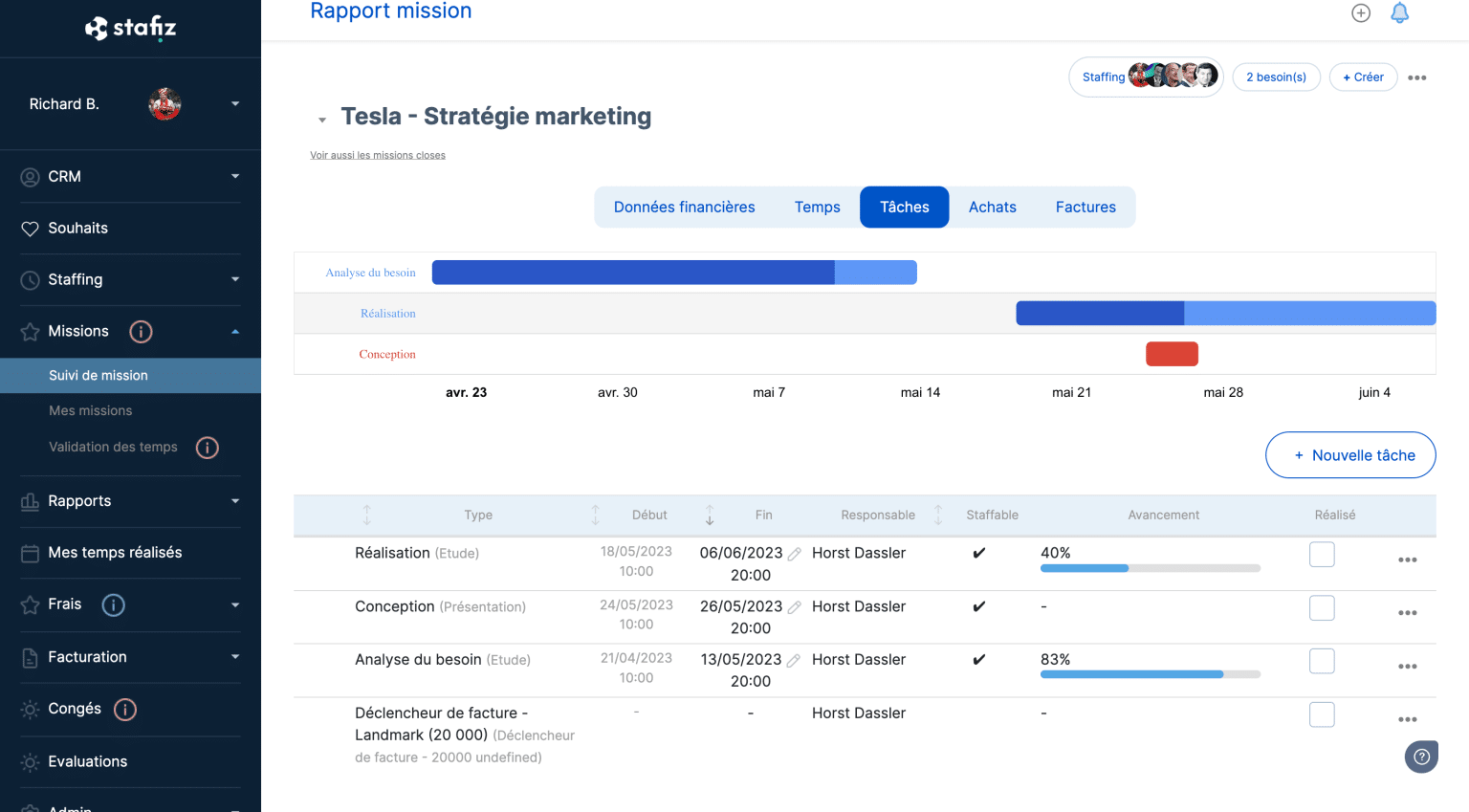
In Stafiz, these different project stages are directly linked to the percentage progress, with automated invoice sending as soon as a billable milestone is reached.
PRINCE2 tolerances: how to secure the project margin
The six PRINCE2 variables (time, cost, quality, scope, risk, benefits) represent permissible margins for each project variable. They act as true safeguards for your profitability . By setting acceptable deviation thresholds for time and cost, you transform the method into a margin protection tool : you empower the project manager while ensuring immediate alerts before budget overruns become irreversible.
Rather than overwhelming the steering committee (COPIL) with micromanagement, you define precise tolerance thresholds. As long as the project remains within these thresholds, the project manager can operate autonomously.
As soon as a tolerance level is threatened (for example, if you anticipate exceeding the allotted days by 10% on a fixed-price project), the system forces an immediate escalation to the Steering Committee. This mechanism acts as a proactive alert: it compels decision-making (contract amendment, scope reduction, resource reallocation) while options are still available, thus preventing the silent erosion of your margin upon completion .
| Cost | Direct protection of the net margin; any exceeding of tolerance is a direct loss on the mission's EBITDA. |
| Time | Maintenance of utilization rate ( billable utilization rate ); a calendar drift immobilizes your consultants and generates a commercial loss (opportunity cost). |
| Perimeter (Scope) | Control of "Scope Creep"; freezing the scope tolerance requires billing for amendments rather than the free execution of customer requests. |
| Quality / Risk / Benefits | Securing the Business Case; ensures that the final value to the customer always justifies the investment and use of your resources. |
PMP Consulting Use Case
The practical application of these tolerance mechanisms is what has enabled firms like PMP Conseil to transform their management. For this international consulting firm, the implementation of Stafiz and a project management methodology similar to PRINCE2 resulted in a 25% increase in project margin and a 30% gain in overall utilization rate .

❝
Stafiz has allowed us to grow our teams more efficiently. The structure that Stafiz provides us with allows us to manage more and more projects while maintaining the expected level of reliability.
Frédéric Jover
Co-founding Partner
By leveraging a consolidated multi-country view and automated alerts, PMP has proven that the right project management methodology, when supported by an ERP like Stafiz, secures profitability while streamlining the process. resource planning .
MSP and PRINCE2 methods, or multi-project management
PRINCE2 and MSP (Managing Successful Programmes) are two complementary methods but situated at different governance levels:
- PRINCE2 is a project management method: it focuses on the execution, control and governance of a single mission, with a start, an end and specific deliverables;
- MSP is a program management methodology: it guides a set of coordinated projects towards a common strategic benefit. It moves beyond simply operational execution to encompass the management of a project portfolio and medium-term strategic alignment.
In short, MSP is a step above PRINCE2 in the management hierarchy. While PRINCE2 ensures the success of each individual mission, MSP orchestrates the coherence of the entire portfolio to maximize the overall value of the company.
PRINCE2: a tailor-made method for a consulting firm?
Tailoring is one of the pillars of PRINCE2: the method is not meant to be applied rigidly, but to become a customized asset. The perceived cumbersomeness does not stem from the method itself, but from a lack of adaptation to the real challenges faced by the company.
For a consulting firm or a IT Services The pragmatic approach consists of focusing efforts on the non-negotiable elements that guarantee profitability: the business case systematically revisited, explicit financial tolerances and a streamlined steering committee (COPIL) for agile decision-making.
Conversely, it is recommended to significantly reduce the paperwork (exhaustive registers, overly dense interim reports) in favor of automated tracking tools. This flexibility makes it possible to reconcile the rigor of an international standard with the speed required by service missions.
Frequently asked questions:
PRINCE2 (PRojects IN Controlled Environments) is a structured project management methodology organized around 7 principles, 7 themes, and 7 processes. Originating in the British public sector and used in over 150 countries, it guides a project from its justification to its closure. It is a methodology, not primarily a certification.
Continuous justification, experiential learning, defined roles and responsibilities, sequence management, exception management, product focus, and adaptation to the project context. These are the non-negotiable rules: if any one is missing, the project is not being conducted according to PRINCE2.
PRINCE2 is a prescriptive governance methodology (it dictates how to structure and control a project); the PMP is based on the PMBOK, a knowledge repository (a toolkit). One describes a process, the other certifies a foundation of knowledge. The two complement each other more than they conflict.
Yes. PRINCE2 Agile combines the governance of PRINCE2 (roles, milestones, tolerances) with an iterative delivery approach similar to Agile. PRINCE2 defines "who decides what," while Agile organizes "how to deliver." The method doesn't mandate a waterfall model; it adapts to the delivery method.
Yes, provided it's tailored to your needs. We keep the non-negotiable elements (business case, tolerances, lean steering committee) and streamline the documentation. The perceived cumbersome nature of PRINCE2 almost always stems from an unsuitable application: when properly adapted, the method is appropriate for a firm of 20 to 100 people.
Yes. PRINCE2 version 7 (2023) has become more flexible and now focuses on practices rather than themes. The method remains a standard in the public sector, large organizations, and international projects, where it is often contractually required.


 WEBINAR STAFIZ