Everyone is talking about artificial intelligence. But where does it actually create value for consulting and service companies?
For this edition, we spoke with Minh Tuan Nguyen, Co-founder and Commercial Director of Rokodo , an expert in AI topics and a Stafiz client, to understand what they are actually observing in their activities and with their clients.
Their observation: AI is no longer limited to a few isolated experiments. It is already involved at different levels of a service company, from business development to application development, including meeting preparation and decision-making.
Gains that can be very tangible.
At Rokodo, AI is used primarily in the early stages of projects, to automate certain LinkedIn content, prepare sales proposals, and even participate in contract negotiations. It is also present throughout the entire application development process: needs analysis, design, development, testing, and documentation.
But it is above all certain concrete use cases that illustrate the potential of these technologies.
Rokodo cites two examples. In the first case, they claim that agents specializing in ISO 27001 enable them to process certain support and document production requests five times faster . In the second case, using multiple agents in the insurance claims field allows them to process customer files ten times faster, with the same team .
These examples illustrate an important development: the challenge is not just to use AI, but to integrate it into processes where it can produce a measurable operational gain.
Moving from "I produce everything myself" to a new way of working
For Rokodo, this transformation also concerns the way teams work on a daily basis.
Translation, information extraction from long documents, ticket qualification, meeting preparation: the tasks that can be assisted by AI are numerous.
But Rokodo summarizes this evolution with a particularly clear principle:
"AI prepares, humans control, decide, and enrich."
The goal is therefore not to eliminate the human role, but to shift its contribution towards control, decision-making and enrichment of the work produced with the help of AI.
AI is also changing the relationship with customers
This development is not solely related to internal productivity.
According to Rokodo, clients are now largely aware of AI and its potential value. For them, one of the risks would be continuing to sell and deliver services exactly as before, while keeping the productivity gains generated by AI to themselves.
Rokodo explains that it has integrated this logic since its beginnings, particularly through LowCode, and indicates that it has always sought to share transparently with its customers the problems encountered as well as the productivity gains obtained.
AI is thus also becoming a subject of customer relations: the gains it makes possible to generate can become an element to be shared rather than a benefit to be kept solely within the service provider.
Start with the business problem, not the technology
For Rokodo, one question is essential to determining whether an AI project actually creates value: does it solve a business problem?
The team emphasizes that success factors must be defined from the outset of the project. These factors then allow us to determine whether the expected value has actually been created—but also to know when to stop a project, which could otherwise continue indefinitely.
This approach therefore puts technology at the service of a business objective, rather than the other way around.
✨ AI in Stafiz
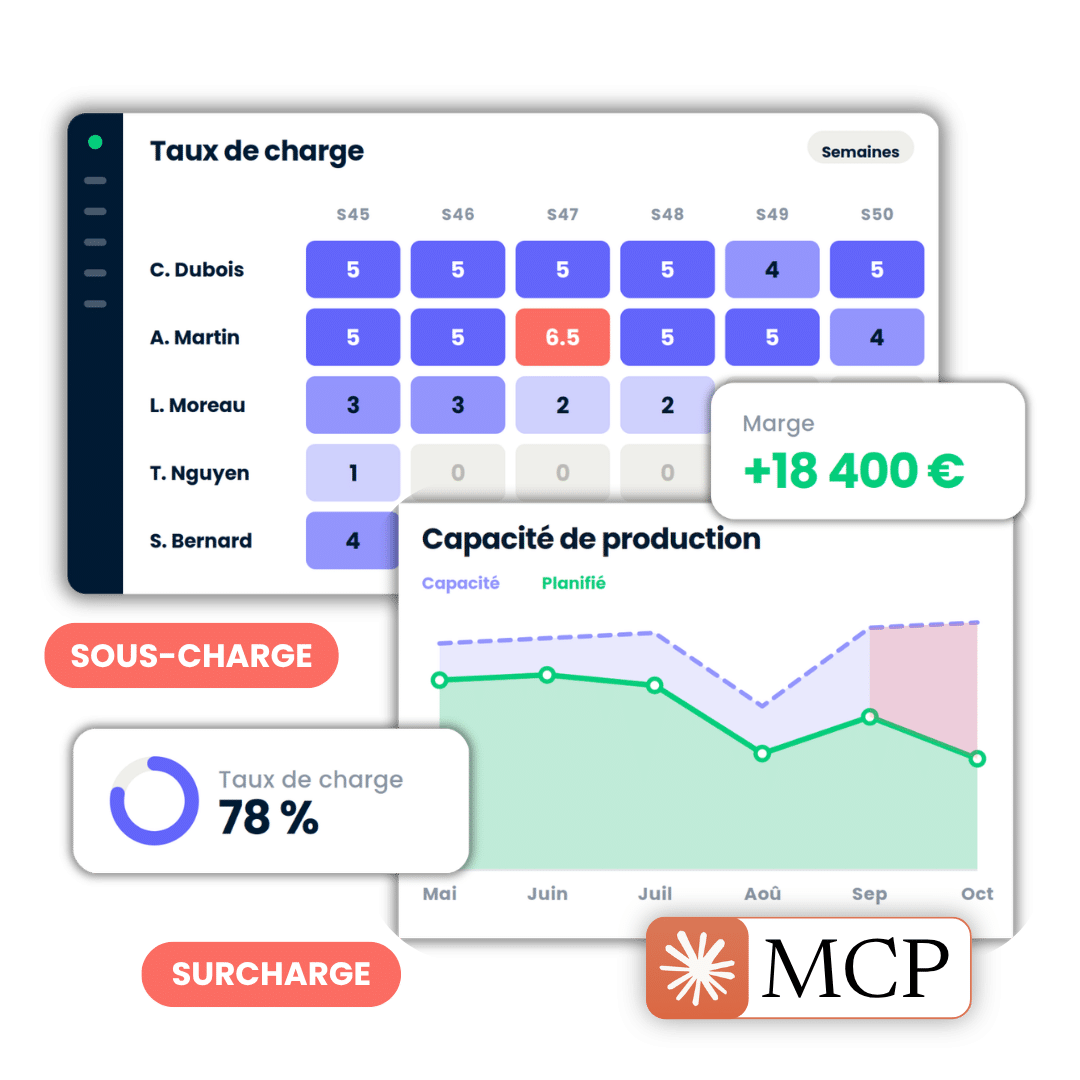
At Stafiz too, we are choosing AI directly integrated into the uses of service companies: resource planning , filling in time worked from Outlook, Stafiz Lumen, connection to Claude via MCP and customer support .
Rather than viewing AI as a separate layer, we are gradually integrating it into the workflows and data that service companies use on a daily basis.
The objective remains the same: to start from concrete needs and integrate AI where it can be useful, at the heart of existing tools and processes.
The main obstacle may no longer be technology.
When Rokodo is asked what is hindering the adoption of AI today, the answer is also nuanced.
According to them, the main obstacle is rarely the technology itself. Habits and skills are the primary barriers, followed by data quality. Technological limitations come next, although they quickly disappear.
In other words, adopting AI also implies changing the ways of working, the skills and the processes that surround it.
Three priorities for getting started
We wanted to know what the first three actions would be for a consulting or service company looking to begin its AI strategy. As an AI expert, Rokodo told us they would start by:
- Identify concrete use cases with high business value and potential ROI.
- Deploy the appropriate tools , and not just limit yourself to prompting, while keeping the human element at the center.
- Establish a governance structure that is light enough to remain operational, but necessary to frame both the technical challenges and the business gains.
An approach that sums up their vision well: AI represents a threat to many companies, but also, according to Rokodo, a considerable opportunity.
And tomorrow?
For Rokodo, AI is intended to be used at all levels of a service company . But this transformation does not exempt companies from working on their fundamentals: the quality of data and human-centered processes remain essential.
This is also the direction we are following at Stafiz: to gradually move AI from experimentation to daily use, directly at the heart of operations.
With the resource planning Timesheets, Lumen, integration with Claude via MCP and support, the objective is the same: to make AI useful where service teams actually work, based on their processes and data.
And this is just the beginning. With Lumen, the next step will be to go beyond responses and allow AI to directly perform actions within Stafiz.
As Rokodo's experience illustrates, the challenge is not simply to use AI for its own sake. It's about integrating it into the right processes, starting with the right problems, and enabling teams to derive tangible value from it.
About Rokodo
Rokodo is a collective of around thirty AI experts, united by a mission: "To make tech faster, more pragmatic, more useful." Project managers, low-code developers, designers, and tech leads transform their clients' ideas into concrete digital solutions.
Their team also supports its partners from generative AI to agentic AI, capable of acting autonomously to optimize business processes and accelerate digital transformation.