Estimating the success of a project can be a complex task. Indeed, even if the mission is accomplished, it does not necessarily qualify the project as a success.
Take the case of an ERP implementation or the launch of a product: although the implementation was done, it may have involved a higher budget, significant delays or missed objectives.
Therefore, it is important to determine precise evaluation criteria that will allow you to measure the performance of your project.
In this article, we guide you step by step to define consistent criteria and thus evaluate the success of your projects.
Define your evaluation criteria
Depending on your hierarchical position or the challenges you face, you might potentially have a different perception of the success of a project compared to your colleagues.
Indeed, the success of a project can vary depending on the point of view: this is why it is essential to define criteria for evaluating a project from the planning stage.
All of these criteria must be met to consider the project successful. In most cases, the trio of objectives, costs and deadlines will provide a relevant element of measurement .
Achieving objectives
- Questioning the necessity of the project
Determine the expected outcomes of the project so that you can answer the following questions.
– What problem will this project address?
– Why do it? Why is it important ?
– Will this project contribute to the company's overall strategy?
- Setting SMART goals
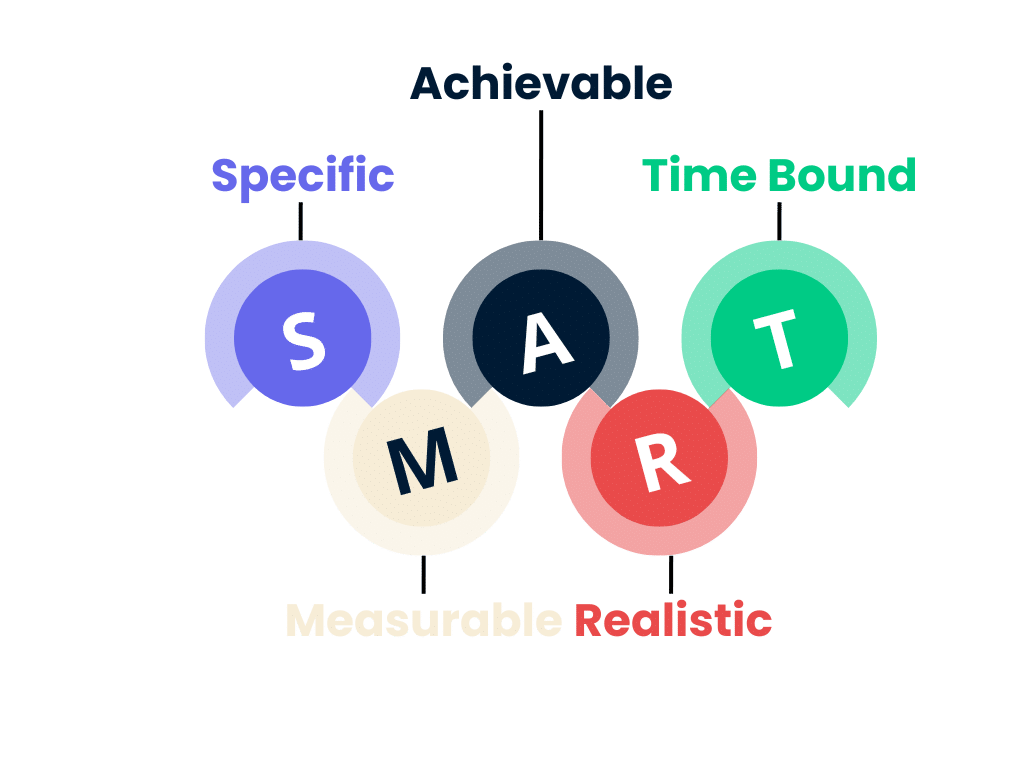
To define your objectives, we recommend using theSMART framework: Specific Measurable Achievable Realistic Time Bond.
This will help identify goals whose success can be measured in a tangible way, not just the result of a simple impression.
For example, make sure you have in mind what the expectations are in terms of deadlines, costs, deliverables or features.
Meeting deadlines
- Dealing with hazards
The progress of a project is never a long, quiet river. Despite a thorough anticipation of risks during the planning phase, no project is immune to hazards, both internal and external (modification of available resources, organizational changes, wars).
- Plan for margins
As a result, you must make a realistic time estimate, but above all taking into account a margin of error.
When the project manager frames the project temporally, he must already be aware of the resources at his disposal, but also be perfectly clear about their capacities and availability.
Budget monitoring of projects, in anticipation
See Stafiz in action in 2 minutes
Cost compliance
- Thinking wide
In the same way, costs can be largely impacted by hazards.
Thus, it is also recommended to anticipate a margin varying from 10% to 30% on your budget which will allow you to absorb any unforeseen events.
- A strategic evaluation criterion
In many projects, cost compliance tends to be considered as one of the main evaluation criteria and thus greatly influences the success of the project.
Indeed, a cost overrun could cause a snowball effect by impacting other projects within the company, or even other departments, and thus have serious repercussions.
Find out how to set up effective project accounting for cost and profitability monitoring.
- Stay Flexible
However, if cost compliance is the most strategic evaluation criterion for your project, you can adapt the other factors.
By adjusting the timeline or expected goals in this way, you could maintain consistency as well as achievability.
Other criteria
While the trio of objectives/costs/deadlines remains widely used among the evaluation criteria, others may prove to be more strategic depending on your context.
Other criteria include, for example:
- customer satisfaction,
- the quality of the deliverable,
- communication during the project,
- risk and problem management,
- the degree of innovation generated by the project,
- environmental impact.
However, remain vigilant in carefully defining your performance indicators. These criteria may not be as quantifiable as the widely used classic trio.
Determine performance indicators
This crucial step is to identify the key project success indicators that will allow you to affirm the success of the project.
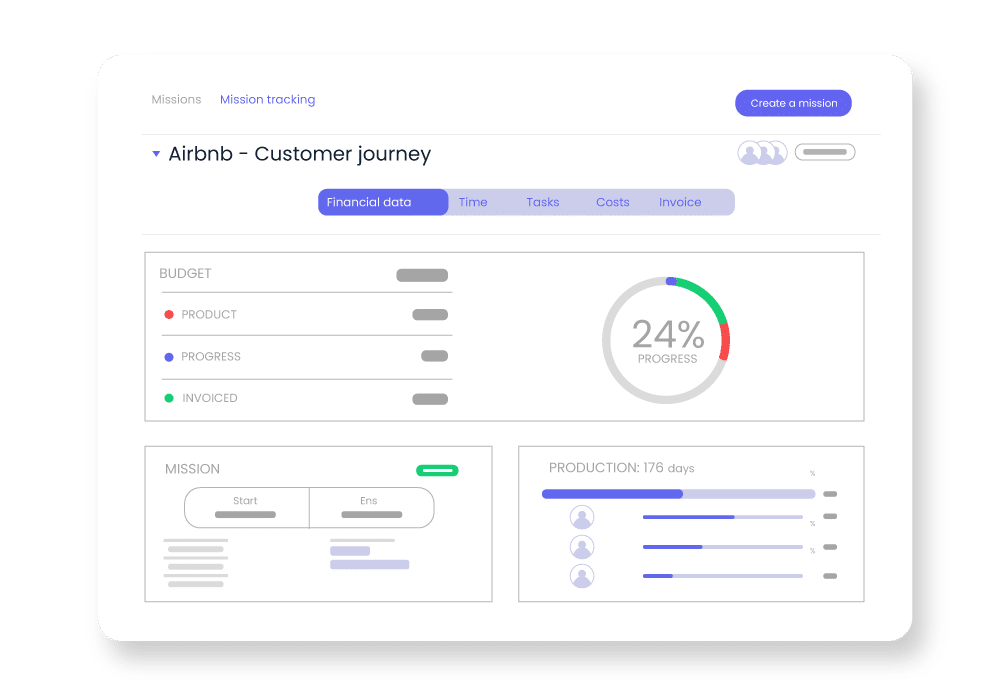
Visualize the performance of your projects in forecasting
Gap analysis: compare the planned activity with what was produced and scheduled. Visualize the financial impacts of your scenarios ( resource planning, purchases etc.) and get notified.
Estimating the results
- Set a target value
Start by estimating the results in realistic figures. To do this, define a target, i.e. a value that will serve as a benchmark.
For example, you could set a number of days for the deadline criterion, and an amount in euros for cost compliance.
- Find references
Base your estimates onsimilar projects, to keep them as realistic as possible .
You can also consult with project stakeholders to get a consistent forecast.
Take into account that any change in one of the criteria (especially the objectives) impacts the rest, which will therefore have to be adapted.
Choose relevant KPIs
The choice of your KPIs, also known as key performance indicators, is decisive in measuring the performance of a project.
The type of project developed will also be taken into account in the choice of your KPIs.
Take a close look at the objectives defined above to select the most relevant indicators.
Here are some examples of KPIs depending on the type of project:
- ERP implementation or migration: time savings generated, level of satisfaction of end users, degree of accuracy of the data.
- Product Introduction: Additional revenue generated related to the launch, amount of return on investment.
- Geographical/open branch expansion: profitability, number of customers in this new branch.
- Organizational restructuring: cost reduction generated, increased productivity, employee retention rate after reorganization.
- Process optimization: cost savings, reduced project delays.
Stafiz helps you anticipate risks. Predictive KPIs tell you about future deviations before they happen. This allows you to make decisions to correct the trend.
Thanks to the overview, filters and views, you can compare your projects with history. You evaluate and cost your future projects with more precision.
Measure the progress of the project
It's vital to establish regular project follow-up to measure progress.
This also makes it possible to take into account the reality on the ground and to have a comfortable margin of manoeuvre in the event of a deviation.
Compare forecasts with reality
- Set up a project performance board
Despite realistic forecasts, few estimates coincide perfectly with reality. However, your task is to find out for sure.
Setting up a project performance board will allow you to gain visibility into ongoing projects and compare them with the goals to be achieved.
Thus, time tracking and project management tools such as Stafiz will prove to be formidable allies.
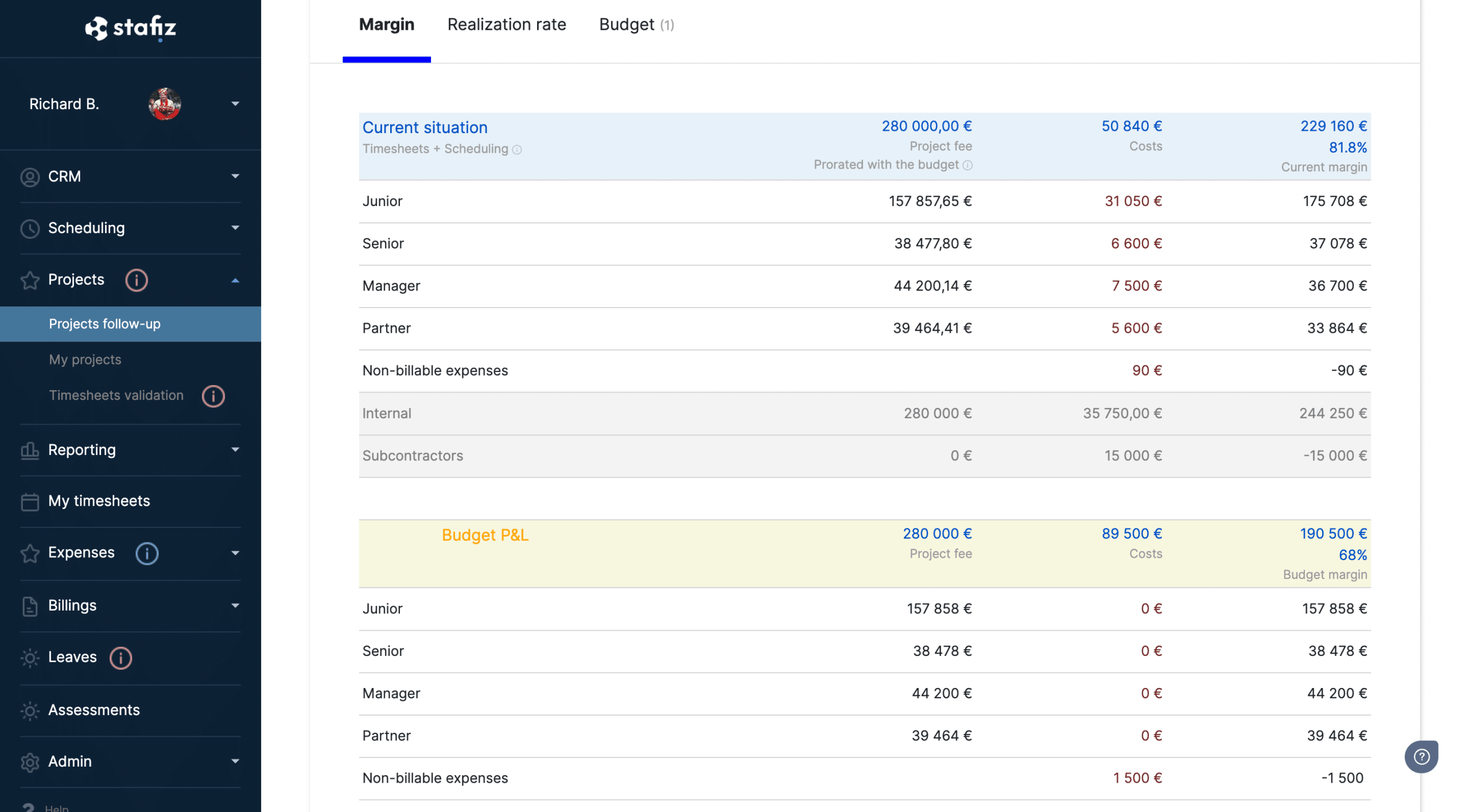
One of the features of Stafiz is to offer powerful project monitoring dashboards. These will allow you to manage the different aspects of your project in the best possible way.
In the example above, the tool will give you the opportunity to compare your budget forecasts with the current situation.
- Compare your expectations with reality
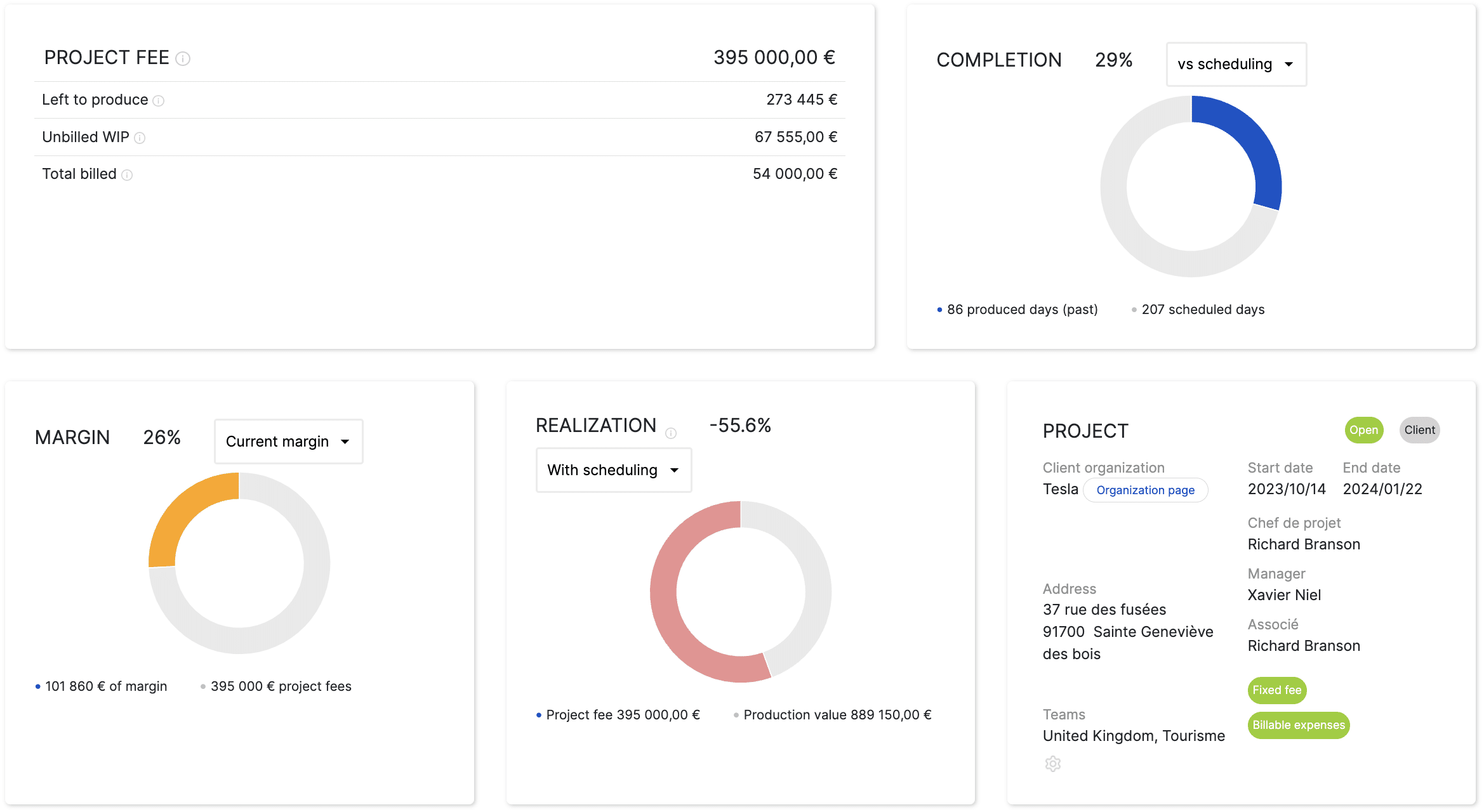
Ensuring regular project monitoring by comparing your performance indicators with your expectations and reality is essential.
Let's take a concrete case: your project has an expected lifespan of 6 months, you are halfway through, 3 months. You are 50% of the way through the project, but your actual progress is only 40%. In this case, it is necessary to quickly make adjustments in order to make up for the accumulated shortcomings.
- Limit meetings with increased transparency
It should be noted that this visibility will prove to be an essential asset for effective communication between the different parties involved in the project.
The information then made accessible and reliable will help reduce the number of progress meetings.
Thiswill not only save time, but above all provide some relief from your teams.
Adapting your evaluation criteria
- Aggregated information
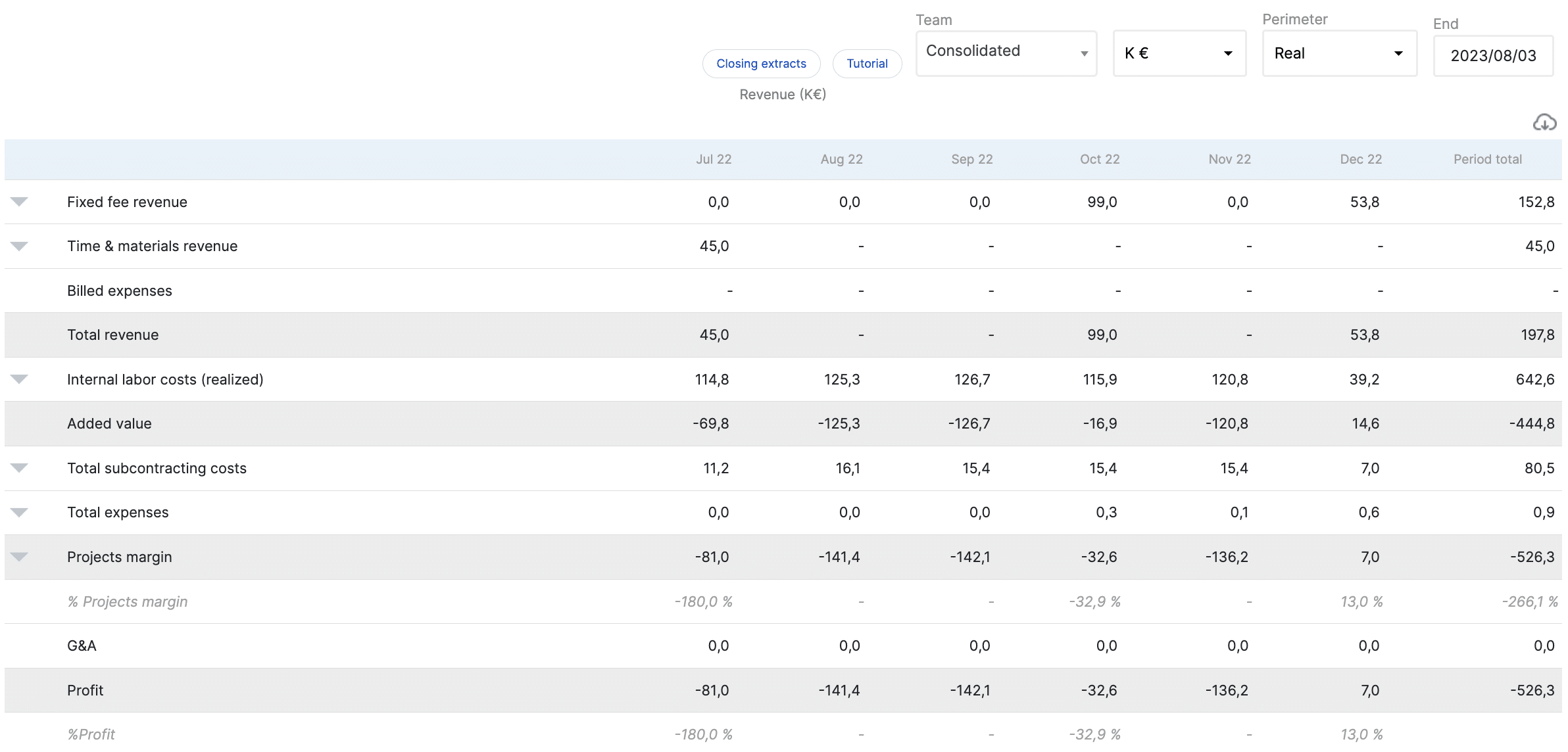
Stafiz provides both a macro and micro view of your projects, throughout their progress.
The tool aggregates information from resource planning, time spent, and costs to give you clear visibility into these strategic evaluation criteria for your project portfolio.
- Agile projects made easy
Stafiz gives you access to a complete continuous audit, both predictive and in real time. This transparency will be particularly useful for projects using the agile method.
With a live view of the evaluation criteria, the project manager will be able to evolve project management and propose iterations quickly, ensuring project success.
Should a project evaluation tool be used?
While the criteria for evaluating a project depend on each project, the trio of objectives/costs/deadlines remains widespread. Measuring the performance of your project therefore involves carefully studying each of these aspects, and the use of software makes it easier to do so.
A project management tool like Stafiz allows you a real-time view, helping you adapt your criteria along the way to maximize the chances of success of your project.
In all cases, careful planning is key to its smooth running and ultimate success.
Finally, benevolent communication and transparency of information that empowers the entire team will prove to be valuable success factors.