In IT Services and consulting firm, lean project management maps the mission in 7 steps, from quote to payment, to see where the margin disappears.
In a factory, waste piles up at the end of the production line, it is measured in excess parts and cluttered square meters, and the production manager knows how to look at his production line to know where it is forming.
In a consulting firm or a digital services company ( IT Services ), the waste of time and margin is invisible.
When you mistakenly assign a senior consultant to a junior consultant's project, it leaves no trace: the project is delivered, the client is satisfied, and the discrepancy is only discovered at closing, without anyone linking it to the decision of resource planning taken two months earlier.
Lean project management helps to raise awareness and bring these issues to light during the project. Its value stream mapping, applied to a project, identifies where value is generated, at what stage, and which indicator makes it visible.
🔎 Key elements to remember
- The waste of a service company doesn't accumulate anywhere: it dissolves into hours that look normal.
- Toyota's seven wastes all translate into a single task, from the costing of a lost deal to the bill that's dragging on.
- Lean names three enemies and not just one: waste, irregular load, and overload.
- Identify seven specific leakage points and the indicators to manage them.
- Continuous improvement relies on accurate time data, an essential foundation for any project management.
What is lean project management?
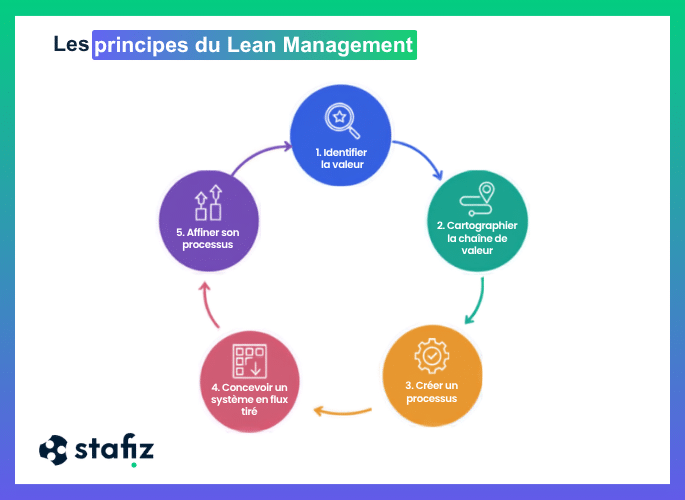
Definition of Lean management. This project methodology allows companies to eliminate tasks that do not produce any added value, based on the 5 principles inherited from the Toyota Production System:
- Define value from the customer's perspective. What the customer approves and pays for, nothing else. The rest does not produce value and is non-billable time.
- Map the value chain. All the steps that separate the customer's need from their satisfaction: those that produce a concrete deliverable or a CRA, and those that bring nothing.
- Create a continuous flow. Every process contains waiting times between the salesperson, the project manager, the staff consultant(s) or the client.
- To produce on a just-in-time basis, that is, according to actual demand rather than anticipating future demand.
- Striving for perfection through continuous improvement. Kaizen, improvement through small, regular steps, stands in opposition to the announced transformation project. Its best-known mechanism is the PDCA cycle, also called the Deming wheel: plan, do, check, act.
Lean project management is based around a simple idea: anything that does not add value for the end customer should be eliminated.
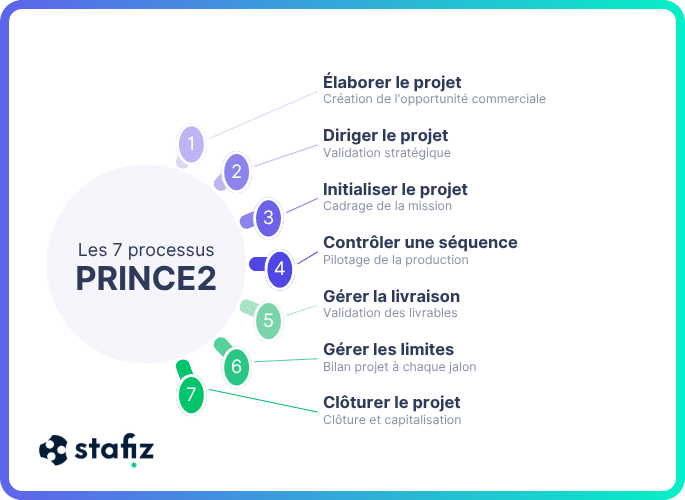
Lean project management holds a special place among project management methodologies : it focuses on the chain that produces value, whereas agile methods and PRINCE2 organize the work of teams.
What are the 7 wastes of lean manufacturing, and what happens to them when you sell to ADR ?
The seven muda identified at Toyota, that is, the seven forms of waste, describe physical losses. In a service company, they manifest as hours produced but never billed, regardless of the average daily rate ( ADR ) to which the mission was sold.
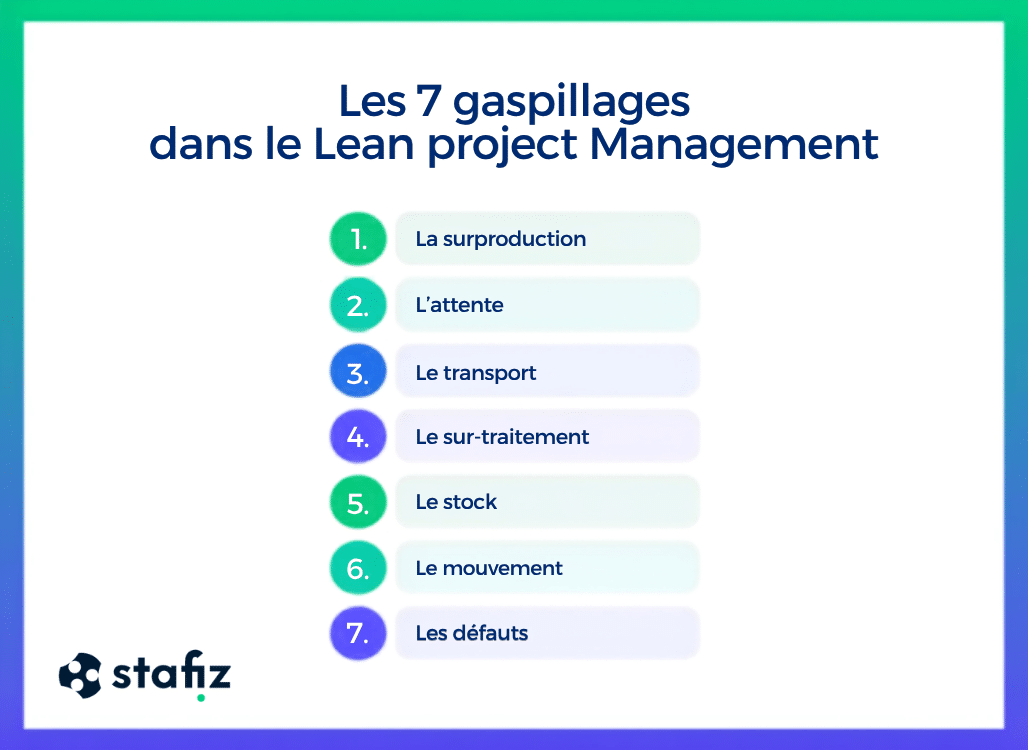
- Overproduction. Production occurs before there is a request from the client or an amendment to the contract.
- The wait. It often arises from a validation process or project governance that relies on a single person on the client side, without a substitute appointed at the start of the mission.
- Transportation. In the case of project management, it is more about double entry problems, when the same information exists between an Excel spreadsheet, a CRA (activity report) and a billing software that do not communicate with each other.
- Over-servicing. This waste often stems from project specifications that define the scope in terms of resources committed rather than accepted deliverables. The team then delivers a service that exceeds what the client purchased, and consumes more days because they wanted to "do it right."
- Inventory. This refers to the situation where work completed has not yet been invoiced. For example: a milestone reached in March, invoiced in May, and paid in July—four months of cash tied up in wages already paid. This stems from a billing schedule based on the calendar rather than actual progress.
- The movement. Spreading yourself across too many projects hinders efficiency: a consultant loses valuable time with each change of context. This waste stems from a desire to maximize activity without an overall view of the cognitive load.
- The drawbacks. When a deliverable is not accepted by the client, but its rework is neither planned nor billed as a fixed price, it's the profit margin that suffers. The problem often stems from deliverable acceptance criteria being established too late, or being absent from the project charter .
To these seven wastes, we can add an eighth: the matching between the profile and the mission, one of the most frequent errors in resource planning management .
These various flaws are sometimes difficult to visualize without a suitable project tracking tool, and can weigh more or less heavily on the mission's margin.
What are the key tools of lean project management?
Lean Management tools are perfectly suited to the service sector under the name of lean service. Applied to a service company, a IT Services or a consulting firm, Lean Management enables the management of data flows, knowledge and available brain time.
Each of these tools addresses a specific need, from process analysis to continuous improvement.
| Value Stream Mapping (VSM) | Map out all the steps from quote to payment and measure which ones create value | When the margin is discovered at the close without knowing at what stage it originated |
| Kanban | Visualize the workflow and limit the number of tasks open simultaneously | When deliverables pile up awaiting client validation |
| Poka-yoke | Making the mistake impossible instead of correcting it afterward | When activity reports arrive incomplete and follow-up is required every month |
| Heijunka (straightening) | Distribute the load over time rather than adding capacity at peak times. | When two months of inactivity alternate with two months of overheating |
| Andon | Report the anomaly as soon as it appears, and stop until it is resolved. | When a budget overrun is discovered too late to be corrected |
| Kaizen | Improve through small, regular steps rather than through a single, announced project. | A brief monthly review, focusing on an indicator that has changed |
| PDCA (Deming cycle) | Plan, do, check, adjust: test a correction before generalizing it | To validate a process change on a mission before extending it to the portfolio |
| 5S | Sort, organize, clean, standardize, maintain | When deliverable models are reinvented with each mission |
Lean, agile or six sigma: which lean management approach answers which question?
These three approaches are complementary because they do not address the same problem:
- Lean management seeks to eliminate production steps that do not generate added value.
- The Six Sigma methodology aims to ensure the reliability of the final result so that it is always consistent.
- The agile method tries to adapt to an evolving project framework, through short iterations and customer feedback.
| The problem addressed | Waste and disruptions in the supply chain | Variability and defects | A customer need that changes along the way |
| The question asked | What in the chain does not create value? | Why is the result not consistent? | How to deliver useful results when the scope is changing? |
| The method | Map the value chain, eliminate, pull the flow | DMAIC, a five-step statistical approach: define, measure, analyze, improve, control | Short iterations and continuous customer feedback |
| What it measures | The ratio between value-added time and total time | Standard deviation and defect rate | Velocity and value delivered per iteration |
| When you sell days | It's useful when profit margins are lost to non-billable time, waiting, and rework. | It is used for repeatable services where quality varies from one assignment to another. | It is useful for managed services and on an open-scope fixed-price contract, less so for a fixed-term commitment. |
How to map the value chain of a project, from quote to payment?
Value stream mapping involves drawing all the steps that separate a customer need from its satisfaction, and then measuring which ones create value.
On a project in IT Services or in a consulting firm, the reasoning is identical to industrial VSM: it is based on the history of similar missions carried out to reconstruct the production steps and identify the waste that lies in wait (pre-sales, resource planning (production, time entry, customer validation, invoicing, payment collection).
What is the value chain of a project in a service company?
We then distinguish between value-creating tasks (what the client is willing to pay for) and non-billable time ( billable utilization rate ).
Here are the 7 steps to map the value chain of a project in a service company:
- Determine what type of project to measure. The tasks must be grouped by category and a comparative table made with the project stages ( resource planning (production, invoicing, etc.). If two missions are 80% similar, they belong to the same family.
- Prioritize the missions you work on. We advise you to keep the mission category that represents the highest revenue or the one with the lowest profit margin.
- Define the limits of the value measurement. Is the start calculated from the date of signature of the quote or from the actual start date? Does the end represent the issuance of the invoice or the receipt of payment?
- Reconstruct the steps of the mission, by collecting data in the tracking tool: planned vs billed days, validation time, double entry issues.
- Add the human factor: interview project managers to understand the causes of deviations that the monitoring tool cannot explain alone.
- Identify areas of drift: quantify unbilled work, time wasted in information flow, or tasks that are reworked. We map the current state.
- Write the improvement plan: specify the participants, costs and expected benefits to optimize the value chain.
| Pre-sales | Overproduction: detailed costed proposals on deals that will not be signed. | Quote conversion rate, pre-sales time per signed deal |
| resource planning and assignment | Underutilization of skills, the eighth waste: a senior profile placed on a task that does not require them. | Profile/need match, occupancy rate, lead time resource planning |
| Mission production | Over-processing: deliverables that are more extensive than what the client purchased. | Difference between days sold and days spent |
| Time entry and CRA | Transport: the same information re-entered in the spreadsheet, the CRA and the invoicing tool. | Average data entry time, rate of CRAs completed on time |
| Customer validation | Waiting: the deliverable is ready, validation is not coming, nothing is moving forward and nothing is being invoiced. | Average validation time, pending, blocked |
| Billing | Stock: work produced, accepted, but not yet invoiced. | Discrepancy between project progress and billing progress |
| Cash receipt | Inventory, in its financial form: the value is invoiced, the cash arrives weeks later. | Average payment time, outstanding customer balance |
Monitoring the value produced with Stafiz
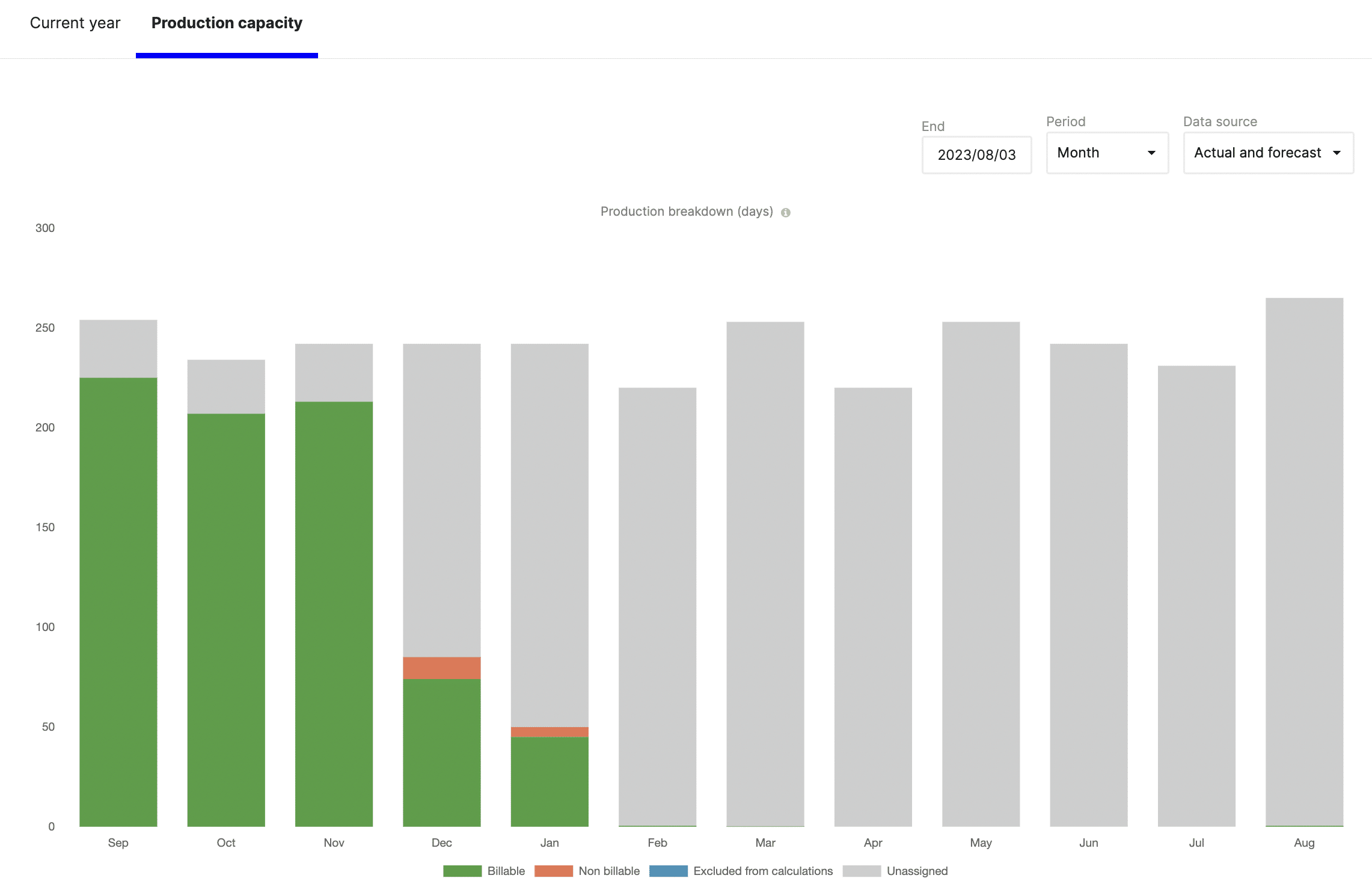
In terms of project tracking, Stafiz allows you to:
- real-time monitoring of planned vs. actual (workload, costs, deliverables);
- complete visibility on the progress and the project's end-of-project forecast;
- an alert system to quickly detect deviations from the project;
- integrated financial management: margins, invoicing, cash flow.
JICAP Customer Case Study
Founded in 2016, JICAP is a strategic consulting firm specializing in procurement performance, with 45 employees and an annual growth rate of 50%. They needed to increase productivity by eliminating the need for resources to manage the administrative aspects of separate tools.

❝
Before selecting Stafiz we had a number of software programs that were "stand-alone", which were functional blocks and which did not communicate with each other. The firm's strong growth made us realize that we had reached a threshold in terms of the use of tools that no longer allowed us to evolve in line with our growth.
Jean-Pierre Vignes
Founder
Results obtained with Stafiz:
- eliminating double data entry between tools has made it possible to recover one full-time equivalent (FTE) day per month;
- Centralizing their tools by adopting Stafiz enabled them to achieve 25% savings on software costs.
How can we plan the workload of a project team without relying solely on the occupancy rate?
A workload plan is usually judged by the occupancy rate. Lean adds the regularity of the workload (Mura) and its ceiling (Muri). Together with waste (Muda), these form the "three Ms" of performance. These three concepts are interconnected: irregularity (Mura) creates overload (Muri) during peak periods and waste (Muda) during off-peak periods.
The muda of resource planning Why is inter-contract time the most direct waste for a service company?
A consultant between assignments represents a salary expense without corresponding revenue. This is the most direct form of waste in a service company. The key here is not to try at all costs to shorten the inter-contract period, but to anticipate it as best as possible .
Indeed, once a consultant is between contracts, they are subject to the situation just like the service company they work for. The only possible actions are to train them in new skills, in an attempt to place them on other projects. Even then, these are non-billable hours that remain the responsibility of the company .
It is therefore necessary to intervene proactively, as soon as it is known that the consultant's assignment is about to end, and to successfully place them on another project. This problem will arise with projects where you bill for recurring services, whether on a time and materials basis or a fixed price.
As soon as this information is known, it must be transmitted by the consultant or project manager to the person in charge of resource planning : if you have several weeks to place a profile, there is little risk of it ending up in inter-contract.
The levers that can be used once the period has started are a separate topic, covered in our article on inter-contract periods in IT Services .
The mura: why does an irregular workload cost more than a consultant between contracts?
An irregular workload for a consultant generates losses on two levels:
- You pay for inter-contract periods during off-peak periods,
- You incur additional costs (emergency subcontracting, reduced hours) during peak activity periods.
Don't rely on an annual average of a consultant's workload: a high occupancy rate smoothed over a long period can easily mask months of inactivity followed by burnout. That's why you need two tools:
- A time tracking tool that allows you to monitor the variability of a consultant's activity (overload or underload),
- A projected workload plan that allows monitoring of consultant activity and the resource planning real-time missions.
This organizational lever is, in fact, very effective. For example, in the case of Colorado Consulting, a firm with 30 employees, visibility and anticipation of needs have made it possible to improve the utilization rate of +35%, while guaranteeing a better resource planning collaborators.
The challenge remains to build a workload plan that covers the coming months, and to integrate this plan with the date commitments made in pre-sales, which falls under the umbrella of project forecasting management .
Discover the utilization rate (video)

The Muri: What is the real cost of a consultant staffed at 120%?
Overloading a consultant does not produce more value. This overwork comes at a high price on several levels:
- The delay: By spreading his attention across several simultaneous missions, the consultant ends up delivering late on all fronts.
- Quality: Work done under pressure inevitably generates defects. If the project is a fixed-price contract, the hours spent on rework and corrections directly eat into your profit margin.
- Employee turnover: This is the heaviest and most often underestimated cost. It encompasses not only the recruitment process and skills development, but also the irreplaceable loss of customer knowledge.
Let's take a consultant staffed at 120%. Although he works 20% more than a normal week, this overload does not necessarily translate into an increase in production: if 30% of his time is absorbed by administrative tasks or poorly designed tools, he is exhausting himself on non-billable tasks to the detriment of client deliverables.
- He is exhausted, particularly by non-billable tasks that are disproportionate to his capacity.
- He's clearly having trouble prioritizing his tasks, or he lacks clear processes, which is causing him to waste time.
How can you tell if a consultant is overloaded before it becomes critical? All the information is usually already present in your project management system:
- THE utilization rate measures the occupancy rate of an employee over a period;
- The completion rate, what proportion of this occupancy is actually billable.
Simply multiply the number of non-billable days by the average daily cost (ADC) to find the amount the surcharge costs the company. Details of the formulas can be found in our article on utilization rate and completion rate .
How to apply lean management to a mission or a portfolio of projects?
Historically, when lean management was applied to Toyota's production line, any operator could raise the alarm when they noticed an anomaly. This system has a name: the andon.
Software like Stafiz already does half the work: it alerts you if there's a risk of a discrepancy. Then it's up to the project manager to make the decision. Applied to a project or a portfolio of assignments, this process becomes a set of calculation rules. The software continuously compares actual results to forecasts and flags a risk of budget overruns or an underperforming project.
Most importantly, it doesn't just observe: by calculating the remaining work and future costs, it provides the margin at completion , that is, the margin the project will have if nothing changes. On this specific point, the tool goes further than the original andon, which reports a defect that has already occurred and not a future one.
It is important to implement a project management dashboard that sets the thresholds that trigger the alert.
Once this is given, the project manager must determine the cause of this discrepancy and, if possible, make a decision at his level, or notify the steering committee that it is necessary to launch a project review, or a portfolio review (which falls under multi-project management ).
What mistakes should be avoided when applying lean project management in a service company?
Lean rarely fails because of the method itself, but rather because of its initial execution. Here are the five most common mistakes to avoid during the launch.
- Lean should not be confused with cost reduction. Lean aims to eliminate what is not billable, not to cut budgets. A lean approach conducted as a cost-cutting plan may indeed reduce the number of days in the contract, but risks lowering the quality of deliverables, and therefore generating customer dissatisfaction.
- Managing lean processes based on utilization rates is the most common mistake in service companies, and it produces the opposite of the desired result. A management team that sets a 90% target ends up with overworked consultants, delayed projects, and deliverables that need reworking, which eats into project margins.
- Launching a lean management initiative before having reliable data, or mapping processes based on late activity reports or a system with poor information flow, will lead to false conclusions and poor project decisions.
- Mapping the entire portfolio at once. The exercise takes weeks and produces a map that no one opens. A single completed mission is enough to reveal leaks and generate internal proof. The portfolio itself comes later, once the method has already demonstrated something.
- Adding a ritual where the method is to remove one. A lean approach that translates into three additional weekly meetings failed before it even began. Each added instance consumes billable time and must be justified by the waste it eliminates.
Frequently asked questions:
Lean manufacturing refers to its original application in industrial production. Lean management extends the same principles to the management of an organization, regardless of its sector. The method remains the same; what changes is the nature of what flows through the value chain.
The seven-principle version comes from Mary and Tom Poppendieck's lean software development, not from Womack and Jones. It notably adds the elimination of waste, continuous learning, and deferred decision-making. This is the most common point of confusion on the subject: five principles according to some, seven according to others.
The economic mechanism differs. With a fixed-price contract, each unplanned day falls outside the project's budget, so the gain is immediate and internal. With a time and materials contract, the time is billed, but the capacity used is missed elsewhere: the gain lies in the utilization rate and the renewal of the project.
No to the method, yes to the measurement. Value stream mapping can be done on a whiteboard. However, continuously tracking workload, progress, and margin requires consolidated time data, which a spreadsheet can no longer handle beyond a few dozen employees.
This is its main constraint in a service company. Continuous improvement rituals require a level of availability that client consultants don't have. The solution is to make them short, monthly, and based on pre-collected data rather than workshops.
It depends on the project. Removing duplicate data entry is measured as early as the following month. Workload smoothing is assessed over a quarter, because it's necessary to observe a trough and a peak. A continuous improvement method cannot be evaluated before two or three cycles.
The real cost lies less in acquiring a tool than in the time invested by teams to map tasks and facilitate routines. The main effort often focuses on ensuring the reliability of time tracking.
No, because none of these lean methods completely replaces the other. They are applied in different contexts: value creation, team organization and work pace, and the reliability of a result.
The three methodologies combine perfectly. In consulting firms, most teams often start by applying lean management, because the time wasted per project is quantifiable before the variability of a result can be measured.

 WEBINAR STAFIZ