Managing multiple projects simultaneously is often a balancing act. This exposes your teams to constant pressure: simultaneous requests, unclear trade-offs, unstable priorities, and fragmented visibility into workload and profitability. Service companies that experience this situation are feeling the immediate consequences on their margins, delivery times and customer satisfaction.
Indeed, when project resources circulate between ten different missions, management becomes fragmented, Excel files multiply and decisions are sometimes taken too late. This can create an unexpected overload, or budget drifts that end up weighing heavily on your business.
However, this complexity conceals a major operational advantage. Imagine a control system in which:
- projects move forward without being blocked;
- the charges are anticipated;
- the margin to date and the margin to be completed are continuously updated;
- Each project manager relies on the same data to arbitrate.
Adopting this level of maturity allows your organization to move from simple execution to strategic planning risk and value creation. Management is becoming a strategic lever, as well as a risk management tool.
To achieve this, you need a clear framework, consolidated visibility into load and capacity, and financial management that connects progress, production, and margin without delay. In this article, we detail the operational levers and the stages of multi-project management that structure stable management in a service company.
What is multi-project management?
Definition of multi-project management
Multi-project management in a company consists of supervising several projects in parallel, often carried out by common teams or resources. The objective is to ensure operational coherence:
- Balance load and capacity.
- avoid scheduling conflicts;
- and ensure that each project progresses without negatively affecting the others.
In concrete terms, it is a question of managing the complexity of daily life by optimizing multi-project planning, the distribution of resources and the prioritization of work. For example, a IT Services who conducts ten client missions simultaneously with the same consultants must continuously adjust assignments to maintain operational fluidity.
How does multi-project management differ from program or project portfolio management?
Multi-project management, program management and portfolio management are based on different logics, decision-making levels and objectives. Understanding their respective roles helps to structure coherent management between strategy, coordination and operational execution.
Portfolio management: driving the overall project strategy
Project portfolio management intervenes at a strategic level: it consists of ensuring the strategic alignment of the project portfolio, selecting, prioritizing and arbitrating projects according to the company's objectives, available resources and expected ROI.
You deal with what to do and why, rather than how to do it. For example, your management usually doesn't look at each project individually. It analyses all possible projects, compares their strategic impact (e.g. accelerating digitalisation), their expected profitability or their contribution to annual priorities (e.g. entering a new market), and then decides which to launch, postpone or abandon. In other words, it builds the "optimal basket" of projects for the year.
Program management: coordinating interrelated projects
Program management aims to steer a set of interdependent projects contributing to the same overall objective. It is intended to ensure consistency in deliverables, timelines and expected benefits across the program.
For example, the launch of a new offer cannot be treated as a single project. It is based on several distinct but related projects: product development, preparation of sales materials, team training, customer communication, support organization, etc. These projects must move forward in a coordinated manner, because the success of the offer depends on the synchronization of the entire program.
What is the difference between multi-project management, program management, and project portfolio management?
The difference between multi-project management, programme management and portfolio management is essentially based on the level at which the activity is managed and the nature of the decisions taken.
- Multi-project management focuses on operational complexity (balance of resources, daily trade-offs and planning). Several projects are carried out simultaneously by the same teams.
- Program management manages functional complexity (interdependencies and common benefits). It encompasses several projects that depend on each other. The goal is to ensure that their contributions converge towards a common outcome by aligning their rhythms and deliverables.
- Portfolio management acts on strategic complexity (choice, prioritization, budget allocation). More upstream than the other two, it consists of choosing which projects to retain or abandon in order to maximize the overall value created for the organization.
| Objective | Ensure operational coherence between several projects carried out in parallel. | Coordinate multiple interrelated projects to achieve a common goal. | Select and prioritize projects to maximize strategic value. |
| Intervention level | Operational | Functional | Strategic |
| Perimeter | Concurrent projects sharing the same resources. | A group of projects linked by a common objective or result. | All potential or ongoing projects at the company level. |
These three approaches constitute complementary levels of project management. Distinguishing and articulating them well allows your company to reconcile a long-term strategic vision, good coordination between several interdependent projects and operational efficiency on a daily basis.
Why move from single project management to multi-project management?
When several projects are taking place in parallel, multi-project management becomes essential. It allows, while maintaining a global vision of the profitability of your consulting firm:
- better prioritising,
- anticipate loads,
- optimize team occupancy,
What are the main challenges of multi-project management?
When your company manages several projects in parallel, each decision influences the whole. Without a framework, priorities become blurred, resources are depleted , and performance becomes unpredictable. The IT Services are particularly exposed to these challenges, as they often work with the same experts on multiple concurrent assignments.
Here are the 6 main challenges of multi-project management in a service company to master to avoid friction and preserve your profitability.
Coordination between projects and priorities
In a multi-project environment, the same employees are mobilized on several fronts. Without a framework, the lack of coordination of projects quickly leads to unclear trade-offs, scheduling conflicts and a loss of focus that slows down all initiatives. The challenge is therefore to ensure the prioritization of multiple projects and to orchestrate dependencies between projects to prevent everyone from working "in silos".
Structured multi-project management clarifies priorities, reduces project tensions, and secures overall progress, ensuring that resources are used at the right time and in the right place.
Lack of visibility into workload and capacity
The lack of visibility into workloadload and capacity makes planning unstable: some resources are over-worked while others remain under-utilized, leading to avoidable delays, additional costs, and inter-contract periods.
The challenge is to have a multi-project workload table that makes it possible to anticipate peaks in activity, to balance the availability of teams and to secure the billable load.
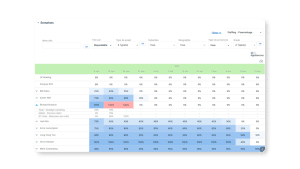
Overall employee workload view, by project, by team or by customer
This monitoring gives you the ability to detect load overruns, under-invoicing and discrepancies between planned and actual earlier. By identifying these drifts before they hurt your bottom line, teams can readjust planning, renegotiate, or remediate scope. This prevents the margin of a project from deteriorating silently and protects the overall profitability of the BU.
Governance and communication
In a multi-project environment, coordination is above all a human issue. Without clear decision rules, teams lack alignment, priorities clash and arbitrations come too late. Structured governance (multi-project PMO, steering committees, synchronization rituals) highlights dependencies, harmonizes decisions, and stabilizes the overall progress of the portfolio.
Building a culture of transparency is essential. Each employee must understand:
- why a project is a priority,
- how are the trade-offs made,
- and what information should be reported.
Such an organization streamlines communication and reinforces the coherence of the entire portfolio.
The limits of traditional tools
The transition from Excel to multi-project management software is becoming a major issue. Excel or single-project tools are no longer enough to supervise several projects simultaneously. Data is fragmented across multiple files or applications, due to a lack of tool interoperability, with no direct link between time tracking, scheduling, and financials. The result: loss of reliability, input errors, contradictory versions, and time-consuming consolidation.
Without a centralized system, it becomes nearly impossible to get a real-time view of future load, profitability, or risks. Moving to a single, integrated tool makes it possible to automatically synchronize information, anticipate drifts and manage the entire portfolio with much greater precision.

The agile method vs. the classic approach
The approach to Agile vs. classic (or waterfall) multi-project management is a common question. Whether it's coordinating sprints or traditional project phases, the challenge remains the same: the allocation of multi-project resources and the prioritization of multiple projects at the portfolio level. The flexibility of Agile can even exacerbate the need for centralized visibility to arbitrate between short cycles and cross-functional teams.
How to prioritize multiple projects simultaneously?
Prioritizing multiple projects in parallel requires understanding how to allocate resources, adjust schedules, and drive profitability across the portfolio. The goal: To avoid load conflicts, maintain overall consistency, and ensure that resources are working on what has the most impact at any given time.
How to distribute resources across multiple projects?
The allocation of multi-project resources requires a consolidated view of all active projects: their progress, their projected margin, their workload and the skills mobilized. Without this unified view, organizations quickly fall into overload, late arbitrations, and chain delays.
Key indicators to track in a multi-project context include:
- the rate of advancement,
- The utilization rate (activity rate excluding holidays),
- the projected margin,
- the rest to be done (RAF).
This data makes it possible to arbitrate in real time, prioritize projects with the highest impact and adapt assignments according to available capacity. Multi-project dashboards facilitate these decisions and provide a clear view of future risks.
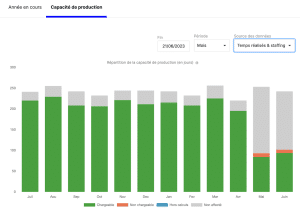
Production capacity report in Stafiz
In Stafiz, the production capacity report shows you the productive, non-productive, and unaffected load month by month. This consolidated reading helps managers optimize their management decisions. resource planning and to anticipate capacity tensions.
Rolling and collaborative planning
In a multi-project environment, project resource forecasting cannot remain static. Priorities change according to commercial signatures, customer constraints, absences, or even unforeseen technical events. Planning must therefore be sliding : updated regularly, adjusted according to availability and focused on team synchronization.
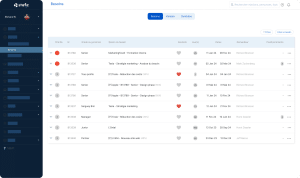
The requirements screen in Stafiz allows you to list all current and future resource requirements.
With a visual multi-project schedule (such as the Consolidated Gantt) and load/capacity view, managers immediately see overlaps and can reallocate resources with just a few clicks. This gives you full transparency into critical skills, upcoming loads, and areas of tension.
As a result, your organization adapts continuously, without loss of coordination or unanticipated overload.
Integrated economic management
In multi-project mode, a bad assignment or an uninvoiced project can degrade the profitability of the entire BU. In service companies, where fixed-price projects and time-based assignments coexist, managing these two models simultaneously requires consolidated visibility of costs, margins and workload forecasts.
Economic management is also based on the Follow-up to the billable utilization rate (activity rate excluding holidays), which measures the actual occupancy of the teams. A billable utilization rate too low indicates an underload that dilutes the margin; a billable utilization rate Too high indicates an over-solicitation that increases the risk of drift, delays and non-billable time. This indicator therefore serves as a point of support for adjusting the load and securing profitability.
In this context of multi-project management and inter-contract, unified management ensures that you can:
- anticipating inter-contracting;
- Identify non-billable time.
- Visualize the margin at termination.
- compare the profitability between the management and the fixed price;
- react before deviations become irreversible.
Stafiz centralizes this data (planned / realized / invoiced) and automates the reconciliation between production and finance, in particular via the automated invoicing module. Each Adjustment of resource planning or budget instantly recalculates the forecast margin, which makes decisions more reliable and secures the economic landing of the BU.
HR management and resource planning are connected
Prioritizing multiple projects also means aligning human resources with the needs of the portfolio. Companies that manage 10, 20 or 30 active projects must anticipate resources in 3–6 months, slow or busy periods to avoid critical situations: emergency recruitment, overload of teams or costly inter-contracts.
Connected HR management involves:
- regular capacity monitoring,
- a matching of profiles / projects,
- monitoring of key competences,
- anticipation of recruitment and skills development.
Stafiz's AI search engine simplifies this work: skills, roles, experience, custom keywords or availability; all HR data is centralized to quickly identify relevant profiles.
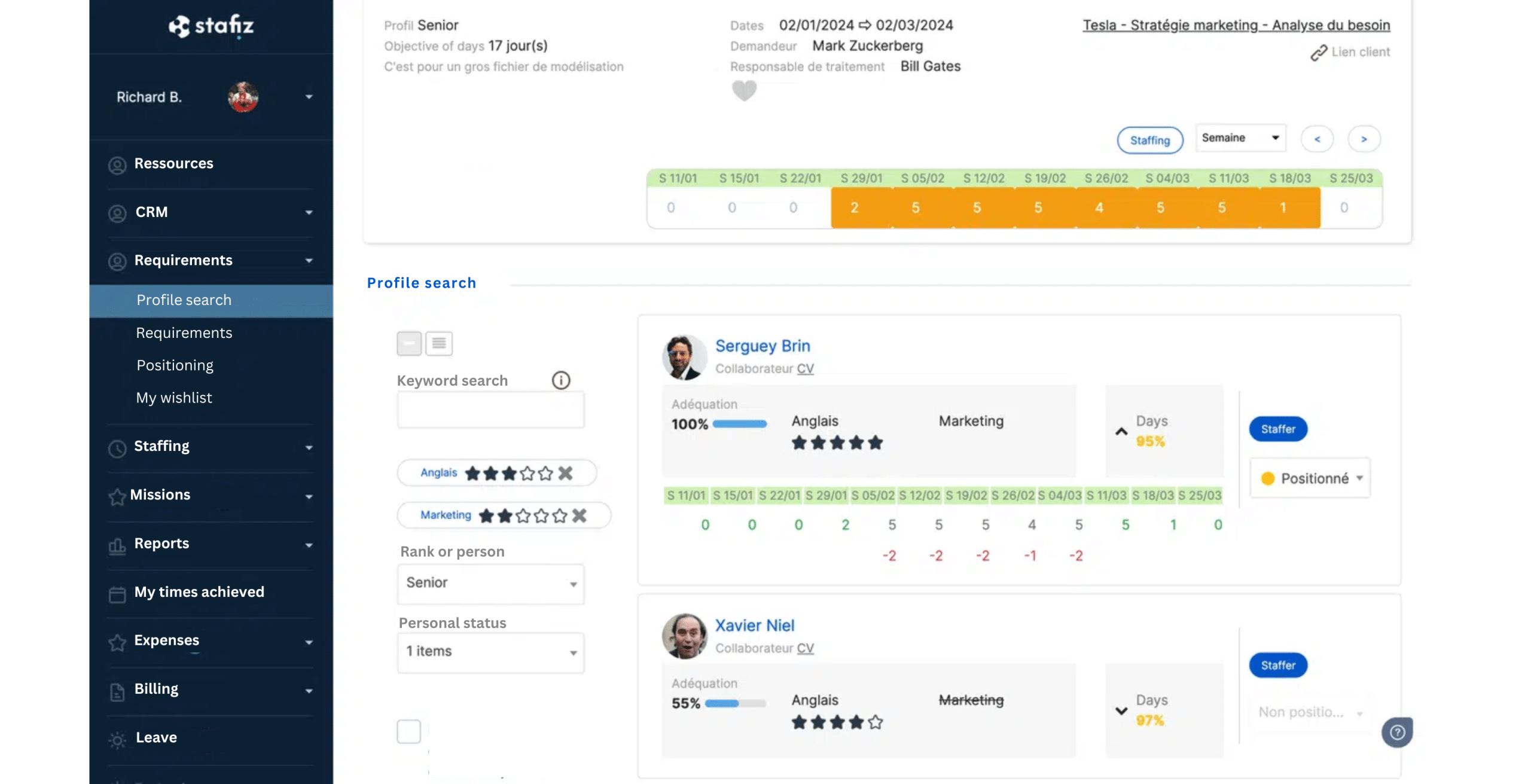
Here skills, availability, assignment history, suitability as needed, overload or underload visible at a glance: the manager no longer has to arbitrate "by feeling". He immediately visualizes the relevance of the profiles and can decide without the risk of overbooking.
Stafiz's AI displays for each employee:
- the rate of adequacy with the need;
- actual week-by-week availability;
- the associated key competences;
- the number of days still available for staffing;
- overload (in red) or availability (in green) alerts.
This level of accuracy allows for a resource planning Truly forward-looking, aligned with your sales pipeline and operational constraints. In concrete terms, you reduce assignment errors, avoid resource conflicts and anticipate recruitment needs much earlier.
Unified reporting for management
To arbitrate effectively, management needs a double vision.
- Micro level : status, budget, deadlines project by project.
- Macro level : total capacity, cash flow, overall profitability, BU or customer performance.
Unified reporting consolidates project, HR, and financial data into a single dashboard. This makes it possible to:
- identify projects in tension,
- evaluate the performance of the teams,
- make strategic decisions based on reliable data,
- to anticipate risks instead of being subjected to them.
Project prioritization then becomes a streamlined, consistent and strategy-aligned process.
What are the best practices for multi-project management?
Robust multi-project management is based on three axes: clear governance, consistent monitoring methods and a high level of automation. Without this triptych, decisions are based on partial data, decisions are made on the basis of feeling and the margin deteriorates without anyone seeing the landing approaching.
Structuring governance
One of the best practices for multi-project management is the structuring of project governance. This determines who decides, on what criteria and at what pace, in order to avoid improvised arbitrations and tensions between project managers. It defines roles (management, PMO, project managers, finance) and frames priority rules at the portfolio level, rather than at the level of each individual project.
In concrete terms, there are three building blocks that change the game for your teams:
- understand the role of the PMO in multi-project management: have a PMO or portfolio referent that consolidates load, risk and margin at the multi-project scale;
- set up recurring rituals (workload reviews, prioritization committees, portfolio COPIL) with an agenda focused on deviations from the forecast;
- Establish explicit decision-making criteria to promote collaboration and transparency (margin at completion, customer engagement, strategic impact, criticality of the skills mobilized, etc.).
Companies that do this get fewer resource conflicts, faster decisions, and a unified customer narrative.
Depending on the maturity of your IT Services or your consulting firm, a PMO can take many forms. There are generally three levels :
- PMO Support : it supports teams by providing methods, templates, tools and best practices. Its role is above all pedagogical and facilitative;
- PMO Control : ensures that projects meet defined standards. It makes reporting more reliable, monitors key indicators and ensures data consistency across the portfolio;
- PMO Directive: it is directly involved in the management of strategic projects. It arbitrates priorities, steers critical initiatives and participates in resource reallocation decisions.
Standardize monitoring methods
Without common processes for planning, time tracking, and invoicing, each project produces its own numbers, with its own definitions, making the portfolio unmanageable. Standardization establishes a common language and significantly reduces the gaps in interpretation between management, PMOs and project managers. When it is well defined, it also clarifies the challenges of time tracking, by guaranteeing homogeneous and usable data to analyze the load, compare projects and make decisions more reliable.
We recommend that you install a minimal base, which is the same for all projects:
- the same planning rules (units, phases, milestones, deliverables);
- the same multi-project resource planning tool and the same granularity for time entry, with systematic validation;
- The same financial indicators: margin to date, margin to completion, remainder to be made, production value, deviation from budget to realized.
Once these standards are in place, consolidated reporting becomes usable, and management can objectively compare projects, BUs or customers.
Rely on automation
Managing dozens of projects with Excel exports and manual reconciliations leads to inconsistent numbers and overdue reporting. Automation takes this repetitive work away to focus your teams on analysis and trade-offs.
Three projects have an immediate effect:
- Connect CRM, project management, HR management, and invoicing in a single environment to avoid duplicate entry.
- automatically generate key metrics (billable utilization rate, margin at completion, recognized revenue) based on time, schedules and budgets;
- industrialize landing scenarios: each modification of resource planning or budget instantly recalculates the projected margins.
Companies that automate this circuit see a clear change:
Reports produced in minutes rather than hours, a reliable landing forecast from the middle of the month, and budget discrepancies detected before they degrade margins. To structure this level of management without multiplying the tools or burdening the teams, we have gathered the most effective methods in an operational guide.
What tools or methods are used to manage multiple projects?
Managing several projects requires a multi-project management software capable of unifying planning, workload, profitability and resource planning in a single interface. Generalist solutions often do not manage this complexity well (fragmented data, limited visibility). A solution designed for service companies simplifies arbitration, makes decisions more reliable and accelerates the budget landing.
Many teams still use a generalist tool that tracks tasks, but not workload, margin, or interdependencies between projects. This observation is frequently heard by our prospects: the tool works for an isolated project, rarely for ten projects executed in parallel with the same teams.
The best multi-project management software covers individual work organization, task-scale operational monitoring, resource allocation, and overall project management structuring.
Stafiz has been designed to respond precisely to this operational complexity: consolidated visibility, forecasting data, automation of arbitrages, advanced management of resource planning.
Different areas of visualization to manage the portfolio
A multi-project platform must offer several angles of interpretation (per charge, resource planning, profitability or type of mission). These views are essential for identifying risks, isolating projects under pressure, and guiding trade-offs at the team or management level.
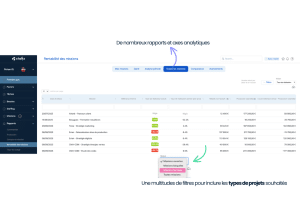
You will find these elements in Stafiz:
- a cost-effectiveness view of assignments with filters by project type or status;
- comparative indicators to analyse margin, utilization rate, advancement;
- Consolidated reports that can be filtered at will.
These views give each role (project manager, manager, director) the ability to analyze the activity from the angle useful for its decision-making.
Management of multiple assignments (without planning errors)
Managing multiple projects at the same time requires allocating resources quickly and reliably. An effective solution should make it possible to modify a need, assign a person or transfer a volume of days in a few clicks, while automatically updating the remaining load.
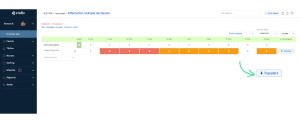
Multiple assignment view to arbitrate the distribution of days at a glance. Each colored box represents the expected charge per person.
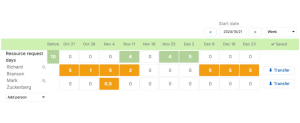
Weekly distribution of days of need over a given period. This view highlights availability and areas of tension and facilitates decision-making when multiple projects are competing for the same resources.
You will find three features in Stafiz that streamline the allocation of resources and limit errors, even on very busy portfolios.
- Changing the days of need : by changing the days to green, you change the days of need. It is possible to move through time with the arrows and the date at the top right.
- Manual allocation : by assigning days to a person, they are automatically subtracted from the need. In the example of the screenshot, if I assign 4 days to Richard the week of November 25, they will disappear from the need line.
- Mass assignment : you can move the daily requirement (those displayed over the period) to a particular person thanks to the "Transfer" button on the right. If you want to assign the days to two different people, start by manually assigning to the person who will receive the fewest days of need, and end up en masse by transferring all the remaining time at once to the user who will get the most days
Centralization of activities to secure planning
The centralization of data (planning, resource planning, sales pipeline, absences) eliminates double allocations and gives a reliable view of future availability. A multi-project platform must rely on this unique information to project the load and avoid schedule drift.
In Stafiz, employee schedules are synchronized and availability takes into account the pre-resource planning and business opportunities. As a result, a person already engaged in a mission cannot be overstaffed.
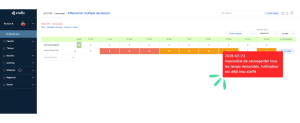
The centralization of data feeds into real-time multi-project management, putting an end to frozen schedules that are quickly exceeded.
Reports and dashboards, updated in real time and in forecasting, support continuous trade-offs. They provide the visibility needed to review priorities as soon as a gap appears and move away from a fixed schedule that no longer follows the pace of projects.
Managing several projects requires a platform capable of unifying load, resource planning, planning and profitability in the same management logic. Organizations that rely on centralized data, reliable forecast views and error-free allocation mechanisms gain fluidity and greatly reduce landing drift. A solution designed for multi-projects transforms this daily complexity into a structured decision-making system: each manager acts on up-to-date information, arbitrations become faster and the portfolio remains aligned with the teams' real capabilities.
To go further, it is useful to assess the maturity of your current tools and to establish a comparison of multi-project management tools to compare their ability to support forecast, point-by-point management, with a dedicated solution such as Stafiz.
Frequently asked questions:
The key is to centralize planning and share a common view of loads and availability. This allows each project manager to visualize the actual capabilities of the teams. The prioritization of projects, validated by a PMO or an arbitration committee, limits overlaps, while regular monitoring of the achievements makes it possible to adjust schedules and maintain balance.
Effective multi-project governance is based on clearly defined roles (management, PMO, project managers) and regular rituals: prioritization committees, workload reviews and consolidated progress points. This organization ensures consistency in decisions, alignment of teams, and control of portfolio-wide priorities.
Alignment involves a rigorous selection of projects based on their strategic value, profitability and contribution to the company's objectives. By linking operational monitoring (progress, margins, workload) to consolidated strategic indicators, management can arbitrate and reallocate resources to higher-impact initiatives.