Updated May 22, 2026
The billable utilization rate (Activity Rate Excluding Leave) measures the share of a consultant's billable days in relation to his or her days worked, excluding leave. The formula: billable days÷ (days worked - foreseeable absences) × 100. It is the central indicator of profitability for consulting firms and IT Services, to be piloted in addition to the ADR and the inter-contract rate.
What is Billable Utilization Rate?
Definition and Formula
The billable utilization rate means Activity Rate excluding leave. Its common synonym is Rate of resource planning.
It is a human resources management indicator that measures the rate of activity spent on billable activities on the basis of total availability (excluding periods of leave, sick leave, etc.).
The billable utilization rate is generally expressed as a percentage, and is calculated by dividing the number of hours worked on billable activities by the number of theoretical hours available after deduction of time off.
📐 The formula of the billable utilization rate
billable utilization rate = billable days ÷ (days worked − foreseeable absences) × 100

What is a potential day?
A potential day corresponds to a theoretical day of work in the period observed (generally a working day), before any deduction of foreseeable absence. It is the maximum basis on which a consultant could be charged.
What is a day produced?
A product day is a day devoted to a billable activity (client mission, project on a contract or on a fixed-price basis). Only the days produced are included in the numerator of the billable utilization rate, which distinguishes it from a simple occupancy rate.
What is a foreseeable absence?
A foreseeable absence includes paid leave, RTT, planned training, internal seminars and any early unavailability. It is deduced from the denominator so that the billable utilization rate reflects actual productivity over the actual time available.
The billable utilization rate is used by companies, and more particularly by consulting firms and IT Services to evaluate the performance and profitability of employees or teams. It allows you to make decisions about resource management.
What is the difference between billable utilization rate, resource planning and utilization rate ?
In consulting firms and IT Services, these three terms are often used interchangeably. In reality, two designate the same indicator, the third measures another.
| Indicator | Calculation | What it is used for |
|---|---|---|
| billable utilization rate Activity rate excluding holidays |
Days Produced / (Potential Days − Expected Absences) | Measure a consultant's actual productivity by neutralizing time off. Corrected vision, fine, to manage on a monthly basis and feed the margin forecast. |
| Rate of resource planning | Same as billable utilization rate | Same calculation, another name. More meaningful in executive committees and for finance departments that do not handle the business acronym on a daily basis. |
| Utilization rate | Days Produced / Potential Days (without deducting leave) | A raw vision that integrates the effect of absences. Useful for an annual benchmark or macro reporting, less precise for operational management. |
In concrete terms, over the same period, the billable utilization rate is mechanically superior to the utilization rate since it deducts leave from the denominator. A consultant with 80% of billable utilization rate can show 70% of utilization rate — the difference corresponds to foreseeable holidays and sick leave. For an engagement director or BU manager who wants to know if their team is actually productive on the days when it is supposed to be, the billable utilization rate gives useful reading.
In operational language, billable utilization rate and Rate of resource planning refer to the same indicator. The first is the technical acronym used in business management tools (ERP, PSA, software and resource planning) and by the management controllers. The second is the term used in strategic presentations, executive committees and commercial materials. The utilization rate, on the other hand, remains a distinct indicator that is best not confused with the other two to avoid biased arbitrage in margin management.
What's the difference between billable utilization rate and utilization rate?
Unlike the billable utilization rate, the TACI, or Activity Rate Leave Included, takes absences into account.
The formula for calculating the CIAT is as follows:

While the utilization rate can vary greatly from one month to another due to holidays, it allows a reading that is closer to invoicing.
For companies that work in a time-based approach (invoicing by time spent), following this indicator helps better understanding a given project's results.
However, this indicator is less widely used in practice than the utilization rate.
billable utilization rate, TACI, occupancy rate, availability rate: what is the difference?
Four indicators of consultant management are often confused even though they measure distinct realities. This table summarizes their definition, formula and use.
| Indicator | What it measures | Formula | When to use it |
|---|---|---|---|
| billable utilization rate | Share of billable days, excluding holidays | Billable days / (days worked − foreseeable absences) | Profitability management consulting firm and IT Services |
| TACI | Share of billable days, including holidays | Billable days / calendar days | Time management and billing |
| Occupancy rate | Share of time spent on an activity (billable or not) | Hours worked / hours available | HR workload monitoring, with no direct link to turnover |
| Availability rate | Share of time unplanned and ready to be staffed | Unallocated hours / theoretical hours | Capacity planning and commercial anticipation |
Why Choose to Track Billable Utilization Rather Than all Activity?
This approach to the billable utilization rate that measures billable activity is particularly important in IT Services, consulting firms or agencies. These companies pay their employees' salaries every month, which represent fixed costs.
For the activity to be profitable, it is necessary that each employee spends a certain percentage of his or her time on an activity that is billable, i.e. generates turnover, otherwise the profitability of the activity will not be there.
It is therefore a standard and major indicator for all companies that sell the work of consultants or projects to clients: consulting firms, IT Services, agencies, design offices, architectural firms, chartered accountants' firms, etc.
Why is Billable Utilization Rate so Important in Project Management?
The billable utilization rate, as a project performance indicator, has several advantages.
The benefits of billable utilization rate
- Enhancing real productivity
The billable utilization rate Measures an employee's activity by taking into account periods not worked. This provides more reliability on the actual activity and allows you to be a better indicator to compare the results.
For example, an indicator that only looks at the number of days produced during a period will penalise the employee who has taken leave during the period in question.
The representation of production by the utilization rate is therefore more objective.
- A sign of an unequal distribution of labour
The billable utilization rate also makes it possible to identify employees who are overloaded and those who are underloaded. In either case, an unequal load penalizes productivity.
Overloading can lead to a decrease in the quality of work and employee well-being. As for underloading, it can lead to a drop in the profitability of the activity and dissatisfaction of the employee, who risks losing interest in his or her missions.
- A benchmark indicator
The rate of resource planning allows performance to be measured over time, since each period is comparable. It then makes it possible to monitor and analyze individual or team productivity according to the types of projects or periods.
It is a valuable source of data for planning future projects or improving operational efficiency.
Utilization Rate: What Limits?
However, billable utilization rate as a performance indicator also has its limitations.
- The complexity of monitoring
Without the help of a tool that calculates the billable utilization rate automatically, it's not always possible to differentiate between sales-generating and non-sales-generating activities.
For example, employees may spend time explaining or training other employees, or they may be active in sales activities. We need to be able to measure the time spent on this type of activity, which nevertheless serves the company but should not penalize the billable utilization rate.
Only one Time and time management tool resource planning adapted will allow these calculations to be made automatically.
- An indicator that is not enough on its own
The billable utilization rate does not measure the quality of work or the contribution of employees to the achievement of the company's objectives. Performance must be analysed with other indicators that complement the billable utilization rate.
Certain external events, beyond the control of employees, can disrupt the billable utilization rate results. These external factors are not necessarily taken into account when readjusting the results, and penalize the reading of employee performance.
- An indicator not well suited to fixed-price sales
In the context of a project sold at a fixed price regardless of the work carried out, the billable utilization rate lacks relevance.
If an employee spends 100% of their time on a client project but makes little progress on completing their tasks, they will have a billable utilization rate high, even if the project is likely to be delayed. This is a situation that the billable utilization rate is not able to read.
- A potentially burdensome performance race
The billable utilization rate can push employees to work harder to meet targets, even though they are overloaded.
This not only risks producing low-quality work, but also, in the worst case, putting their health or well-being at risk.
What factors can affect the staff activity rate?
There are many reasons why utilization rate do not meet the objectives.
- Inefficient processes: If employees waste time on non-productive topics, such as administration, work reporting, or project travel, their output will be affected and their output will be impacted. billable utilization rate will be lower than expected;
- insufficient capacity: if the workforce is underloaded, production will also be lower than the total theoretical capacity available. The billable utilization rate will probably not live up to the objectives;
- Poor time management: If employees mismanage their time and spend too much time on non-billable tasks, the billable utilization rate will be impacted.
What is the average billable utilization rate in a consulting firm?
The standard staff activity rate vary greatly depending on the industry and the profession carried out. It is therefore relevant to calculate the staff activity rate for each employee, but also to be able to consolidate them by type of profile or by type of activity.
The billable utilization rate of a full-time consultant working for one customer for one year will thus be much higher than that of a manager in charge of several projects.
The latter will spend time managing teams, perhaps selling other projects to the customer. His billable utilization rate target should therefore be lower, so as not to penalize him.
On average, successful consulting firms have billable utilization rate in the order of 70 to 75%. However, this figure varies, and the most junior profiles show billable utilization rate close to 75 to 85%, while the most senior profiles are around 60 to 65%.
How do you interpret the billable utilization rate in the workplace?
The billable utilization rate results need to be read from different angles.
- Comparison of actual billable utilization rate with targets
To set a course, it is important to define an annual or monthly billable utilization rate target when the business cycle has a significant impact on this indicator.
We then need to monitor the deviation of actual billable utilization rate from target, and understand the reason for these deviations in order to improve future production.
- Comparing the billable utilization rate of one team to another
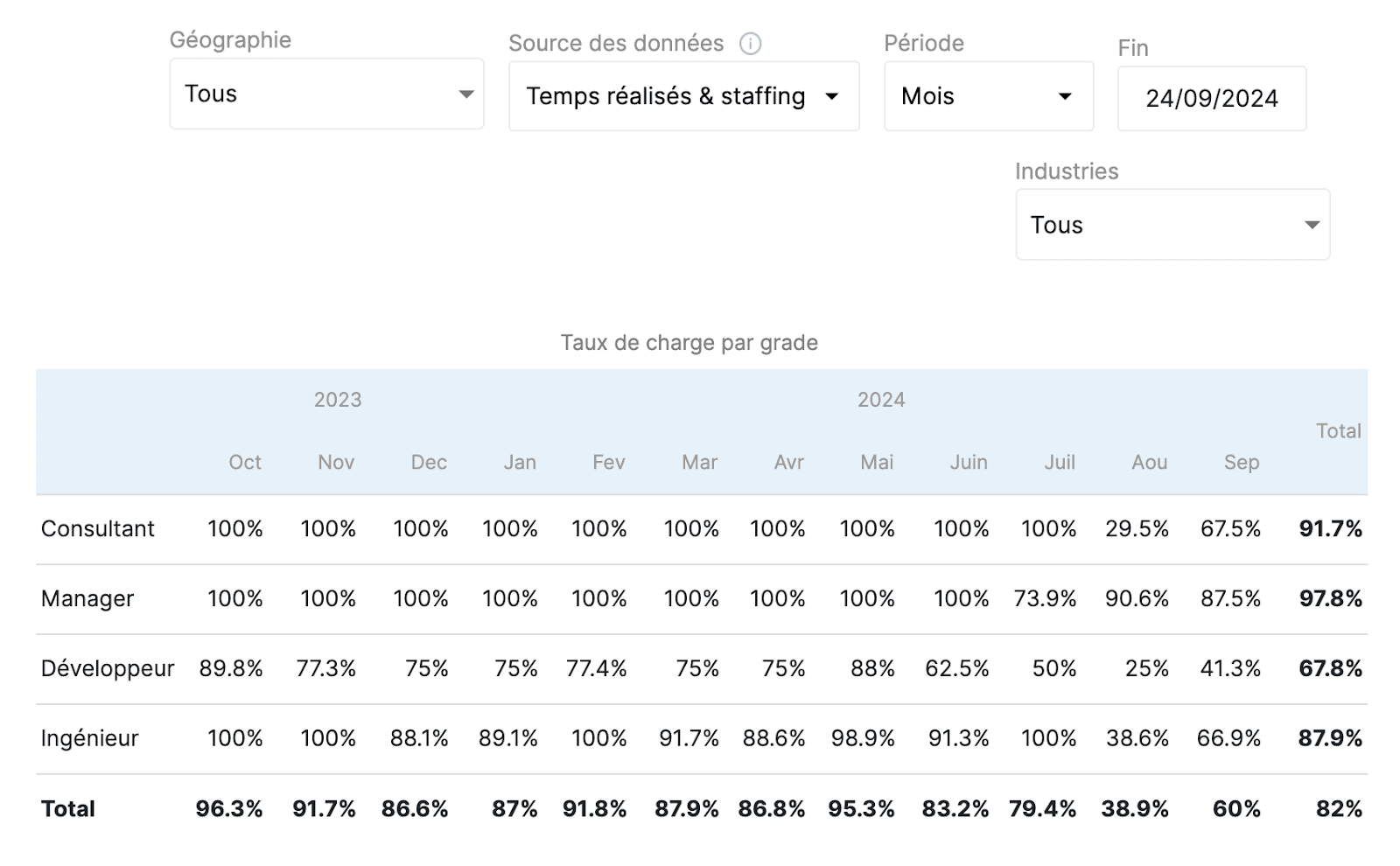
It's interesting to take the billable utilization rate analysis a step further by grouping utilization rate by profile type, or by team type.
This makes it possible to benchmark the performance of a group and to set objectives at the level of a team manager.
- Follow the utilization rate forecast
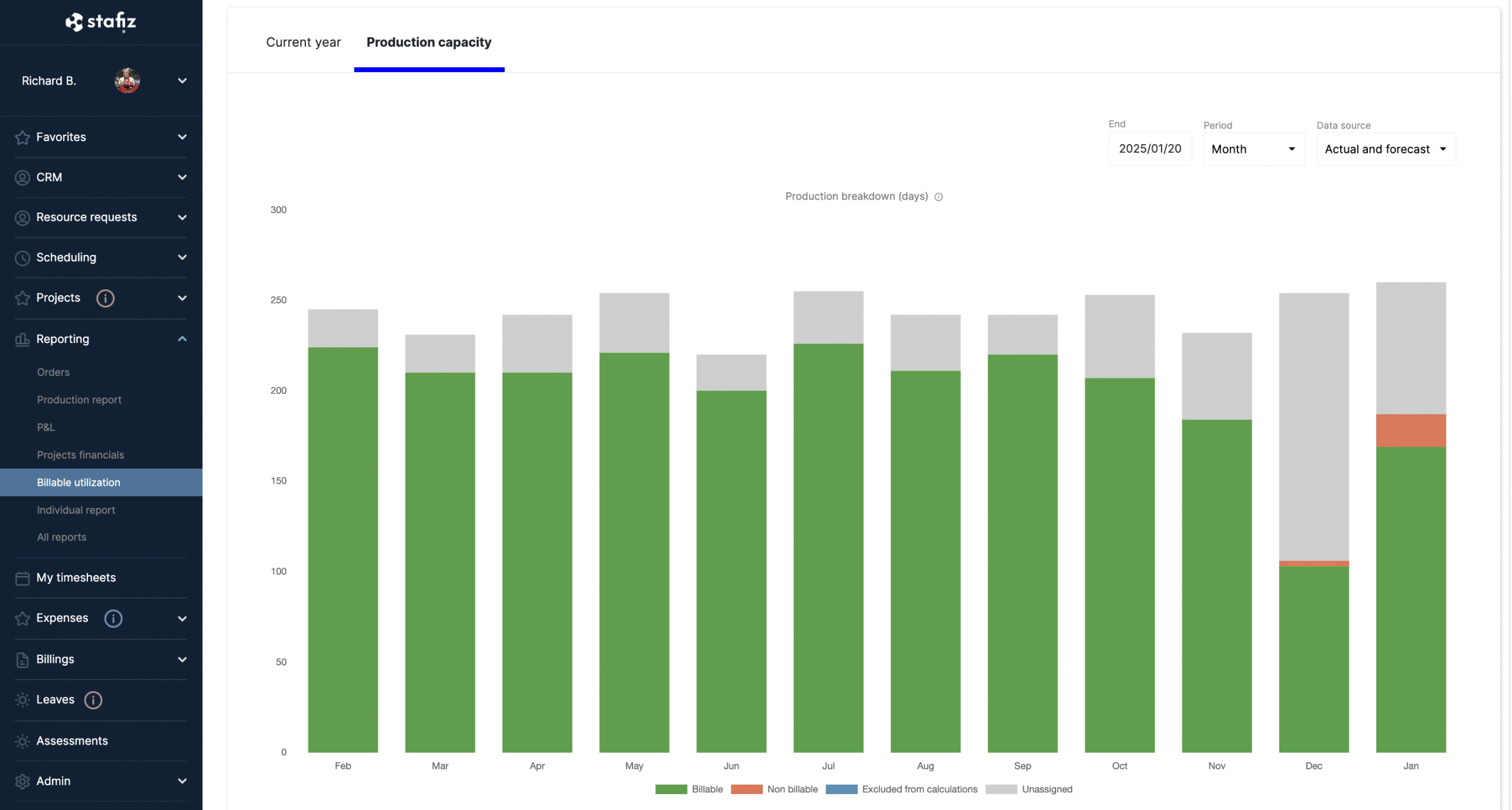
This exercise makes it possible to anticipate variances in order to adjust the planning to achieve the objective.
When monitoring allows it, the billable utilization rate is not just an indicator looked at in the past. It can also be used to take the temperature of the load forecast for the coming months.
How can the billable utilization rate be improved in a service company?
The key toimproving the billable utilization rate lies in better mastery of the resource planning (or capacity planning) management process.
The more accurate the visibility into the forecast load , the more managers will have the ability to optimize production and improve utilization rates.
The importance of communicating around the staff activity rate
Once the billable utilization rate calculations have been put in place, the work doesn't stop with monitoring by management or management control. We need to make the billable utilization rate a performance indicator that is understood and monitored by all our employees, so that they can appreciate what's at stake.
You can train them to explain why and how to track this indicator.
It is important to be educational to make it clear that it is not a question of monitoring the employee but of improving the overall performance of the activity.
It is then necessary to make the follow-up available for each of the employees, and each of the managers who have an objective of billable utilization rate. They should be able to read the billable utilization rate up-to-date, in real time, based on the activity that has been confirmed.
The more reliable and transparent the calculation, the more employees will monitor this indicator and contribute to its improvement.
Using the right tools to monitor the billable utilization rate
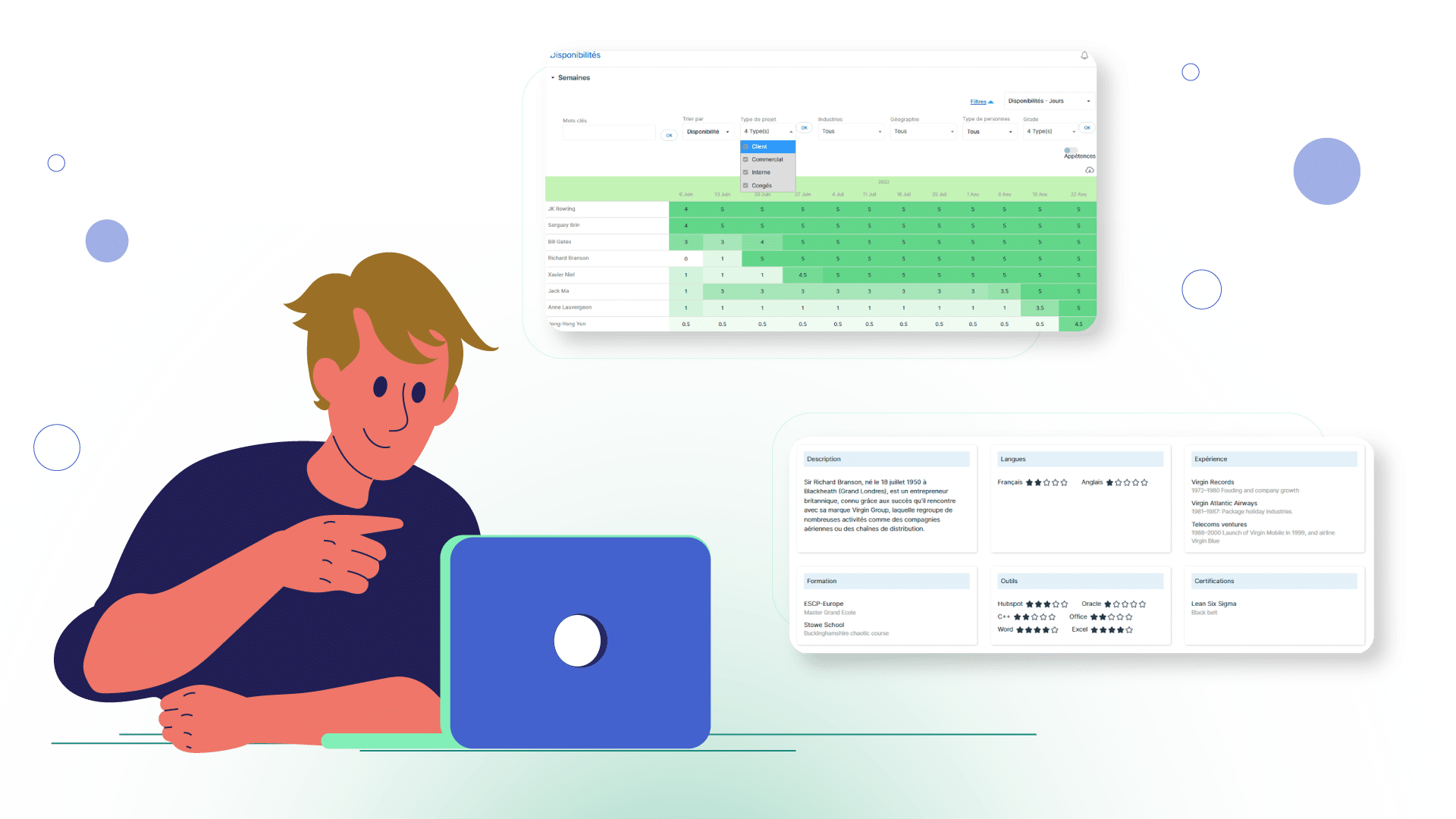
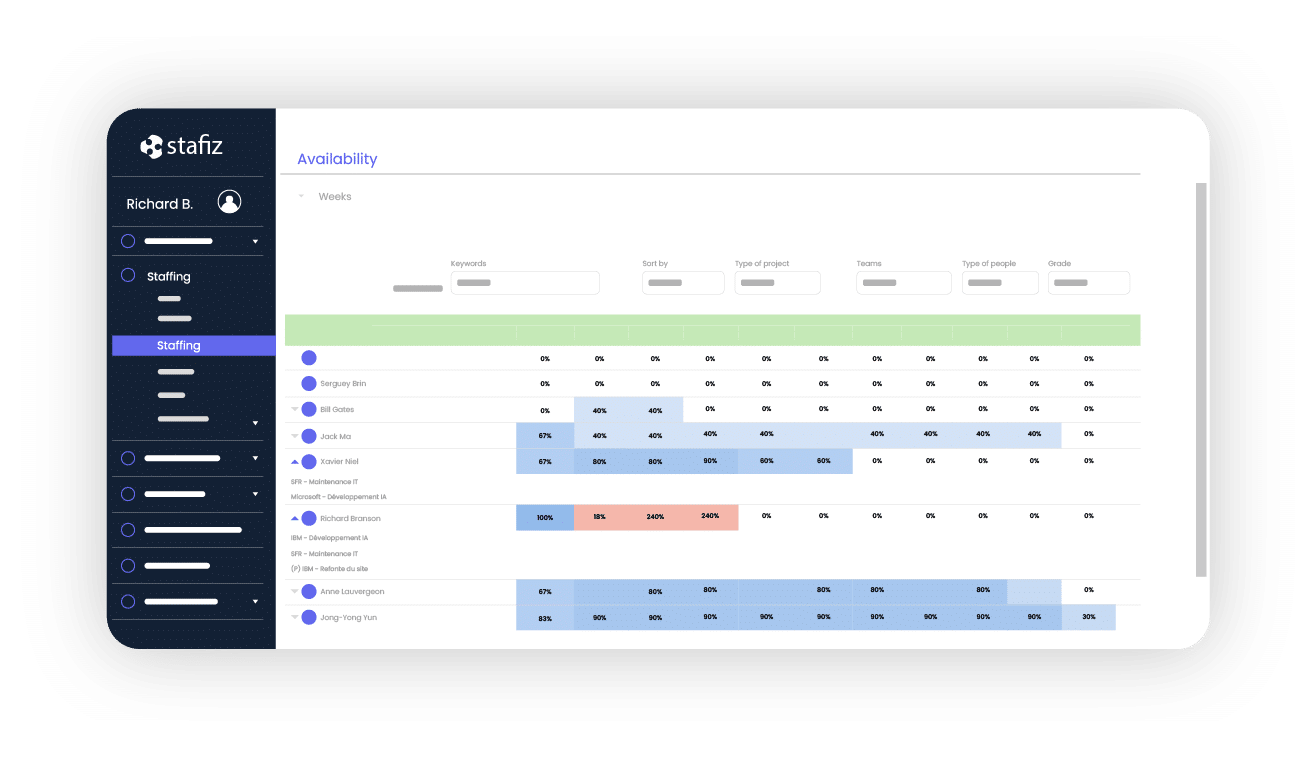
Using a resource planning tool such as Stafiz to manage forecasted workloads, reduce inter-contracting and gain visibility over forecasted schedules is essential. This is by far the easiest way to improve a company's billable utilization rate.
Stafiz allows you to track the billable utilization rate of past projects, in real time, and to gain visibility on the forecast. It is therefore easier to identify opportunities that correspond to the different profiles to avoid inter-contracting.
Finally, it provides the visibility needed to adjust recruitment policies, and always optimize capacity in relation to demand. Better anticipating overload and underload implies clearer recruitment policies, at the right time.
Discover Stafiz, the resource planning complete and forward-looking for your teams. Gain in performance while satisfying your employees thanks to optimal management.
Project resource planning software
Simplifying processes
Work to simplify processes for employees who work on billable projects.
The organization must be overhauled to reduce the time spent on non-billable tasks as much as possible and allow employees to focus their work on billable activities.
For IT Services : reduce the inter-contract period
By working to systematically reduce the inter-contract, it is possible to improve the billable utilization rate.
To do this, we need to have more visibility on the risk of inter-contract and the options for relocating employees.
To do this, set up smart alerts that warn you when an employee is about to go on an inter-contract to try to place them on another billable project.
Ideally, your resource planning tool gives you the visibility you need into upcoming availability and which projects are close to being won. This helps you to find out more easily which opportunities correspond to employees on inter-contract to reposition them.
Frequently asked questions:
billable utilization rate is the acronym for Activity Rate Leave Excluded. It refers to a performance indicator used mainly in consulting firms, IT Services and agencies to measure the billable productivity of consultants, excluding foreseeable leave and absences from the calculation.
Yes. billable utilization rate and Rate of resource planning refer to the same indicator: the share of a consultant's time devoted to billable activities, excluding holidays and foreseeable absences. The first is the technical acronym for activity management tools, the second the term used in executive committees and in commercial media. The utilization rate, on the other hand, is a separate indicator that does not exclude leave from the denominator.
The TACI (Activity Rate Including Leave) keeps leave in its denominator. It reflects the gross expense over a full schedule and is closer to the accounting reading of invoicing. Companies with a direct management (invoicing based on time spent) prefer it to compare the turnover achieved with the total time available, including holidays.
In IT Services, billable utilization rate target is generally higher than in a consulting firm, because the long-term management concentrates the activity on a small number of clients. The challenge is not to increase it indefinitely, but to reduce the inter-contract periods, which weigh directly on the indicator and on profitability.
The billable utilization rate is one of the two major levers of profitability for a service company, along with the ADR. A point of billable utilization rate more or less, multiplied by the number of consultants and their ADR, represents several tens of thousands of euros in annual margin for a firm of 50 people. This is why it always reads in correlation with the ADR to manage the margin.
A billable utilization rate (below 60% in consulting firms) often indicates an under-burden linked to an insufficient sales pipeline, an imbalance of resource planning or an over-capacity to recruit. A billable utilization rate Too high (above 95%) may seem positive, but it generally reflects an overload that weighs on the quality of work, the well-being of consultants and the time left for internal activities (pre-sales, training, R&D).
Excel remains playable with up to about 20 consultants and for a posteriori follow-up (monthly, quarterly). Beyond that, three limits are blocking: the reliability of the data (multiple manual re-entries), the lack of forecasting (Excel shows the past, not the load projections) and the impossibility of cross-referencing billable utilization rate × ADR × inter-contract in real time. Consulting firms and IT Services that exceed this threshold usually switch to a dedicated tool.
A resource planning and time tracking system capable of consolidating data by project, team and grade. A PSA software like Stafiz automatically calculates the billable utilization rate in real time, compares it to a goal, triggers alerts in the event of a deviation and crosses it with the ADR to read the margin. It avoids Excel reprocessing and makes data more reliable for all levels (consultant, manager, management).