
In IT Services And in a consulting firm, the mission order is the document that covers the consultant sent to the client: it conditions his or her coverage in the event of an accident, justifies his or her travel expenses and protects the margin of the mission.
Let's take a consultant who starts a six-month mission with a client in Lyon on Monday. The order form is signed, the mission is sold, the file seems to be complete. The only downside: no one has drawn up the mission order.
As long as nothing happens, forgetting remains invisible. But if this consultant has a car accident on his way, or when he has to charge expenses related to the project, or on the day of an URSSAF audit, it is impossible to link his trip to any mission.
This type of oversight can often occur in the context of a IT Services (digital services company), or a consulting firm, where the consultants go on assignment to the client. Ideally, a mission order should be planned before each departure, because in these companies that sell services, the mission order (OdM) is much more than just proof for expense reports. It is above all a document that covers the consultant in the event of an accident, determines liability in the event of an incident (client, employer, consultant), and conditions the re-invoicing of expenses, and therefore an item that can affect the margin of a project.
Multiplied to a project portfolio, the absence of a mission order poses a real financial and legal risk for the IT Services and consulting firms. But what does the Syntec agreement really require on this subject? And what is the difference between a mission order, an engagement letter and a contract?
What is a mission order in IT Services, and what is its legal value?
The mission order is the written document by which an employer authorises and supervises the travel of a consultant to a client. Its legal value lies in two effects:
- It covers the consultant in the event of an accident
- and he attaches the mission to the company.
What is a mission order in a service company?
A mission order authorizes a consultant to travel outside his or her usual place of work, most often to a client, and it is signed before departure. He names the mission, the client, the dates, the place and the expenses covered.
Where a "classic" employee travels punctually, in a contract in a direct management mode, the consultant in IT Services or in a consulting firm is sent on a mission to the client: this is his normal working situation. The mission order then becomes a recurring document, reissued with each new mission, each change of client, each extension of the contract.
Several contracts already govern this relationship between the consulting firm, the consultant and the client. The employment contract binds the consultant to his employer. The commercial contract (or purchase order) positions the consultant with the client. But neither of them covers the commuting accident, the justification of the expenses, nor can legally prove that such a specific trip falls within the mission ordered by the employer to this client. This is the function of the mission order in a service company.
What is the legal value of a mission order?
Assigning a consultant is tantamount to sending him or her to act officially on behalf of the company, on instructions. The mission order is the written proof of this mission. This proof engages the company's insurance and responsibility for what happens during the assignment, and not the employee personally.
It also distinguishes between the mission and a private activity, which eliminates the risk of concealed work.
According to Article L411-1 of the Social Security Code, an accident at work is defined as an accident, whatever the cause, an accident occurring as a result of or in the course of work to any person mentioned in Article L. 311-2, i.e. all persons employed or working for one or more employers, regardless of the amount and nature of their remuneration, the form, nature or validity of their contract or the nature of their status.
In our case, the proof needed here to attach the consultant to his employer is the mission order. Without this document, the trip can be reclassified as a private trip. In this case, the consultant loses coverage of his medical expenses and daily allowances and the company is exposed to legal proceedings.
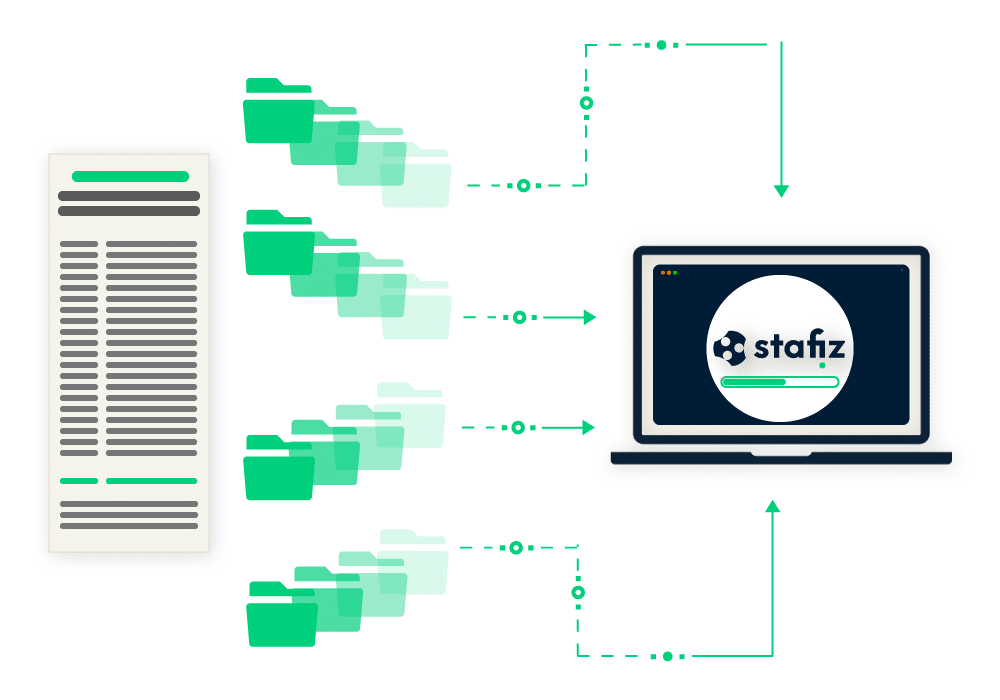
Rather than documents scattered in Excel and emails, Stafiz centralizes the documents of the mission cycle (contracts, fees and re-invoicing receipts) attached to each consultant and each client. The mission order remains established on the HR side, but is part of the same data flow instead of living in an isolated file.
What exactly does the Syntec collective agreement say about the mission order?
No article of the Labour Code explicitly imposes the mission order. The obligation comes from the collective agreement. For IT Services, IT services companies, service companies, consulting and engineering firms, it is the Syntec agreement that applies.
Since its revision (amendment no. 46 of July 16, 2021), the agreement specifies that "prior to departure, the employer must inform the employee of the conditions for the performance of his or her work by drawing up a mission order."
The agreement also provides for the possibility of a permanent mission order for an employee whose contract requires him or her to travel to several sites on the same day.
As far as the management of expenses is concerned, a trip requested by the employer must not cost the employee anything. Transport, accommodation and meals must be reimbursed, either on proof or via a fixed fee set before departure. These costs can then be re-invoiced to the end customer (according to the terms of the commercial contract), so that they do not eat into the margin.
These rules apply to metropolitan France. A mission outside metropolitan France falls under another part of the agreement, with its own terms and conditions; and a long mission abroad may require, in addition to the mission order, an amendment to the employment contract.
Is the mission order mandatory, and what is the risk of a IT Services without him?
Yes, the mission order is mandatory in IT Services under the Syntec agreement, for any trip, including in metropolitan France. The absence of a document exposes the company on three fronts: coverage for accidents at work, the margin and compliance in the event of an URSSAF audit.
A clear obligation, often neglected in practice
From a legal point of view, the travel order is made mandatory by the Syntec agreement. The employer who fails to do so is in breach of a contractual obligation.
In fact, manyIT Services deviate from it. In a small service company that manages HR files and the resource planning with Excel files, the consultant sometimes goes back on assignment before the new mission order is established. It is written after the fact, and sometimes never is. In the event of a dispute, the absence of a mission order may fall on the employer.
What are the risks of leaving without a mission order?
The absence of a mission order poses a legal and social risk. An accident on assignment or on the way, occurring without a mission order, can be reclassified as a private accident: the occupational accident cover is called into question and the employer's liability is engaged. If the insurer or the CPAM disputes the occupational nature of the accident, it is up to the company to prove it, or even to compensate the consultant. The burden does not remain theoretical, it falls on the employer.
The mission order conditions the reimbursement of expenses to the consultant (and to a lesser extent their re-invoicing). The expenses incurred by the consultant during the assignment (transport, accommodation, meals) are reimbursed by his employer, and the mission order certifies their professional nature. The same logic applies to an unexpected expense, an extra trip or a night in a hotel: without updating the mission order, he does not have the proof that makes it properly refundable, nor rebillable.
The re-invoicing of mission expenses to the client depends on the contract (time management, fixed price, fee clause), and this is where the margin is at stake: a re-invoicing but non-re-invoiced fee remains the responsibility of theIT Services, often without anyone seeing him before closing. A consultant three days a week at a client 300 km away combines train, hotel and meals; Over several months, these unrecovered amounts are counted in thousands of euros.
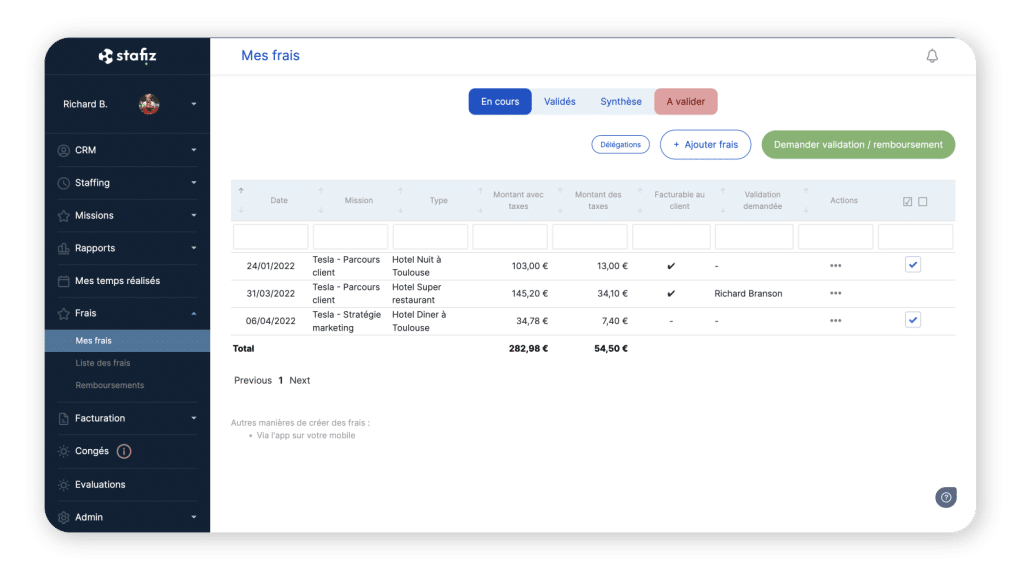
In Stafiz, each expense is linked to its mission and marked whether it is billable to the customer or not. This means that rebillable expenses are no longer lost in an expense report tool that is disconnected from invoicing.
The absence of a mission order can also cause problems during an URSSAF inspection. By default, for the URSSAF, any amount paid to an employee is a part of the salary, and is therefore subject to employee contributions. The reimbursement of professional expenses is the exception to the rule. These expenses are not subject to social security contributions because they are the reimbursement of an expense incurred for work, and not of income. But the employer still needs to be able to prove this, and therefore have a travel order associated with these costs. As such, the mission order is not just an HR formality, but an integral part of the expense compliance file assembled by the CFO of a IT Services or a consulting firm.
Can a consultant refuse a mission order?
In practice, performing the service at the client's site is equivalent to acceptance of the mission. When the travel falls within the scope of the contract (mobility clause, customer consultant function), an unjustified refusal can be considered as misconduct, and punishable by dismissal.
But if the mission order modifies an essential element of the contract, such as a very distant location or an unusual duration, the employee may be justified in refusing, and the assignment is renegotiated by an amendment. On the employer's side, the mission order remains the written record of the proposed framework: without it, the company has less evidence to justify its decision on the day of a dispute.
Mission order, mission letter, contract: do not confuse them
What is the difference between a mission order, a mission letter, a contract and a summons?
In IT Services, we juggle with these 4 documents for the same mission. Every document has a specific issuer and role, and forgetting one can have disastrous consequences. An assignment can start on a purchase order signed on the client's side while the consultant has not received any mission order: invoicing is launched, but his accident coverage and the reimbursement of his expenses remain pending. The opposite error also exists, a mission order issued without any commercial commitment in front of it, which covers the consultant without invoicing anything.
| Mission order | Employer → consultant | Authorizes and supervises the mission-trip to the client; covers expenses and accident (Syntec) |
| Engagement Letter | Service provider → customer | The service sold: object, deliverables, fees |
| Contract / Purchase Order | Client→ IT Services, or IT Services → subcontractor | The sales engagement that triggers invoicing |
| Convening | Employer → employee | A simple invitation, without authorization value or coverage |
What is the difference between an engagement letter and a mission order? The engagement letter is a commercial document: it does not offer any social or legal coverage. To frame what the service sold covers, see the project framework note.
One-off or permanent mission order: which one for a consultant on a long mission?
The one-off travel order covers a specific trip, whereas the standing travel order covers regular travel in a geographical area, and in practice, many employers limit it to one year. For a long-term consultant for the same client, permanent OdM avoids reissuing a document for each trip, and lightens the administrative burden on the company while maintaining continuous coverage.
Questions to ask yourself when choosing between a one-off or permanent mission order:
- Is it an isolated trip or a short-term mission?
- What is the contractual mode: management or fixed price?
- Should we anticipate a change of client, site or scope of mission?
Regarding the duration of a mission order, the Syntec agreement does not set any maximum limit.
Write and maintain a consultant mission order
What should a consultant mission order contain?
A template for a work order must consist of 7 parts:
| Identity of the consultant | Surname, first name, position, personal address of the consultant | Attaching coverage to the right person |
| Mission concerned | Subject and Conditions, Customer Identification | Prove the professional framework of the assignment |
| Dates and location | Start and end dates, performance location(s) with full address | Basis of accident coverage (where and when) and costs |
| Movement | Means of transport, accommodation, catering | Reimbursement framework |
| Fresh | Coverage modalities, actual or fixed price | Justifies the reimbursement to the consultant; support for re-invoicing when the contract provides for it |
| Mentions Syntec | Insurance taken out, benefits according to area and duration | Specificity of service companies |
| Signature | Signature of the employer and the employee | Materializes the authorization |
The mission order can be written by the consultant's line manager, the HR department or the manager resource planning, and then signed by the employer and the consultant prior to departure. It takes the form of a letter or a form containing the information. A simple e-mail is not a proof.
What to do when a consultant's mission is extended?
A mission that is prolonged calls for a new mission order, never a verbal extension or the tacit renewal of the old one. Without reissuance, the document no longer always sticks to reality, and the consultant will no longer be properly covered on the extension. In fact, the costs of this period may remain unjustified.
We recommend that you issue a new mission order whenever the site, travel area, or mission conditions change. If a 4-month mission is extended until December, it is better to issue a new OdM dated from the extension, and verify its compliance, rather than simply continuing with the first one.
How do you manage mission orders on a flow of dozens of consultants?
On a portfolio of several dozen active missions with different clients, Excel monitoring quickly reaches its limits: expired and non-renewed mission orders, geographical perimeters that no longer follow reality, double entry between the resource planning, HR and invoicing. The follow-up also applies at the end of the mission: when an assignment ends, the consultant enters into an intercontract, a period to be traced in order to reposition him and issue the next mission order.
At this level, the mission order is only one link in the mission cycle: positioning of the consultant, mission order, expenses, then invoicing. When these stages live in separate files, each one ignores the others and the mission order risks being uncorrelated with reality. Attach it to the resource planning amounts to triggering it as soon as the manager positions the consultant at the client's site: the positioning decision calls for the document, drawn up and dated in the process rather than re-entered after the fact.
At this size, the right tool depends on the profile of theIT Services, pure management, multiple sales models or multi-entity group: this is the subject of our guide to choose an ERP for IT Services.
YouMeo case study
In IT Services, the mission order is the first proof of the mission cycle: it is the one that opens the reimbursement and re-invoicing of expenses. When the → charge management cycle → invoicing is held by hand, expenses and work produced are no longer invoiced. This is exactly what YouMeo experienced.
YouMeo, an innovation consulting firm with about twenty employees, managed its missions in Excel (resources, expense reports, leave) and wrote its invoicing by hand. Due to a lack of visibility, part of the work produced and the costs were not invoiced. Administrative tasks piled up without guaranteeing a reliable result. This is the typical margin leak that a manual follow-up lets through.

❝
We realized that we sometimes didn't charge part of the work or fees because of a lack of visibility. With Stafiz, we finally have an accurate system, which avoids errors and provides all the visibility to direct our business. We save an infinite amount of time and gain peace of mind. Managing our projects has become so much simpler since we started using it. The software has allowed us to automate our project and performance management. It was a real game-changer!
Raphael Beziz
COO
With Stafiz, YouMeo has made it more reliable to track fees and billing, eliminated oversights due to lack of visibility, and improved profitability.
Frequently asked questions:
No. The mission order must take the form of a letter or form containing the mandatory information: identity of the consultant, mission, dates, places of execution, expenses covered and signature of the employer and the employee. A simple e-mail does not have this value: it is not valid as proof in the event of an accident at work or an URSSAF inspection.
Yes. In IT Services and in consulting firms, the obligation stems from the Syntec agreement (article 11.1) and applies to all business travel, including in metropolitan France. Long-term assignments outside metropolitan France are covered by a separate title of the agreement and may, in addition to the mission order, require an amendment to the employment contract.
No: Article 51 (Title VIII), which provided a framework for the mission order, has been repealed. Since amendment no. 46 of 16 July 2021, the obligation is included in Article 11.1 (Title 11) of the Syntec agreement, which requires the employer to draw up a mission order before any trip. The sources that still cite Article 51 refer to an outdated version of the text.
The mission order itself is not accounted for: it is a social document, not an accounting entry. It justifies the mission costs (transport, accommodation, meals) which are recorded as expenses and, if necessary, re-invoiced to the client. It is the piece that connects the trip to the expenses reimbursed to the consultant and rebilled to the client.
The Syntec agreement does not set a single notice period: it depends on the consultant's employment contract and the remoteness of the assignment. The best practice is to draw up the mission order sufficiently in advance of departure so that the consultant is aware of the conditions of the mission and validates them before leaving.
Any change in scope, site or dates is dealt with by a new mission order, never by a deletion or a verbal extension. In the event of cancellation of the mission, the written record is kept; Expenses already incurred by the consultant remain reimbursable as long as they have been reimbursed within the framework of the planned mission.
Yes, as long as you specify the geographical area it covers. The permanent mission order is provided for a consultant who is required to travel regularly, for example on a long-term contract with the same client. But as soon as a client or a site goes outside the defined geographical perimeter, a mission order must be reissued adapted to this new framework.
No, not directly. The mission order provides a framework for the relationship between an employer and its employee. For a subcontractor or a freelancer, it is a service contract that defines the mission, its conditions and the coverage of the costs. In the absence of a written framework, the relationship can be reclassified as an employment contract, or even expose the company to undeclared work.