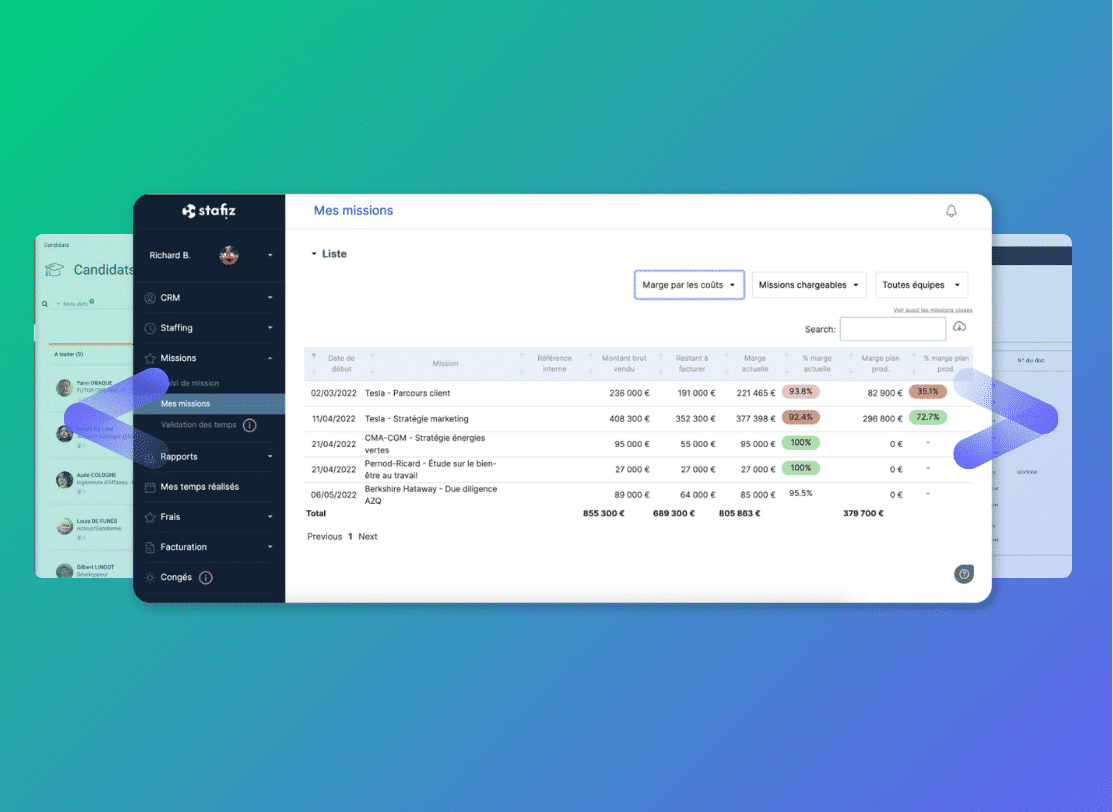
Chosing an ERP software for IT Services is rarely a simple tooling project. It is a structuring decision that conditions the visibility of your projects, the control of margins and the ability of your teams to manage the activity on a daily basis. Between generalist ERPs to be adapted, more or less complete business solutions and specialized tools to be assembled, it is becoming difficult to identify the best ERP for your IT Services.
The risk is well known: a poorly sized tool creates data silos, multiplies re-entries and hides the discrepancies between the forecasted and the actual situation. Budget overruns are detected too late, workload is poorly anticipated, bench time progresses and the margin at completion deteriorates. At the portfolio level, the lack of consolidated KPIs complicates trade-offs and slows down decision-making.
The purpose of this article is to allow you to compare best ERP software for IT Services according to concrete operational criteria. We analyze the strengths, limitations and use cases of each solution to help you make an informed choice, adapted to your size, your challenges and your organizational maturity.
🔎 What you need to remember
- Choosing an ERP for IT Services is a strategic decision: it conditions the visibility of projects, the control of margins, the anticipation of the workload and the ability to manage the activity at the level of the portfolio.
- Generalist ERPs are quickly showing their limits for IT Services : lack of native skills management, inability to manage multi-profile opportunities, low anticipation of shortages, difficulties in the resource planning, forecasting and complex billing models (time management, fixed price, TMA).
- An ERP IT Services covers the business cycle, from customer needs to margin management: profile-oriented CRM, integrated ATS, resource planning By skills, fluid time monitoring, multi-mode invoicing and permanent control forecast vs. achieved.
- The solutions on the market are distinguished by their scope.
- "Full cycle" ERP (e.g. Stafiz, BoondManager, VSActivity) to centralize all processes,
- Business management ERP for financial management,
- General ERP (Odoo, Unit4) requiring strong customization,
- ATS/CRM (Unatrix) bricks limited to the front office.
- Stafiz differentiates itself with a IT Services Native and Predictive Solutions: Advanced Pre-Sales Management Profiles, Deployment Scenarios resource planning multi-criteria, real-time management of profitability and complete continuity between operations, finance and strategic decisions.
Why Use A Specialized ERP For IT Services?
Unlike the manufacturing industry, which manages physical inventory, a IT Services manages an inventory of human skills and available time. This fundamental distinction requires tools designed to optimize the allocation of these resources. To meet these challenges, a specialized ERP IT Services must cover the entire operational cycle, from the identification of the customer need to the management of the margin, including the resource planning, fulfillment and invoicing.
Identify and monitor profile needs of an IT Services
Each business opportunity of an IT Services includes precise criteria that are used to source and select the most profitable and available profile:
- the technical skills required;
- the level of seniority expected for the consultant;
- the minimum years of experience of the profile;
- the estimated duration of the project;
- the target cost / expected budget on the client side (ADR ceiling, maximum budget);
- geographical location.
To match the business processes of a service company, these fields must be natively present in the ERP. However, generalist CRMs, Salesforce or HubSpot do not allow you to manage this granularity.
Anticipate skills shortages or market trends
Without visibility on available skills and actual availability, theIT Services Navigates blindly. Generalist ERPs are generally limited to a static view of their available consultants, without the ability to cross-reference this data with business demand, which poses the risk of depending on a limited number of resources on in-demand skills.
Some solutions such as Stafiz allow you toanalyze your needs by skill and by period, in order to identify future tensions and to objectify recruitment or recruitment decisions. resource planning by data. These analyses directly condition key indicators for a IT Services, such as the billable utilization rate, ADR the inter-contract rate or the ability to anticipate recruitment needs.
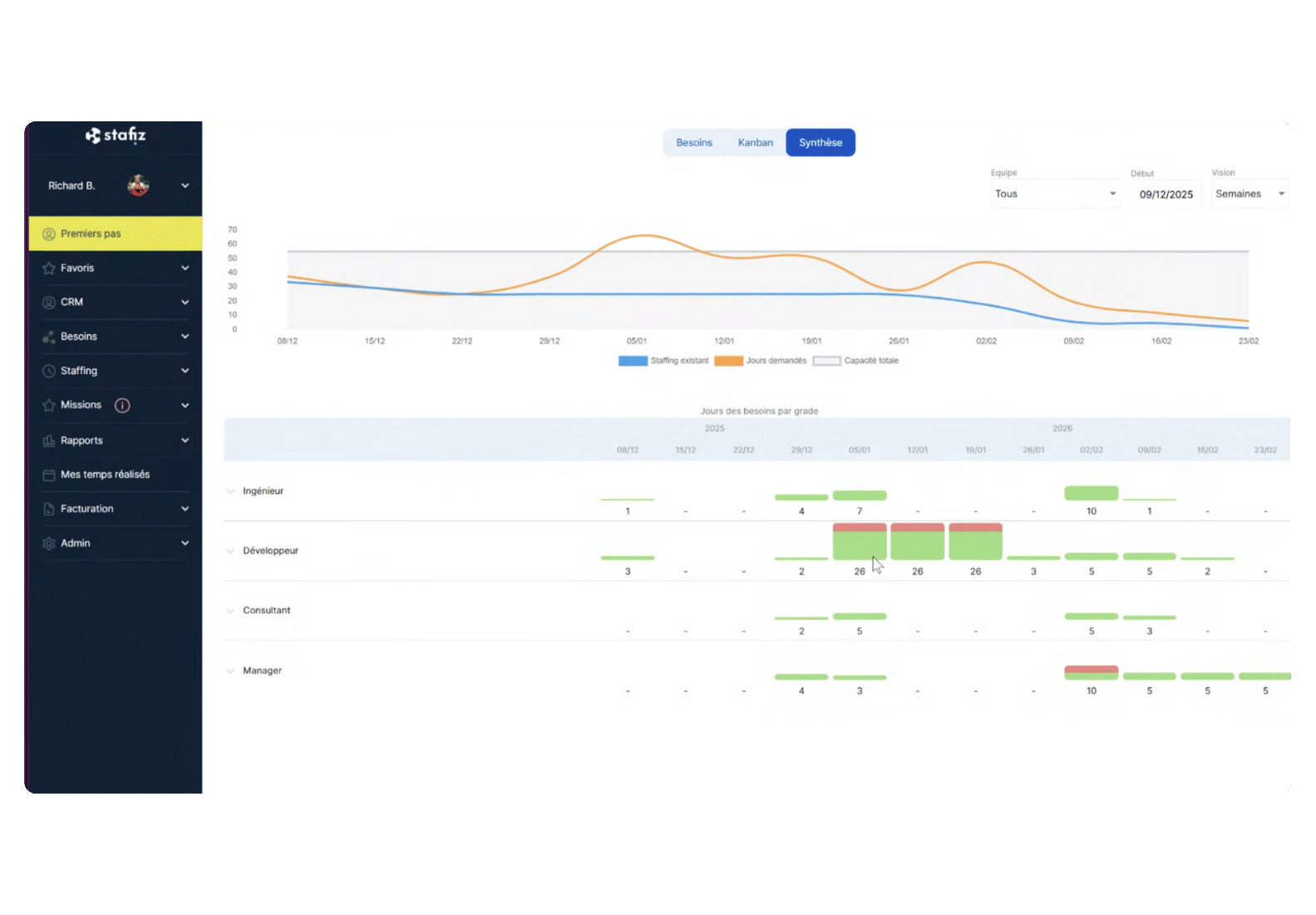
The ERP IT Services Helps you answer questions like:
- Do you have enough capacity in a particular skill?
- Should we recruit to anticipate demand?
- What is the occupancy rate of my teams, and the status of my consultants (intercontract, mission, leave, training)?
Manage the pool of profiles (internal + external) without re-entering
In a generalist tool, sourcing and candidate management is usually outsourced to third-party tools or resource planning managers, who then prepare internal interviews before proposing them to the client. This can be:
- consultants on an inter-contract basis (or those about to be), who are mobilised as soon as the need materialises. This anticipation makes it possible to reduce costly periods of inactivity and to optimize the activity rate;
- the pool of candidates already identified (in post or not) in the profile database. L’IT Services may not have yet exchanged with these profiles, and contacts them according to the progress of the need
To effectively manage these two pools, it is necessary to have a sourcing tool or ATS (Applicant Tracking System) that allows you to record the candidates to be retained, to sort them, to classify them by skills and availability. For sourcing from LinkedIn and other platforms, the tool must integrate OCR technology and automatic CV scanning to avoid time-consuming and error-prone manual entry.
Manage multi-profile opportunities
Opportunity management for aIT Services is not simply an amount that is tracked in the sales pipeline. They often correspond to a customer need on which several profiles are positioned.
Let's take a concrete example: a customer expresses a need for a senior Java developer. L’IT Services will position several profiles in competition. Each person positioned will follow distinct evolutionary cycles: first within theIT Services (internal qualification, validation of the manager, preparation of the skills file), then with the client (sending the CV, client interview, negotiation of the ADR, final validation).
TheIT Services should make it possible to follow these parallel paths, to know in real time where each positioning is and to quickly adjust the strategy if a profile is discarded.
Ensuring the reliability of financial data
Data reliability is a major challenge for IT Services. The ERP must ensure permanent control between the planned, the carried out and the invoiced. This triangulation makes it possible to immediately identify discrepancies: time entered but not invoiced indicates a problem with contracting or customer validation, time planned but not carried out reveals a problem with execution.
Real-time analysis of project margins is essential. Notifications of budget deviations allow project managers and business managers to intervene quickly before the situation deteriorates. This responsiveness directly determines the profitability of theIT Services, where margins are built day after day on each assignment.
Facilitate time entry
Generalist ERPs are designed for accounting or project logic, and not for daily use by consultants on assignment. As a result, interfaces are complex, data entry paths are rigid and counterintuitive, and don't meet the need for mobility.
When the entry of the CRA becomes too restrictive, the consultants postpone it or supplement it in an approximate way. This behavior has an immediate impact on invoicing : as long as the times are not entered and then validated via workflow (by the manager and, if necessary, by the customer), it is blocked. This lag directly translates into a deterioration in the DSO (Days Sales Outstanding) and a strain on cash flow.
A Specialized ERP IT Services must therefore offer time entry designed for field use: native mobile application, duplication of previous weeks, management of comments related to the CRA, internal and customer validation workflows, as well as OCR for expense reports. Adoption by consultants is not a comfort, but an essential condition for data reliability and continuity between execution, invoicing and financial management.
Maintain margin control with multi-mode billing
The IT Services work simultaneously in the on-time basis (time-based invoicing), fixed-price (invoicing on a schedule or progress basis), in TMA (Third-Party Application Maintenance) and in service centres. Each contractual method requires a different billing logic:
- in the management department, the tool must automatically attach the activity statement validated by the customer to the invoice;
- At a fixed rate, he must calculate the remainder to be done to monitor margin drifts.
An ERP IT Services must also follow discounts and non-invoicing : days produced but not invoiced, real impact of commercial gestures and production drifts.
Beyond the generation of invoices, an ERP IT Services must guarantee consistency between the planned, the carried out and the invoiced. This continuity makes it possible to monitor the project margin in real time, to quickly identify budget drifts and to trigger alerts before they impact overall profitability. Without this control, the discrepancies are often only visible a posteriori, once the margin has already deteriorated.
These issues constitute the essential framework for comparing the ERPs dedicated to IT Services, to find out the mistakes to avoid when choosing an ERP IT Services and understand why some solutions adapt better than others to specific organizational contexts.
Comparison of the Best ERP Softwares for IT Services
Not all the ERPs presented in this comparison respond in the same way to the issues listed above. Depending on their design, functional scope and target, certain solutions, in particular French public buildings for IT Services, cover the entire cycle, while others focus on specific building blocks (recruitment, business management, finance) or require significant adaptations to your business model.
| Stafiz | PSA / ERP IT Services full-cycle | IT Services, Consulting firms, Service companies (20–1000+) | Full sales cycle coverage (pre-sales, profiles→ resource planning → CRA → invoicing → financial management), which is very strong on forecasting, resource planning and multi-models (control room, package, TMA, service centers). | Rich solution requiring framing and change support; can be oversized for micro-structures. |
| BoondManager | PSA / ERP IT Services full-cycle | Small & Medium IT Services, consulting firms (10–300 people) | Business ERP IT Services covering CRM, recruitment, assignments, time, expenses and invoicing; good 360° view of the activity; Quick to learn. | Limited advanced financial management and consolidation; Editor-dependent customization and advanced reporting. |
| VSActivity | PSA / ERP IT Services full-cycle | IT Services, structured consulting firms | All-in-one service-oriented ERP: CRM, projects, resource planning, time, HR and invoicing; good ergonomics for everyday use; mobile application. | Less suitable for complex financial environments (multi-country, consolidation); Advanced framed customization. |
| Everwin | ERP back-office / business management | SMEs and mid-caps in services, IT Services (100–2000 people) | Mature and robust solution, strong financial depth, multi-entity management, advanced consolidation and management control. | More historical ergonomics; Long and structuring implementation project, not well suited to small structures. |
| Athena Perisoft | ERP back-office / business management | IT Services, IT services companies, umbrella companies (10–300 collab.) | Very specialized in production, payroll and portage; reliability of payroll variables; rapid deployment. | Limited functional coverage (CRM, BI, global management to be completed). |
| Altik | ERP back-office / business management | IT Services, outsourced CIOs, consulting firms (20–500+) | Very fine management of profitability by deal, multi-mode contractual management, precise margin forecasts. | Focused on the back-office: CRM and pre-sales to be completed; Longer adoption curve. |
| Odoo | General ERP | Multi-activity SMEs (services + others) | Modular and open source ERP, highly customizable, large ecosystem of modules and integrators. | Needs IT Services non-natives (resource planning, intercontract, forecast) requiring configuration and developments; Overall integration cost to monitor. |
| Unit4 | Generalist ERP service-oriented | Midsize & Large Consulting Firms (300–5000+) | Structuring financial ERP with FP&A, projects and integrated HR; Very suitable for multi-country environments. | Heavy implementation project; oversized for IT Services small or poorly structured. |
| Unatrix | Brick ATS / CRM | IT Services Recruitment-oriented, recruitment agencies | Excellent front-office tool for sourcing, applicant tracking, and business opportunities; Quick to deploy. | Does not cover projects, time, invoicing or profitability; requires a complementary ERP/PSA. |
ERPs Covering IT Services' Full Cycle
Some solutions cover the entire cycle IT Services, from CRM to invoicing to resource planning and financial management, as opposed to business management ERPs, generalist ERPs and ATS/CRM bricks. They are the preferred choice for companies that want to replace multiple disparate tools with a single platform.
An ERP of IT Services The comprehensive strategy takes into account key needs for a consulting firm:
- CRM attached to the ERP : the commercial work of IT Services requires an integrated CRM aspect to monitor pre-sales, a phase where many key processes are concentrated (qualification of needs, positioning, negotiations).
- Native field management IT Services : the tool adapts to business needs on the sourcing side with dedicated fields for skills, seniority, ADR, duration, costs, location, availability.
- The integration of an ATS/sourcing : recruitment Kanban, automatic import of CVs, search by skills to build and efficiently exploit talent pools.
- Process automation : automation of after-sales (contract generation, automated invoicing) and time tracking to reduce time-consuming manual tasks.
Stafiz, the ERP for IT Services The most complete on the market
Stafiz is the benchmark ERP for IT Services, consulting firms and intellectual services companies with 20 to 500 employees. The solution natively covers the entire business cycle with an approach designed from the outset for intellectual services.
Key features of Stafiz
Full cycle coverage
- CRM and sales pipeline : opportunity management, qualification of customer needs and follow-up of candidate positioning with a 360° vision of pre-sales.
- resource planning and planning : allocation of resources by skills, management of availability and optimization of the activity rate.
- Time and absence tracking : intuitive time entry by employees with automated management of leave, RTT and absences.
- Expense reports : Expense reporting and posting with configurable workflow.
- Invoicing and purchasing : automatic generation of customer invoices and management of supplier purchases centralized.
- Financial reporting : real-time monitoring of turnover, margins, cash flow and profitability by project, customer or BU.
Time reports and time tracking
- Comments in the activity reports.
- Flexible approval workflows : internal approval by the manager before invoicing or directly by the customer.
- Special non-project times : entry of on-call duties, overtime and emergency interventions with automatic calculation of pricing according to schedules and days.
- Flexibility in maintenance pricing : the ERP automatically calculates variable maintenance rates according to the defined contractual parameters (time slots, weekends, public holidays).
Automated invoicing
- Invoicing generated directly from the posted CRAs.
- Multi-contractual modes: time management, fixed price, maintenance, TMA, mixed projects.
- Tracking of non-billable hours: distinction between unbilled days and unbilled product days.
- Variance analysis: immediate visibility between production, invoicing and impact on margin.
Sourcing and candidate management
- Profile & CV Management (OCR): automatic creation of candidate files without manual entry.
- AI search : rapid identification of profiles according to skills, seniority and availability.
- Predictive candidate pipeline : anticipation of positioning according to the progress of commercial opportunities.
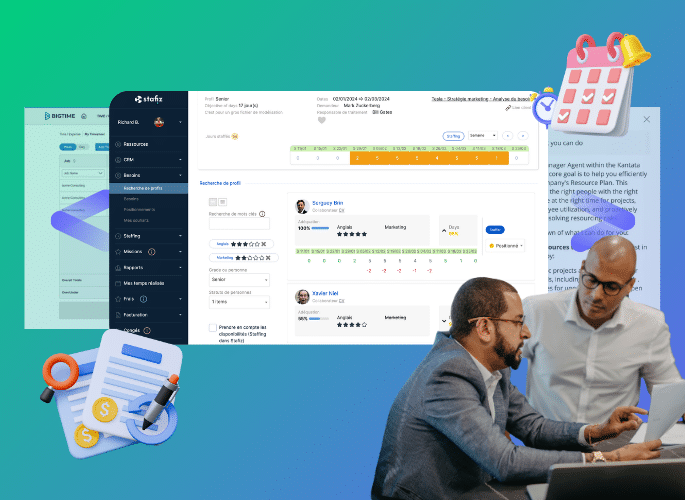
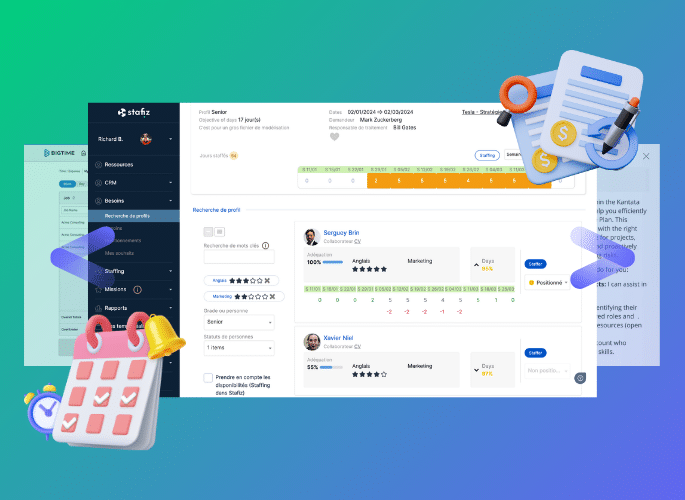
In Stafiz, customer needs and the positioning of profiles are managed via a dedicated Kanban, directly linked to business opportunities.
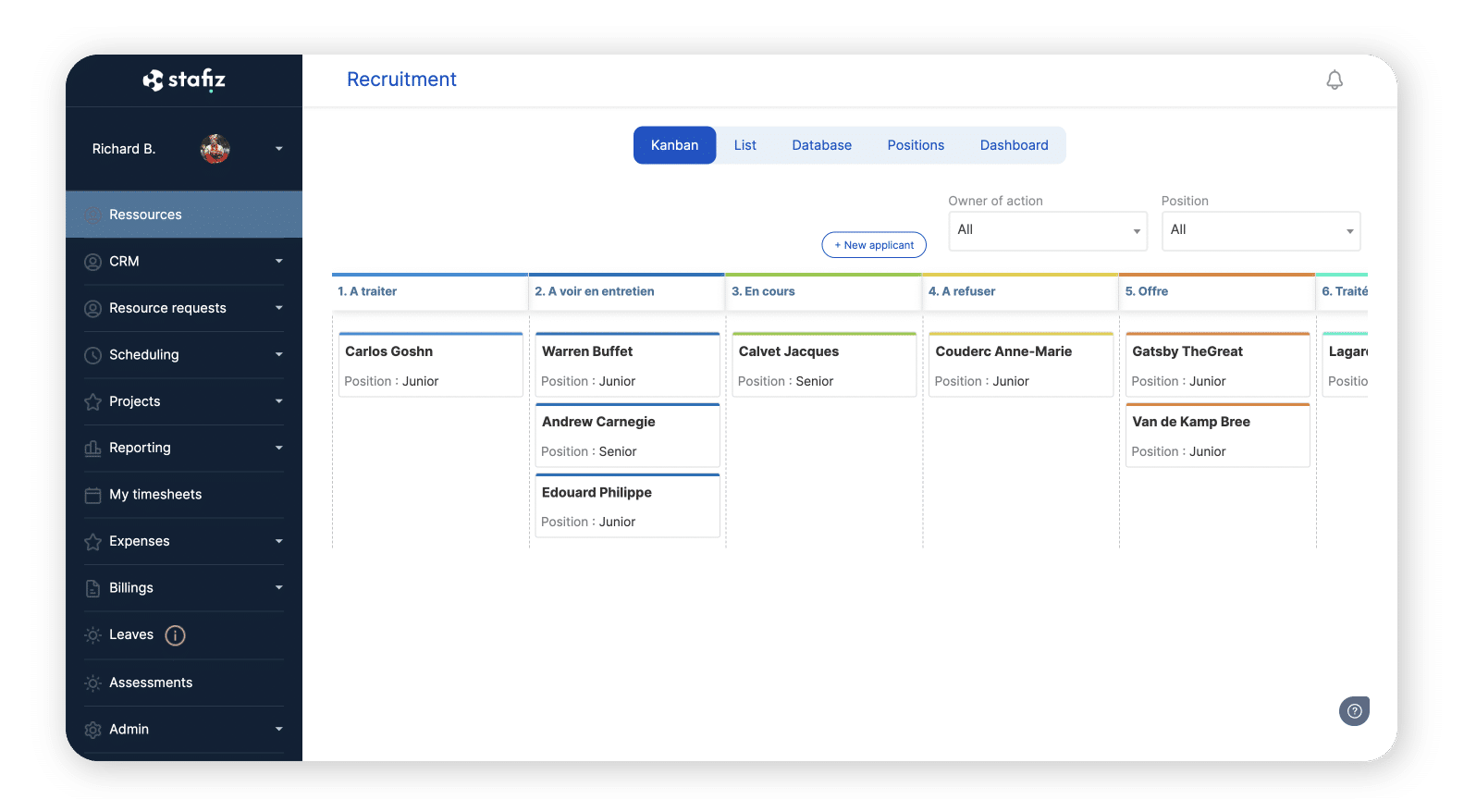
Stafiz's candidate pipeline allows you to anticipate the positions to be expected and to follow them according to the progress of the opportunities. Each positioned profile progresses in its own cycle, providing clear, real-time visibility into the status of opportunities and chances of completion.
Workload and Resource Planning Management
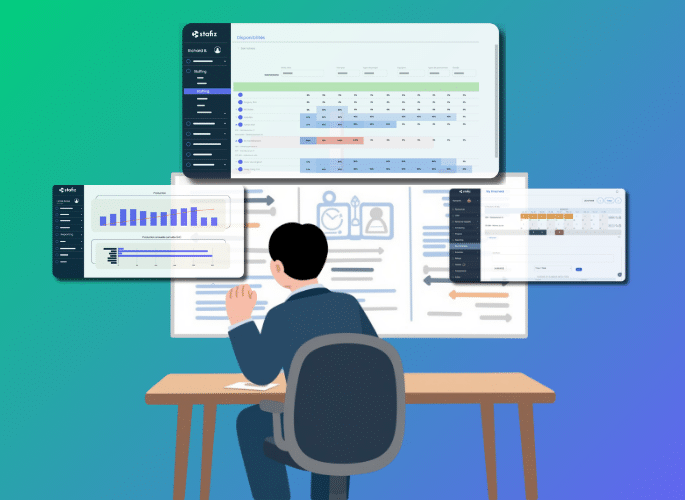
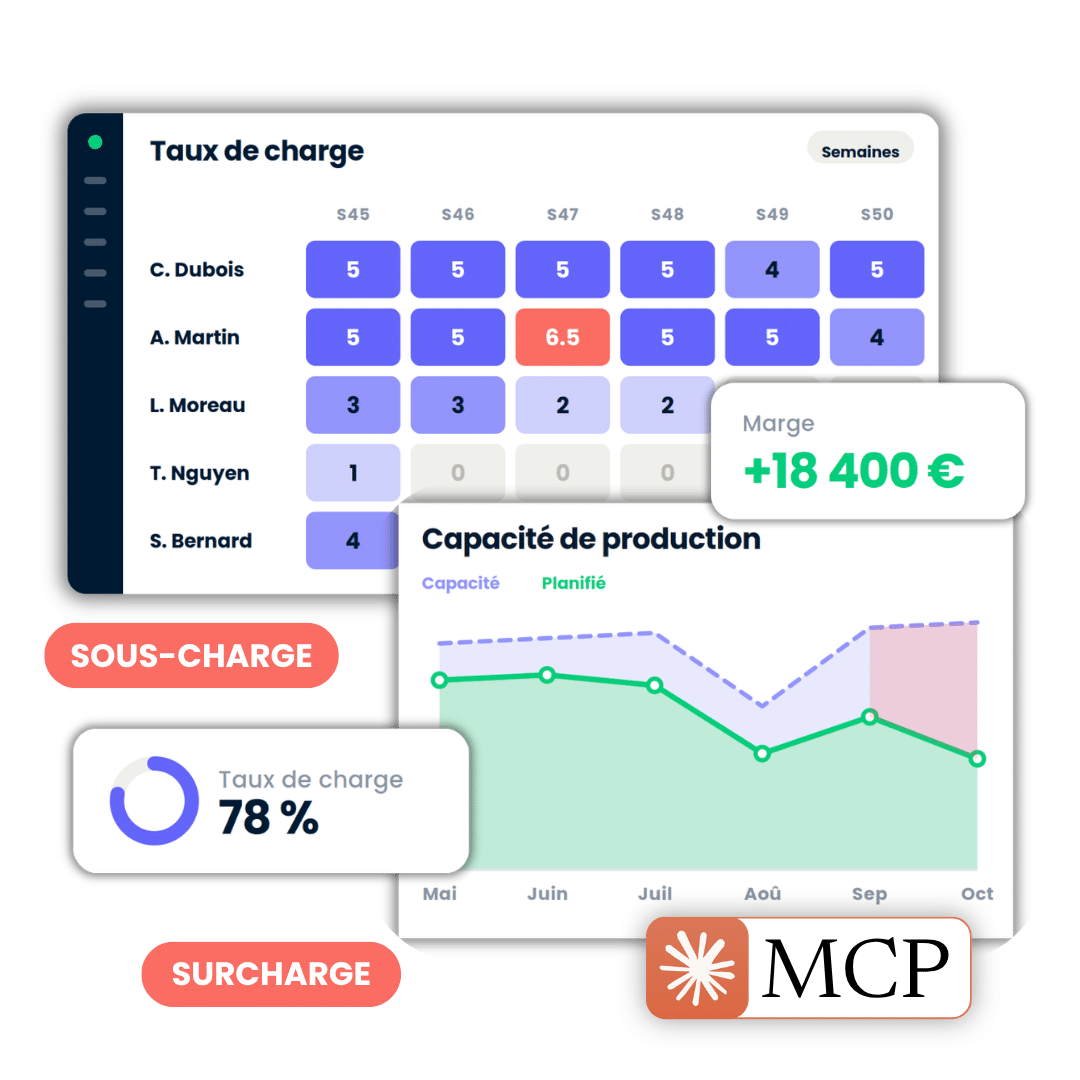
- Capacity vs. demand: real-time coordination between available load and customer needs by skill.
- Inter-contract monitoring: identification of employees on inter-contract or at risk in order to reposition them quickly.
- Planning scenarios: Simulation of allocations to measure the impact on revenues and margins.
- Management of purchase orders: detection of expiring contracts to anticipate renewals and prospecting.
- Employee availability: 100% accurate visualization of the workload, inter-contract periods and compatible needs.
- Optimization of the inter-contract: automatic matching between available resources and customer missions or internal projects.
Scenario builder
- Simulation of positioning : study of the impacts related to the positioning of each individual available on different missions
- Multi-criteria arbitration (reduction of the inter-contract, optimization of profitability, development of skills).
- Decision support resource planning by quantitatively measuring the impact of each choice.
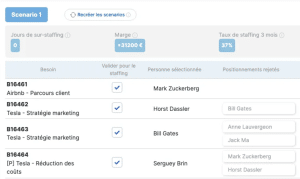
Stafiz's scenario builder allows you to simulate, compare and arbitrate decisions resource planning complex by combining:
- an operational vision (who is working on what),
- a financial vision (margin, profitability),
- a forward-looking view (utilization rate, future load), in order to select the most relevant scenario for the IT Services, and not just the easiest or quickest to implement.
Integrations via API
- Connections with payroll tools : automatic export of payroll variables (hours, bonuses, expenses) to software such as Silae.
- Accounting interfacing : bidirectional synchronization with Sage, Cegid and other accounting solutions.
- HRIS and BI integration : connection with HR systems and business intelligence tools (Power BI, Tableau).
Full Process Automation
- Automatic creation of employee or customer contracts once the deal has been won, with management of different contractual types.
- Integration into the schedule : automatic switch of the recruited candidate to the operational schedule with resumption of already planned times.
Advantages of Stafiz
- Very business-oriented solution IT Services/consulting : real coverage of the entire lifecycle of a mission, from pipeline to cash, without the need for heavy developments.
- High value on planning : excellence on the resource planning, forecasting (expenses, turnover, margin) and decision-making support for trade-offs between projects, recruitment or subcontracting.
- Advanced automation : CRA, customer reminders, invoicing, forecast versus realized reconciliation, accounting exports and automated reporting to free up time for teams.
- Modern interface : designed to limit double entries and centralize information, facilitating adoption by field users and decision-makers.
Stafiz Limits
- Functional richness requiring support : a framework and support, planned and provided by the Stafiz teams, are necessary to exploit the full potential of the solution.
- Potentially excessive completeness : may seem too complete for very small structures looking only for a timesheet or simple invoicing tool, although the possibility of choosing only the desired modules meets this challenge.
Ideal use cases for Stafiz
Stafiz is ideal for:
- The IT Services and consulting firms that want to replace several tools (Excel, CRM, time tracking, invoicing, management) with a single platform;
- companies with several libraries, several countries, several types of assignments (time management, fixed price, internal project) that need consolidated and predictive management;
- Structures that want to professionalize project financial management (margin, remaining to be done, cash flow, profitability per offer/customer).
Stafiz is less suitable for:
- micro-structures looking only for a minimalist timesheet solution without the ambition of in-depth management;
- companies that are loosely structured or unprepared toto organize their pre-sales, resource planning and their financial management.
Boondmanager
BoondManager is positioned as a SaaS Business ERP for IT Services, IT services companies and mid-sized consulting firms . It is aimed at organizations that want to structure the entire operational cycle, from sales prospecting to mission monitoring, without switching to a complex generalist ERP.
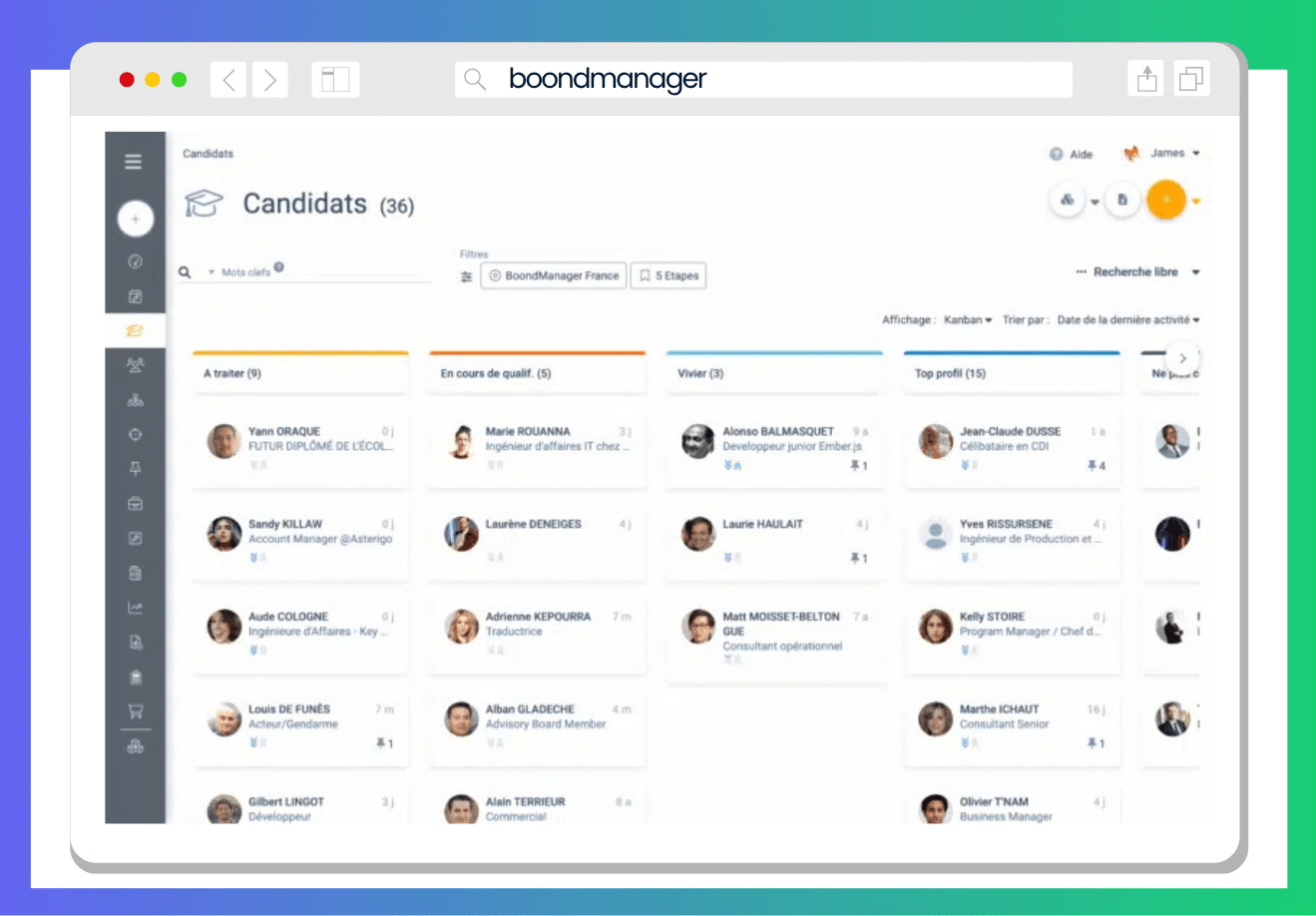
Key features
- CRM and Business Opportunity Management
- Recruitment and candidate management
- Business and Mission Management
- Time and Expense Tracking
- Invoicing of services
- Project Management Dashboards
- Connectors and APIs
Benefits
- Dedicated business ERP IT Services, with consistent coverage of the business, operational, and administrative cycle.
- Management and fixed price management with a clear reading of the pipeline, active assignments, positioned consultants and ADR partners, facilitating margin monitoring.
- 360° view of the business in a single interface, which simplifies the overall reading of the portfolio and limits data breaks between teams.
- Interface that makes it easy to get started, especially for time entry and mission tracking.
- Ecosystem of connectors and APIs to interface BoondManager with third-party tools (HRIS, payroll, public invoicing).
Bounds
- Financial scope : the solution shows limits for complex financial consolidation or multi-GAAP management needs.
- Limited customization: Workflows, fields, and dashboards are configurable, but are not suitable for advanced business or analytics needs.
Use cases:
Boondmanager is suitable for:
- The IT Services Standardised management systems oriented towards pure management or a mix of management and fixed price, with relatively homogeneous processes and a need for rapid structuring of the service cycle.
- Consulting firms wishing to supervise prospecting, missions and operational monitoring in a single tool, without investing in a generalist ERP.
Boondmanager is less suitable for multi-activity or multi-country groups looking for extensive customization or financial management integrated with the ERP.
VSActivity (vsa) – Veryswing
VSActivity is positioned as a business SaaS ERP for IT Services, consulting firms, engineering firms, software publishers, with a broad coverage of back-office and project operations. It is aimed at companies that are looking for an all-in-one solution, with a particular focus on the daily use of teams.
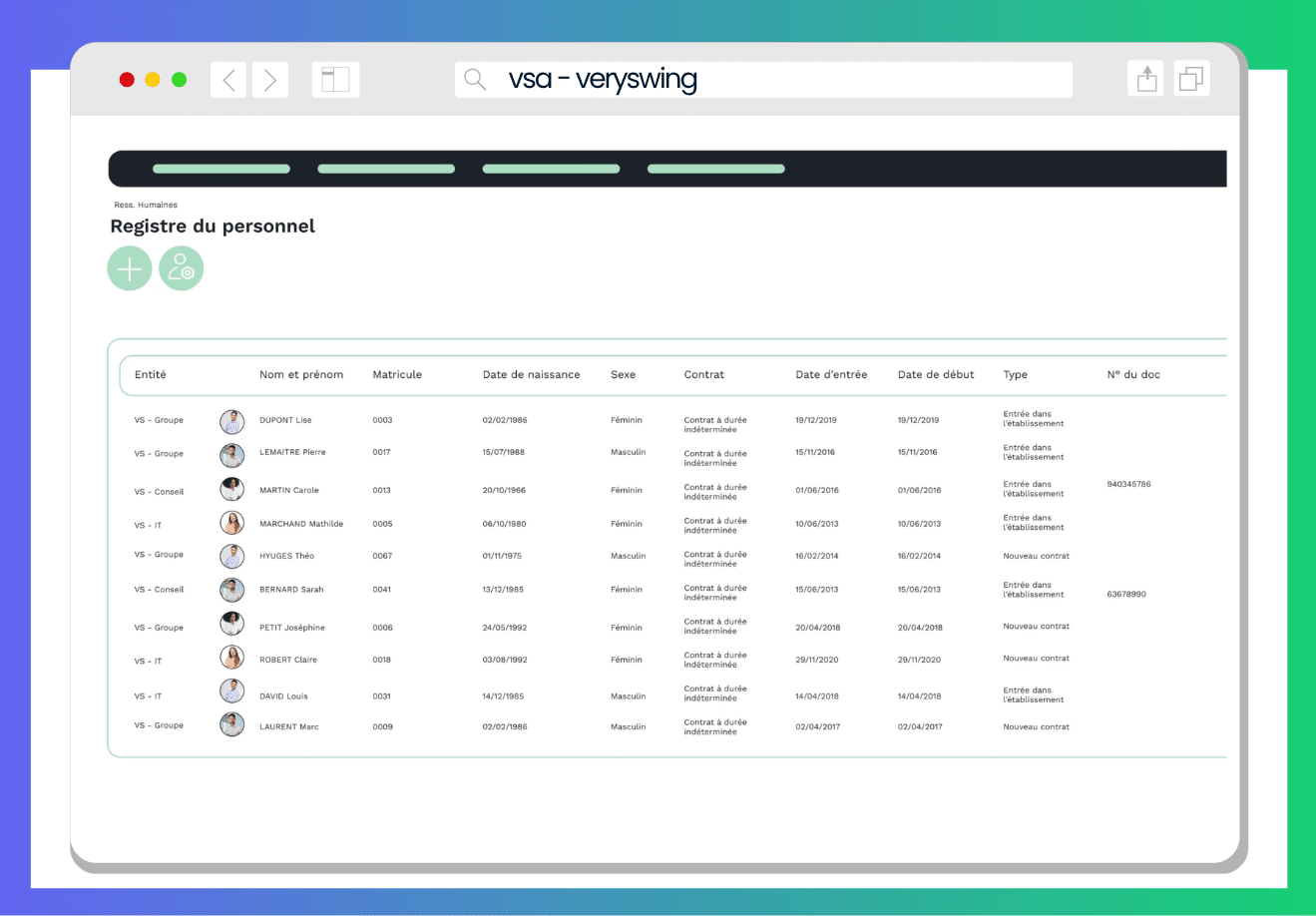
VSActivity Key Features
- CRM and sales pipeline
- Business and project management
- Resource management and resource planning
- HR module (leave, absences)
- Activity and time tracking
- Expense reports and invoicing
- Reporting and performance indicators
- Electronic signature
- Recruitment
Benefits
- Extensive functional coverage that brings together CRM, project management, activity monitoring, HR and invoicing in a single environment.
- All-in-one service-oriented ERP, with a coherent articulation between commercial activities, resource planning and operational monitoring of missions.
- Interface that focuses on recurring tasks of teams, in particular time and expense entry.
- Dedicated mobile application for recording time and expenses on the move, which makes activity monitoring and associated indicators more reliable.
- Integration of leave, absences and expense reports into activity monitoring, which reinforces the consistency between resource availability and project load.
Bounds
- Scope mainly focused on services : for advanced financial needs, such as multi-country consolidation or complex accounting schemes, additional tools are still required.
- Advanced customization and limited specific developments compared to an open-source CRM ERP for IT Services or a low-code platform.
Use cases
VSActivity is suitable for:
- All-in-one ERPs who wish to centralize pipeline, missions, resource planning, activity monitoring, invoicing and KPIs;
- Consulting firms which seek to link the commercial part and the resource planning in the back office without deploying a generalist ERP.
VSActivity is less suitable for complex environments with high financial, consolidation, or business customization requirements.
How is Stafiz a more complete alternative to Boondmanager or VSA?
Compared to BoondManager and VSActivity, Stafiz provides additional depth in three important aspects.
- The pre-sales process "needs and positioning" is managed natively with a complete Kanban allowing to follow each candidate positioned on each opportunity, whereas competitors remain more basic on this decisive phase.
- The scenarios of resource planning offers a multi-criteria refereeing capability (unique on the market), and avoids decisions based on feeling. The scenario builder allows you to simulate different assignments and quantitatively measure the impact on the intercontract and margin before making a decision.
- The IT consulting and project management coverage offers superior financial granularity with follow-up of the remaining to be done, alerts on budget deviations and profitability analysis in real time by deal, customer or business unit.
Business management and back-office ERPs IT Services
This type of ERP does not manage pre-sales, but provides a reliable and usable reading of profitability, mission by mission. The tool comes into play after the contract has been signed, when the mission has already been launched, and it is necessary to arbitrate on the execution rather than the sale.
These solutions focus on the Back Office IT Services : business management, time, CRA, invoicing and margins, but remain more limited on the CRM, ATS or the pre-sales part of the profiles. They are suitable for IT Services who already have their front-office tools and are looking to professionalize their financial and operational management.
These ERPs meet specific needs around two major axes.
- Business and project management
- Follow-up of purchase orders : centralization and monitoring of the execution of customer orders with a view of the volumes consumed versus contracted volumes.
- Renewals and extensions : proactively identifying contracts approaching the end of the contract to organize the hunt for contracts and secure renewals.
- Consolidation of turnover : aggregation of turnover by deal, customer, BU or period to obtain a consolidated view of commercial performance.
- Financial management

Stafiz allows you to track profitability by business. Large discrepancies immediately alert you to overdue or underperforming jobs.
- Visibility on margins per deal: calculation and monitoring of the margin achieved on each mission to identify the most profitable deals and those in difficulty.
- Monitoring of profitability by business: automatic alerts on missions with the most significant delays or budget drifts to intervene quickly.
- Tracking of invoiced and uninvoiced days: Distinguishing between hours produced and hours actually invoiced to measure margin losses due to discounts or contractual issues.
Time management and tracking in Stafiz
Everwin GX/SX
Everwin is a historical player with more than 30 years of existence, leader in market share installed in France. The publisher offers Everwin SX (Full Web/SaaS) for modern structures and Everwin GX (On-Premise) for very specific needs, targeting mid-sized companies and large SMEs with 100 to 2000 employees.
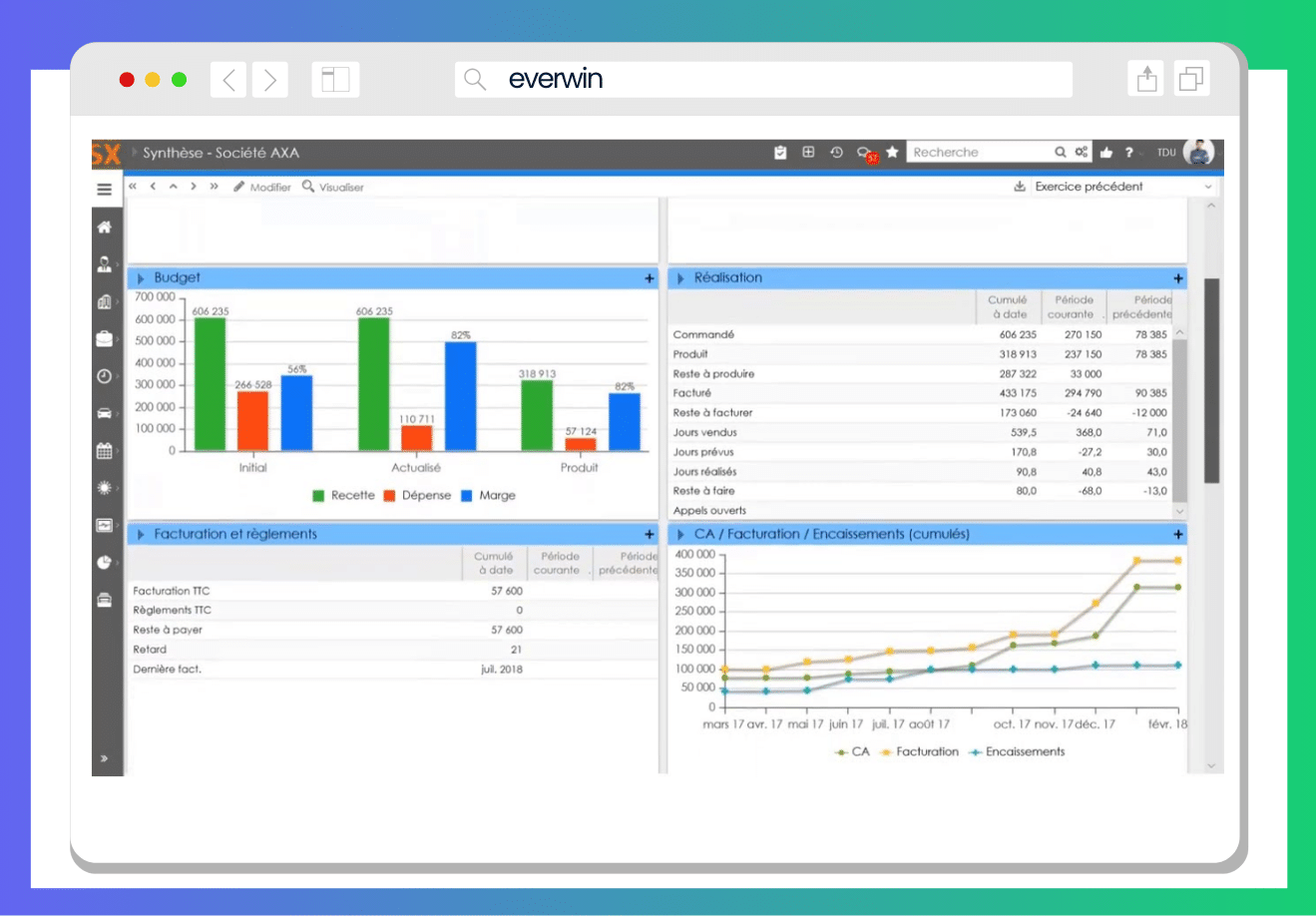
Key features
- Multi-company and multi-currency management
- In-depth business analysis
- Resource Planning
- iVision Employee Portal
- Integrated accounting and finance
- Co-contracting management
Benefits
- Proven robustness : mature solution proven on thousands of installations, ensuring stability and reliability.
- Depth of parameterization capable of modeling very specific processes according to the particularities of each organization.
- Complexity management that can support multi-entity, multi-currency structures and co-contracting schemes.
- Ecosystem of partners and integrators guaranteeing continuity of support.
- Advanced financial consolidation that meets the requirements of management controllers.
Bounds
- Historical ergonomics : the interface is marked by a traditional ERP heritage, less fluid than recent native SaaS solutions.
- This is a heavy implementation project, often requiring several months and the intervention of a specialized integrator.
- Significant learning curve : the functional richness implies a significant training time for users.
Use cases
Everwin is suitable for:
- consulting firms and IT Services 100 to 2000 employees with a structured organization and financial traceability needs;
- Multi-entity companies requiring rigorous financial consolidation and management of complex chargeback flows.
Everwin is less suitable for agile startups or SMEs that favor speed of deployment and modern ergonomics, or structures with less than 50 people.
Athena – Perisoft
Athena is an IT services ERP forIT Services and umbrella companies. The solution centralizes employee data, assignments, payroll variables and production monitoring with a promise of reliability of HR and payroll processes.
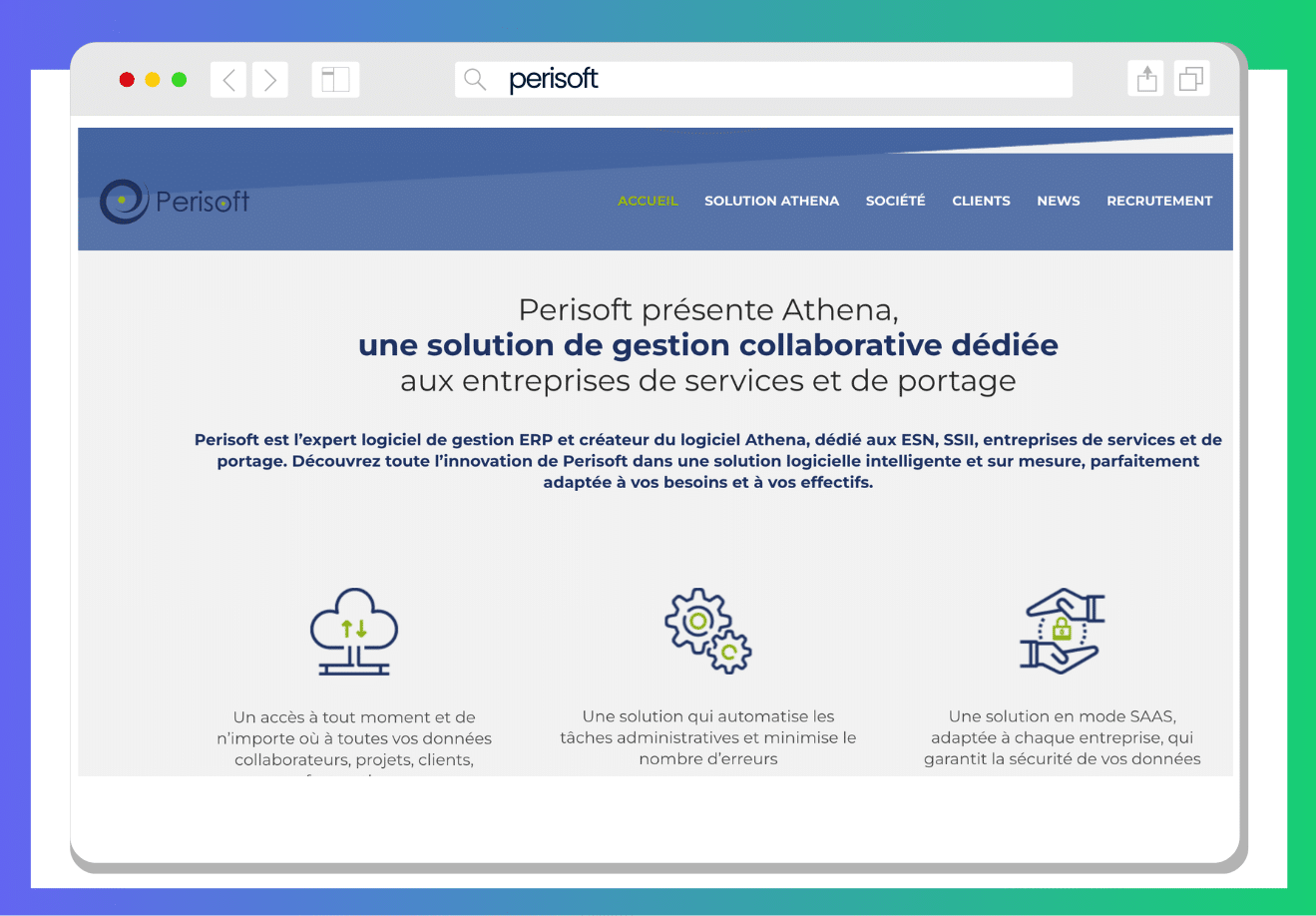
Key features
- Securing payroll
- Management of wage portage
- Detailed production follow-up
- Validation workflows
- Multi-agency management
Benefits
- Specialization IT Services- portage with a focus on the specific needs of production, payroll and HR data for this type of structure.
- Reliability of HR data through automation and integration of consistency checks.
- Rapid deployment in weeks.
- Automation of reminders with notification system for the validation of timesheets, follow-up of unpaid invoices and management of requests.
Bounds
- Restricted functional scope : less focused on CRM, advanced BI or complete project portfolio management.
- Limited sales coverage : No opportunity management module or integrated sales pipeline.
- Limited reporting : Lower analytical capabilities than full ERPs, suitable for standard needs but not for advanced analysis.
Use cases
Athena is suitable for:
- The IT Services and umbrella companies where the main issue is the reliability of HR-payroll data and the automation of production;
- Organizations looking to secure the payroll process and drastically reduce variable errors.
Athena is less suitable for structures requiring an integrated CRM for sales management or advanced financial and analytical management of the business portfolio.
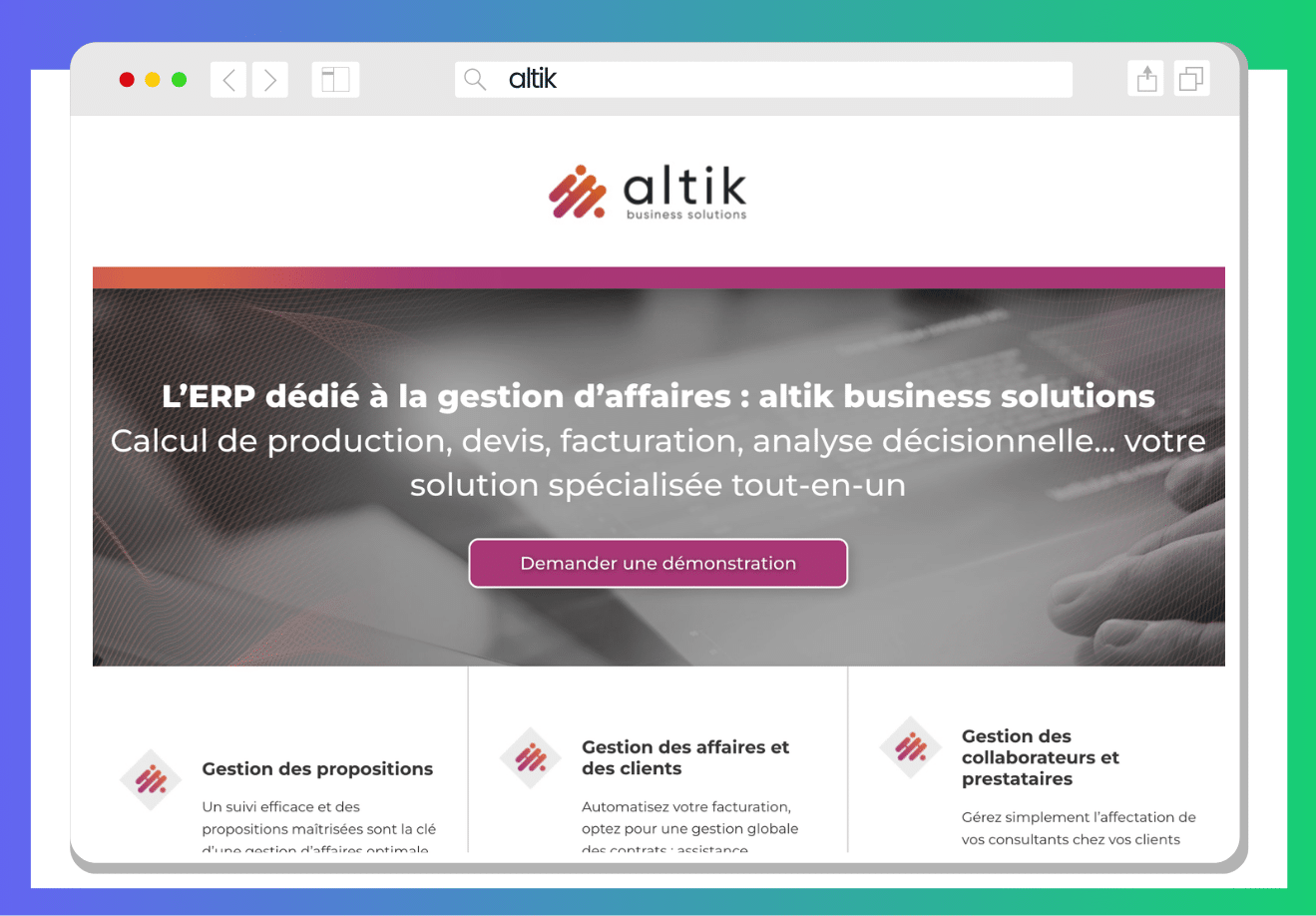
Altik Business Solutions
Altik is a Business Management ERP for IT Services, IT services companies, outsourced CIOs, software publishers and consulting firms. The solution focuses on the back-office with a very fine management of business profitability and a tailor-made approach for digital services.
Key features
- Business Management
- Multi-level project monitoring
- Timesheets and fees
- Validation workflows
- Hassle-Free Invoicing
- Margin monitoring
- Financial forecasts
Benefits
- Financial management by deal which allows a detailed analysis of costs, margins and differences between forecast and actual.
- Multi-mode contractual management: the solution natively manages the management room, the package, technical assistance and maintenance contracts.
- Back-office structuring IT Services : Altik centralizes business, time, contracts and invoicing in a single tool.
- Tailor-made approach IT Services : The flexible parameterization allows the tool to be adapted to the specific processes of each IT Services, without imposing a rigid standard model.
- Advanced forecast visibility: projection tools offer an anticipation of expenses, turnover and margins.
Bounds
- Back-office-centric : Lack of native CRM, marketing, and advanced BI requiring third-party tools for the full sales cycle.
- Long adoption curve : functional richness implies a significant learning curve for small structures.
- Limited market visibility : Altik remains less well-known than some of the market leaders, despite a solid functional coverage for IT Services
Use cases
Altik is suitable for:
- The IT Services working in a direct contract, package or service center structuring their back-office with the need for fine management of profitability;
- structures where the complexity of projects and margins requires in-depth financial analysis and accurate forecasts.
Altik is less suitable for organizations looking for an all-in-one solution including CRM and sales management, or small structures of less than 20 people that favor simplicity and speed of use.
Generalist ERP to adapt to the business IT Services
Generalist ERPs, designed for multi-activity SMEs and ETIs, require substantial configuration to cover the specificities IT Services. These solutions have undeniable advantages such as:
- a very broad functional scope,
- strong personalization,
- multi-country and multi-BU capability.
However, these tools will be very limited for a consulting firm:
- profile-oriented pre-sales management is often absent natively and must be built via custom developments, extending implementation times;
- Fields of work for skills, seniority, ADR, availability and intercontract must be created manually;
- Advanced cases are too complex to set up. It is difficult to model mixed scenarios (management + fixed rate + TMA + on-call duty) with variable pricing according to schedules and days requires heavy developments.
As a result, the deployment of the tool extends over several months or years, and you will depend heavily on your integrator. By comparison, a business ERP only takes a few weeks to be implemented within your company.
Odoo (service modules / timesheet)
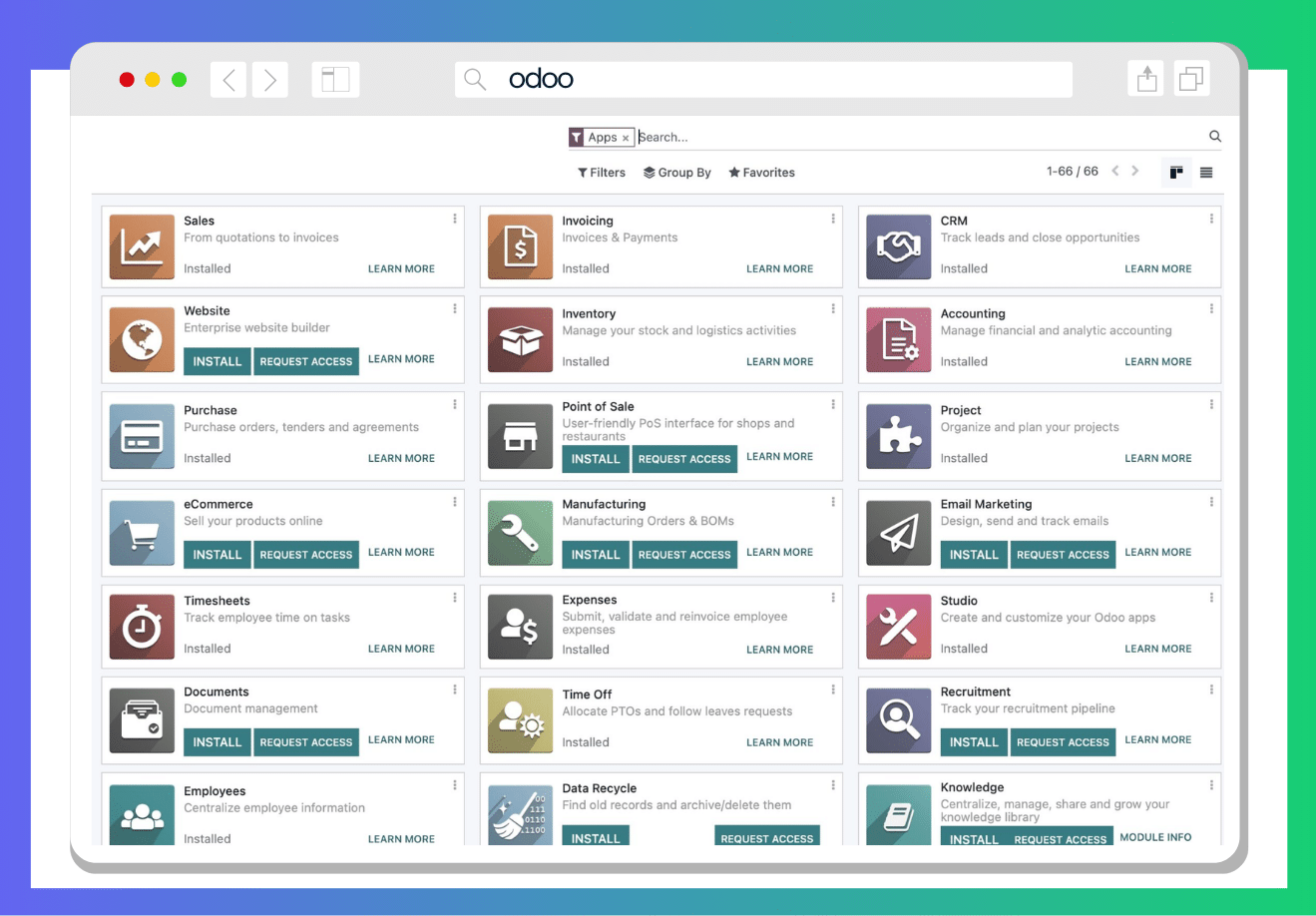
Odoo is an open source modular ERP covering a very wide functional scope, from sales management to accounting, including projects and invoicing. It is aimed at consulting and service companies wishing to centralize their operations on a single and customizable base.
Key features
- Modular architecture (CRM, project, timesheet, invoicing, accounting)
- Time tracking by project/client
- Multi-modal billing
- Invoice automation
- Cost and margin analysis
- Personalization through automations, workflow, and low-code development
- Extensive marketplace of add-ons
Benefits
- Very rich ecosystem : active community, numerous integrators and marketplace providing solutions and support for all types of needs.
- Extendable functional perimeter : Ability to cover well beyond ERP IT Services (e-commerce, marketing, helpdesk) for structures with hybrid activities.
- Open source and scalable : access to source code allowing unlimited custom developments for organizations with in-house technical skills.
- Flexible business model : free Community version or Enterprise version with publisher support, adapting to budgets and requirements.
Bounds
- Generalist solution : often requires configuration or development for very specific needs IT Services (resource planning end, intercontract, native business indicators).
- Potentially high overall cost : Although the Community edition is free, the costs of integration, custom development and maintenance can become significant.
- Integrator dependency : quality of the final result very dependent on the integrator chosen, risk of customized versions that are difficult to maintain.
Use cases
Odoo is ideal for:
- consulting companies that centralize CRM, invoicing, project and accounting on a single foundation ;
- companies with mixed activities (services + trading) requiring a versatile ERP;
- The IT Services "Tech" with in-house skills to set up and maintain the tool.
Odoo is less suitable for:
- structures looking for a turnkey solution without an integration project;
- companies without in-house technical resources to manage custom developments.
Unit4 ERP (Project Management / ERPx)
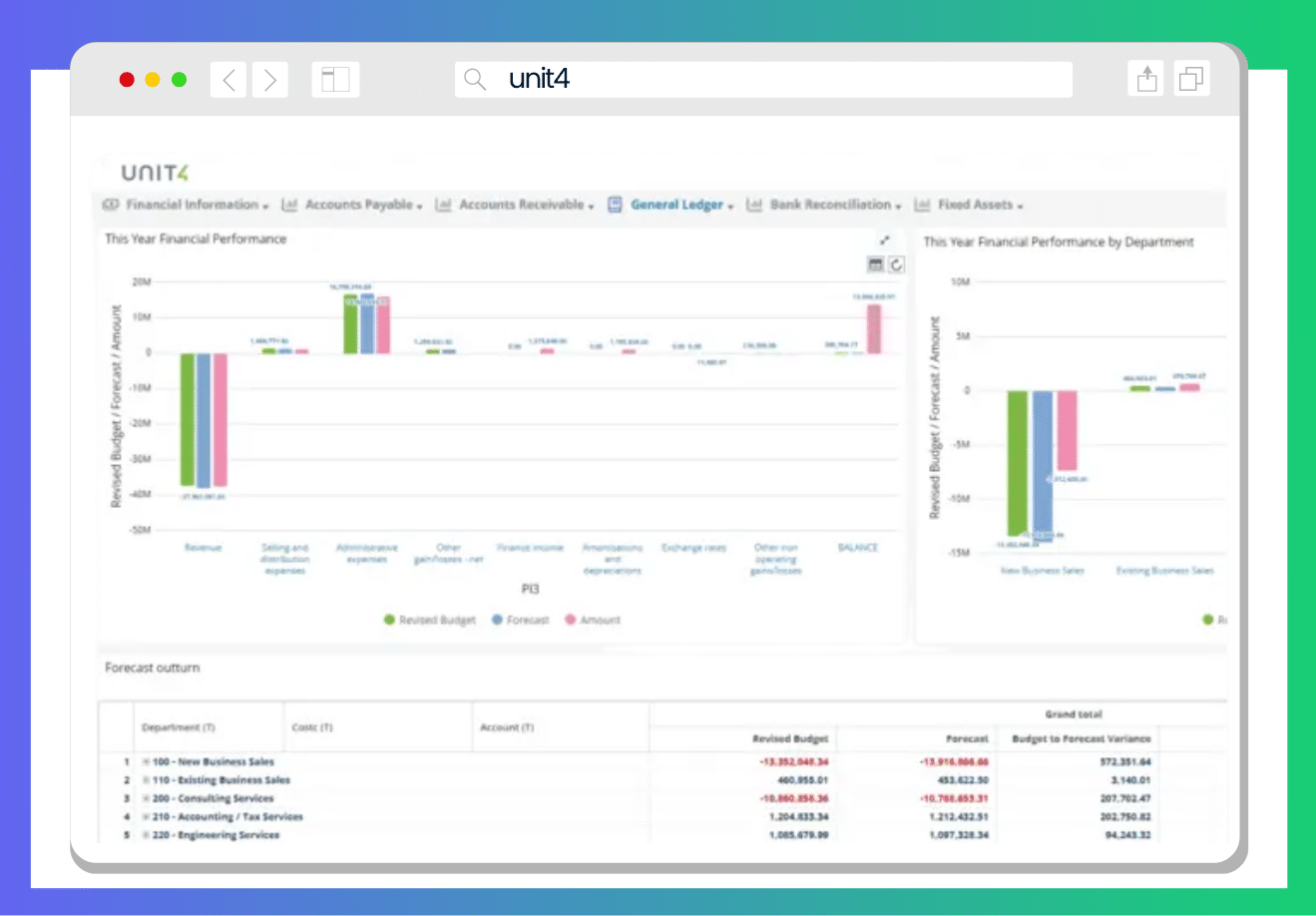
Unit4 ERP is positioned as a cloud-based ERP oriented towards service organizations and people-centric environments, in particular consulting, professional services and the public sector. We address it to structures that seek to align finance, projects and HR in a unified framework, often in a multi-country and multi-entity context.
Key features
- Service-oriented cloud ERP
- Integrated Finance and FP&A
- Project management and resource planning
- Timesheets and invoicing
- Revenue recognition
- HR & HCM
- Reporting and analytics
Benefits
- Structuring financial ERP, integrating accounting, budget management and financial planning.
- In-depth project management which covers creation, planning, resource planning, time entry, invoicing and closing, with a clear continuity between operational execution and turnover recognition.
- Finance-project-HR alignment: the native integration of the modules facilitates consistency between resources, workload, costs and economic performance.
- Integrated reporting, BI, and FP&A tools that support gap analysis, forecast tracking, and capacity trade-offs in complex environments.
- Adapted to multi-country, multi-entity and multi-regulatory international challenges
Bounds
- Structuring implementation : the project requires in-depth framing and sufficient organizational maturity to take advantage of the functional richness.
- High sizing : the ERP may appear oversized for modest-sized or not very formalized consulting structures.
Use cases
Unit4 ERP is suitable for:
- Global consulting and services groups that want to harmonize finance, projects, and HR on a global scale.
- consulting and service companies that want a unified ERP aligning finance, projects and HR, often in a multi-country context.
Unit4 ERP is less suitable for small structures such as firms in the initial structuring phase, for which we advise to favor business ERPs that are lighter and faster to deploy.
How can you avoid the heavy customization of a generalist ERP?
Generalist finance or industry-oriented ERPs offer a robust foundation, but often require significant configuration and customization to cover the operational realities of IT Services and IT consulting.
Stafiz takes a different approach. Our ERP is designed from the outset for IT Services and IT consulting firms. The tool natively integrates everything that is skills management, needs, profiles, resource planning, projected cost and profitability. These building blocks are not based on specific developments, but on integrated, coherent and directly usable business objects.
This design makes it possible to link, without data disruption, the operational and financial dimensions:
- Available skills feed into resource planning,
- the allocations impact the load and the forecast,
- The differences between forecast and actual are visible at both the project and portfolio levels.
Instead of being forced to tailor an industry-ready ERP to your needs, we enable you to drive engagements, resources, and profitability within a framework designed for service models from the start. This approach reduces the complexity of implementation projects, accelerates adoption by teams and secures management over time.
Complete your ERP IT Services with a resource management component
Some IT Services choose to complement their generalist ERP with a front-office brick dedicated to recruitment and resource planning. This approach meets a real need: to structure sourcing, to better monitor candidates and to streamline the connection between available profiles and customer needs. However, this solution remains insufficient to steer the company as a whole.
The most common way of working with a front-office resource brick is based on an ATS + CRM combination that will focus on the connection between the customer need and the sourced profile. This solution is very relevant for IT Services Recruitment-oriented : it professionalizes sourcing, candidate follow-up and commercial exchanges, as it provides a structured view of talent pools and assignments in the process of qualification.
Unfortunately, these tools do not cover the entire project cycle → time → invoicing → profitability, which structurally limits the possibility of global management of missions, or a project portfolio. To manage the CRA, intercontracts, margins, forecasting or complex pricing, it will be necessary to add a new brick: a PSA.
In reality, the challenge is to combine this ATS/sourcing layer (needs & positioning, pre-sales Kanban, CV import, search by skills) with the rest of the ERP cycle. This is exactly what Stafiz offers.
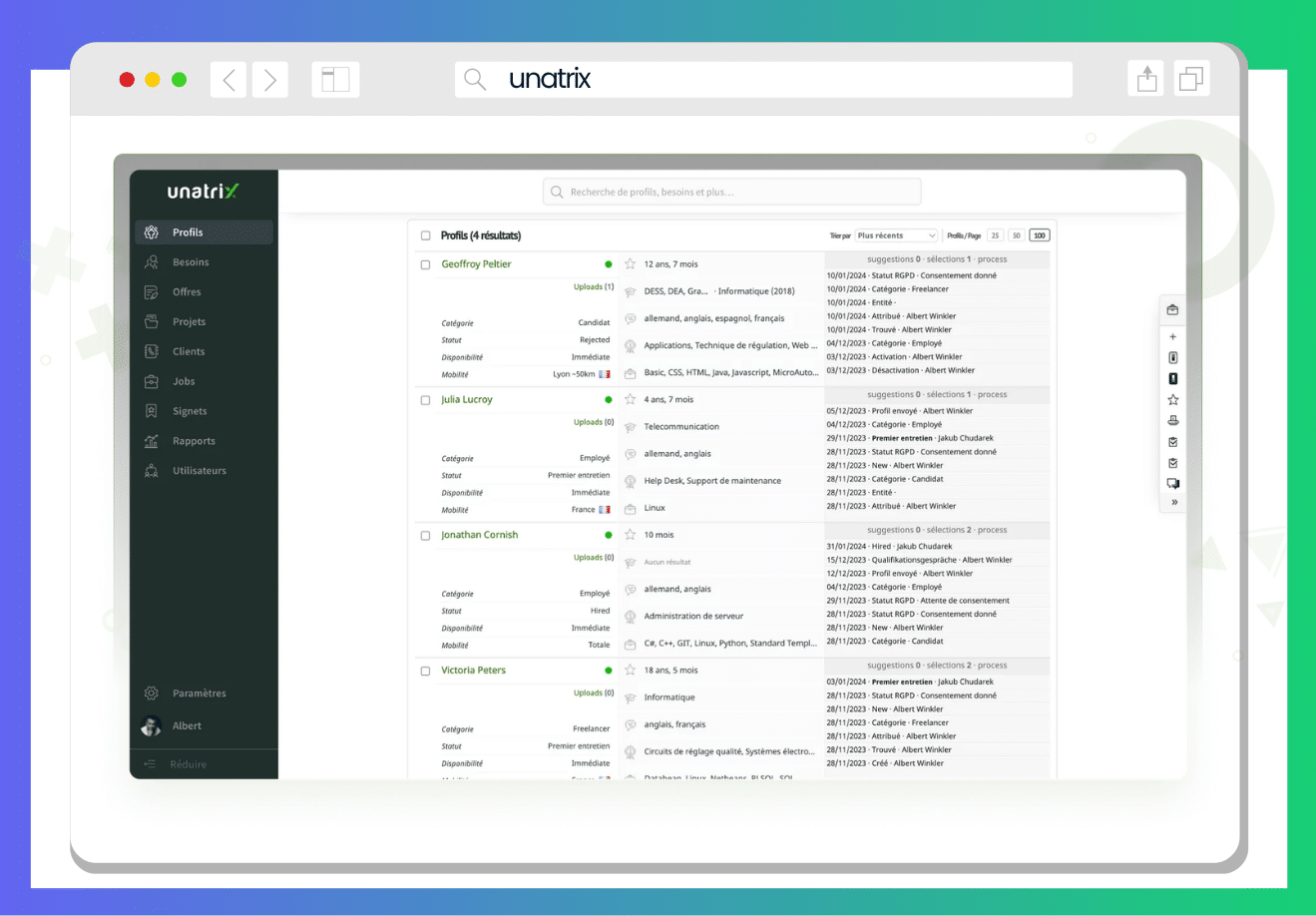
The Unatrix software
Key features
- ATS and applicant management
- CRM and commercial relations
- Recruitment and sales pipeline
- Management of profiles and missions
- Collaboration resource planning and sourcing
Benefits
- Structuring of recruitment: the platform organises sourcing, application follow-up and exchanges with clients, which makes it easier to match available profiles with identified needs.
- Clear view of the pipeline: candidates, assignments, and business opportunities are centralized, making it easy to prioritize recruitment and business development actions.
- Front-office orientation: the tool focuses on the upstream phase, where the speed of positioning and the quality of the pools are at stake.
- Quick to learn: lighter than an ERP, the solution can be easily integrated into sourcing and placement-oriented teams.
- Internal collaboration: Recruiters, sales reps and managers resource planning share a common basis for coordinating their actions.
Bounds
- Lack of financial management: the platform does not cover time tracking, invoicing, margins or profitability by mission.
- Dependence on an ERP or PSA: a third-party tool is still required to manage the back-office and the overall management of the activity.
- Partial project vision: the follow-up stops at positioning, with no continuity towards execution and financial landing.
Use cases
Unatrix is suitable for:
- The IT Services very recruitment and placement oriented, wishing to structure talent and sales above all project management;
- recruitment agencies specialising in IT, consulting or engineering, with a strong need for candidate and client follow-up.
Unatrix is less suited for organizations looking to centralize projects, time, invoicing, and profitability in a single platform.
Frequently asked questions:
A CRM focuses exclusively on managing the commercial relationship: prospects, opportunities, customers. An ERP IT Services goes far beyond that: it manages the entire activity (prospects, customers, projects, time, invoicing, HR, etc.), whereas CRM only covers one aspect. For a IT Services, the CRM can be a brick of a more complete ERP, or a standalone tool to connect to your back office.
There is no universal threshold, but adopt an ERP as soon as your IT Services will give you a good foundation to optimize your human and financial resources. In practice, from 5 to 10 consultants, Excel management becomes an obstacle: invoicing errors accumulate, the monitoring of missions becomes opaque and margin management is lost. A business ERP remains relevant long before it reaches 50 people.
Prices for this type of solution start on average at €35 per month per user. However, the total cost depends on the number of users, the modules activated, the complexity of the configuration and the support for deployment. Some publishers offer modular formulas that allow you to pay only for the features actually used, which significantly reduces the bill for small structures.
It depends on the services offered by the publishers. Some provide the necessary documentation for a client-side migration, while others support it entirely. Some vendors may also work with integrators, who are then responsible for migrating.
This is an important point of differentiation depending on the tool. An adapted ERP must make it possible to monitor the CRAs of subcontractors, to reconcile their incoming invoices with the services performed, and to generate outgoing re-invoicing to the end customer without manual re-entry.