
Updated May 22, 2026
To scale their activities, companies have no other solution than to optimize the management of their projects. Improving day-to-day operations therefore becomes essential to gain competitiveness and conquer new markets.
This is where project governance comes in. It is all the methods and structures that align all the actors and resources mobilized on a project in order to allow its proper execution and financial control, without impacting other projects in progress, or the overall strategy of the company.
Governance should not be confused with project management, which is more limited in scope and stakes. Indeed, project governance involves the definition of procedures and establishes human and financial resources. As a result, it is positioned as an essential method for the sustainability of companies.
In this article, we explain what project governance is, the challenges it represents and present the key factors to help you implement it in the best possible way in your company.
What is Project Governance?
Project Governance: Definition
Defined by the business sociologist Jean-François Chantaraud (2012) as
" the set of rules and methods organizing the reflection, the decision and the control of the application of decisions within a social body ", project governance remains in fact a mode of management and organization.
Consisting of a set of processes, it defines the organization at the global level of the company. Project governance makes it possible to set up the right environment for the effective management of a project portfolio.
Differentiating between project governance and project management
While project management and project governance both involve the delivery of projects within a company, they differ in their dimension.
As project governance is a global methodology, it uses project management as a tool to achieve its strategic objectives.

A strategic dimension
One of the main characteristics of project governance lies in its strategic dimension. Indeed, defining project governance implies taking direction in the vision. Management teams then have a heavy responsibility: that of choosing projects that align with the company's overall strategy.
Why set up project governance?
Guaranteeing a certain level of quality thanks to an efficient structuring and organization, project governance responds to real challenges. In addition, its implementation has many advantages.
Ensure Alignment from Operational to Strategy
Aligning projects with the company's strategy can be complex. However, the implementation of a precise project governance will make it possible to work on this coherence, while taking into account the company's development objectives .
In addition, project governance is particularly useful for reconciling the sometimes divergent interests of the different stakeholders of an organization.
Facilitate Decision-Making
The definition of project governance is based on concrete figures from the company's operational activities .
A reliable analytical vision will help provide all the necessary elements for informed decision-making. It should also be noted that this analysis must be based on relevant financial indicators to be defined strategically.
Optimize Resource Management
Resource management is a particularly complex issue to manage in companies. Indeed, the lack of visibility on availability sometimes complicates the smooth operational running of projects.
By defining project governance upstream, you will improve your long-term vision, which will allow you to better prioritize projects to be developed.
Ensuring Sustainability
While project governance is a major investment within a company as it requires the involvement of teams and management, its benefits are nevertheless significant.
The implementation of project governance contributes to the sustainability of the company by facilitating the smooth running of activities, its proper functioning, which generates a gain in productivity and better profitability. In addition, it allows employees to retain their employees by simplifying their daily activities, thanks to a gain in autonomy and visibility.
Improve communication and collaboration
Project governance helps to streamline the flow of information. This is because each role is defined in advance with transparency. Obtaining information becomes more accessible, as each employee knows perfectly well who to contact. Communication flows are thus simplified and time savings considerable.
The creation of silos between the departments of the project teams and finance does not allow for optimal management of projects. Stafiz provides you with a solution through its project management control tools that allow you to reconcile finance and project management. In addition, the platform access rights, which are fully customizable, provide the right level of information to your various employees. Thus, everyone holds the keys to act at their own level.
Discover Stafiz's planning tool
Functional project governance
Here, the management is in the hands of each business manager. As a result, each department controls its organization and resources. The project manager here plays the role of a coordinator.
This mode of governance is to be preferred for companies that often face silos.
Matrix project governance
With this method, the management is shared between the functional hierarchy and the project managerin order to balance expertise and operational priorities.
This approach is commonly preferred by service companies.
Participatory project governance
Participatory governance involves all stakeholders in steering at each stage. This promotes transparency, collaboration, and consequently, commitment.
Autonomous project governance
In this type of governance, project teams are self-organized, from decision-making to operations.
Autonomous governance is particularly suitable for companies that adopt agile management.
Some examples of project governance
The governance of a project in a large company
For this first example of governance, we are in a large company that is about to undertake a digital transformation project. This type of large-scale project requires many changes and adaptations, especially when the operation is applied on a large scale.
To carry out this project with a high strategic impact, it is necessary to use a hierarchical project governance model. Indeed, the more departments involved, the more a rigid and pyramidal structure is necessary in order to obtain regular results and secure investments.
How is hierarchical governance organized?
An organization with a steering committee (COPIL) at the top of the pyramid on the one hand, and a project committee (COPROJ) on the other hand, is often recommended.
- Composition of the COPIL
- Members: sponsors (Management), PMOs, key business leaders.
- Frequency: monthly points.
- Role: ensure budget arbitration, validation of major milestones, critical risk management and strategic alignment.
- Composition of the COPROJ
- Members: project manager, workshop leaders, technical experts.
- Frequency: weekly updates.
- Role: operational monitoring of progress, day-to-day management of resources and resolution of intermediate bottlenecks.
KPIs to track
- Respect for the overall budget.
- The rate of progress of milestones (Critical Path).
- The end-user satisfaction index.
Governance of a product development project
In this example, we study the governance of a tech company in the context of the development of a new product.
As is often the case in tech scale-ups, governance is decentralized to adapt to more agile management. The objective is therefore to promote responsiveness and rapid iteration, while maintaining product consistency.
How is agile governance organized?
The scrum method is used.
- Synchronization Committee
- Members: product owners (POs) of each team, scrum masters and tech leads.
- Frequency: 2 to 3 times a week (short format).
- Role: Manage dependencies between teams and align with the technical roadmap.
- Product Strategy Committee
- Members: product management, marketing management and general management.
- Frequency: quarterly updates.
- Role: The committee defined OKRs (Objectives and Key Results) and the prioritization of major features for the coming quarter.
Which KPIs are analyzed?
- Team velocity.
- Time to Market (TTM), or the period between production and the release of a product to market.
- The rate of churn and/or engagement on new features.
Project governance for service delivery
Here, the project is purchased by an external customer. This is the sales model for service companies such as IT Services, consulting firms, and creative agencies.
In this context, governance is bilateral : it must ensure profitability for the service provider and satisfaction for the customer.
How is governance organized for a service company?
This type of governance brings together internal actors within the company, and also external ones, on the customer side.
- The Account Management Committee for strategic governance
- Members: the account manager (service provider side), the purchasing manager/CIO (customer side).
- Frequency: quarterly.
- Role: review of the commercial relationship, renewal of contracts and long-term vision.
- The operational monitoring committee
- Members: project manager (service provider side), operational contact person (customer side).
- Frequency: bi-monthly.
- Role: validation of deliverables, monitoring of consumption (man-days) against the quote, and management of change requests.
KPIs to study
- The project margin.
- Compliance with SLAs (Service Level Agreements).
- The rest to be done.
Summary table of project governance examples
| Ideal for... | Long, expensive and multi-department projects. | Innovation, software products, uncertain environments. | Assignments for external clients with a commitment to results. |
| Decision structure | Vertical & Formal: Arbitrations rendered by the management (COPIL). | Horizontal & Standalone: Decisions made by the teams (PO/Team). | Bilateral: Co-decision between the service provider and the customer. |
| Frequency of exchanges | Monthly (strategic) and weekly (operational). | Very common (Daily or bi-weekly). | Bi-monthly or monthly depending on contractual milestones. |
| Main focal length | Respect for the scope, the budget and the deadlines (V-cycle). | User value, responsiveness to change, and velocity. | Profitability of the project and customer satisfaction/loyalty. |
| Major risk monitored | Budget overruns and strategic misalignment. | Technical debt and lack of long-term vision. | Scope creep and margin decline. |
| Indicator of Achievement (KPI) | Adherence to the "Baseline" (Costs/Deadlines). | Adoption rate and team velocity. | Gross margin and compliance with SLAs. |
Measuring performance
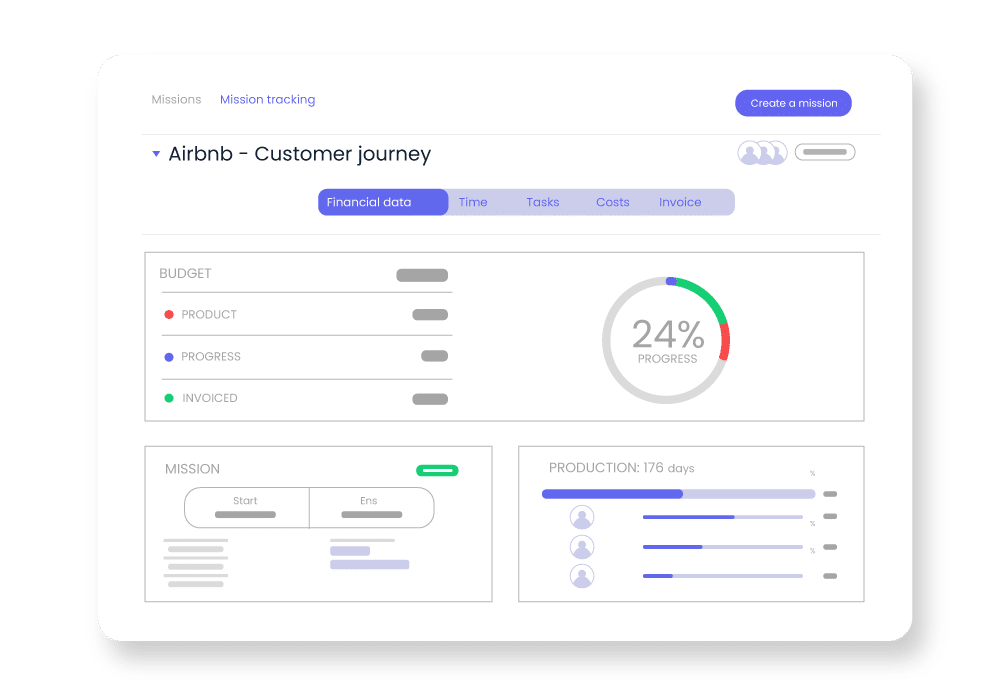
Performance measurement is one of the key factors in project governance. Any strategic decision must be based on facts, taking the form of accurate reporting.
The latter will help the company to move towards the most financially coherent projects and will also facilitate recruitment in anticipation of the coming months.
Staying flexible
Frequently asked questions:
There are 5 models in project governance.
- Hierarchical governance: management and decisions are centralized by management. The operational teams receive and apply the instructions given by the hierarchy. This model is preferred in large companies, where a structured system facilitates production.
- Functional governance: management is in the hands of each business manager. As a result, each department controls its organization and resources. The project manager here plays the role of a coordinator. This mode of governance is to be preferred for companies that often face silos.
- Matrix governance: management is shared between the functional hierarchy and the project manager in order to balance expertise and operational priorities. This approach is commonly preferred by service companies.
- Participatory governance: all stakeholders are involved in steering at each milestone. This promotes transparency, collaboration, and consequently, commitment.
- Autonomous governance: project teams are self-organized, from decision-making to operations. It's an agile management.
The "3 Ps" of project governance refer to:
- project: all methods to ensure the proper execution of the missions,
- sustainability: the challenge of building a project governance that is long-term, designed to adapt to growth objectives and market developments,
- Profit: Ensure that projects are aligned to maximize the profitability of the business.
A project is profitable when it brings a return on investment, whether financial, strategic or organizational. Monitoring of the right indicators (margin, utilization rate sold, planned/realized variances) then allows us to judge precisely.