The Best Consulting Firm ERP Softwares (Guide)
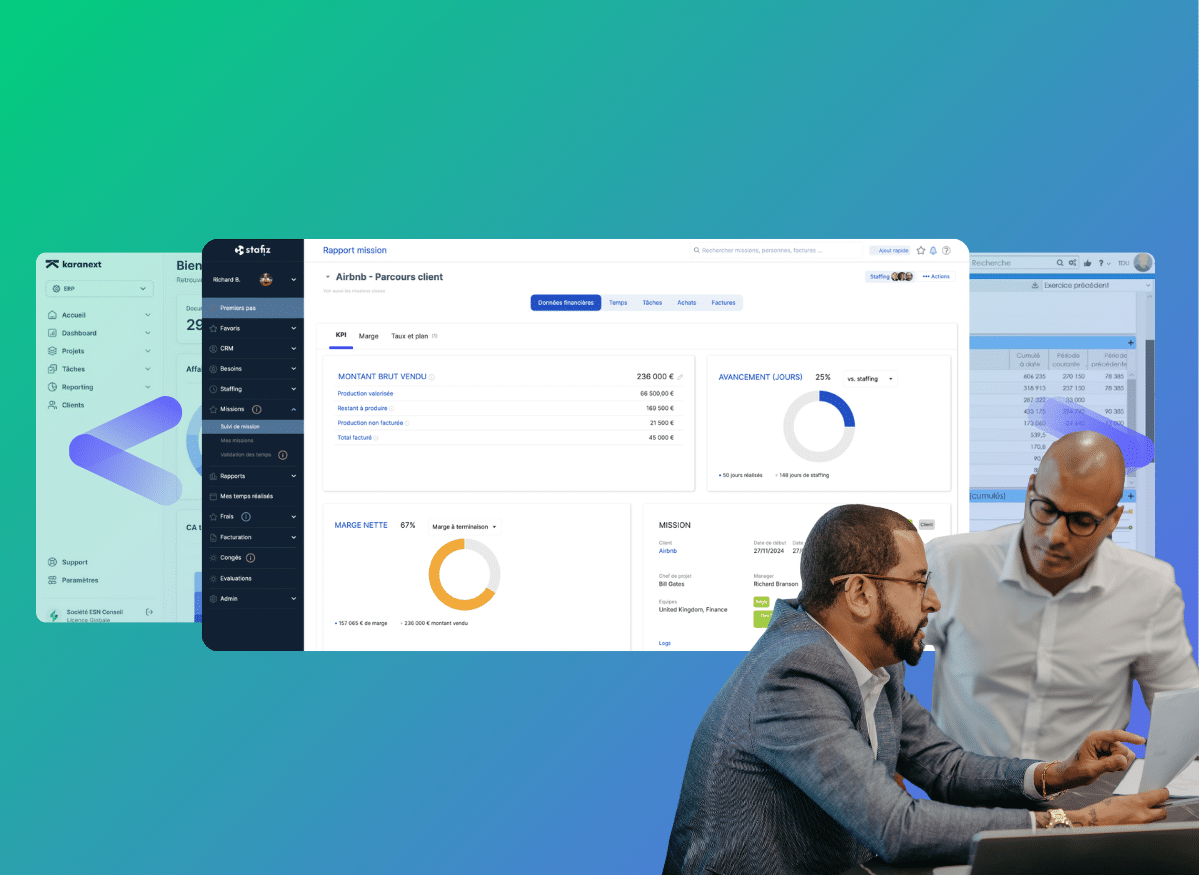
Choosing an ERP is a strategic challenge for a consulting firm: it conditions the control of the load, the margin and the invoicing. But not all solutions on the market are equal, and even less so when it comes to jobs based on intellectual performance.
A consulting firm manages time, skills and project profitability. This is why a specialized ERP becomes essential as soon as the activity is structured: it unifies the data, eliminates re-entry and allows anticipatory rather than reactive management.
In this article, you will find a clear and complete comparison of the most used ERPs by consulting firms. We analyze their positioning, their real features, their use cases, their strengths and limitations, in order to help you choose the right solution for the size, maturity and objectives of your organization.
Comparison Table of ERP Softwares for Consulting Firms
To make your selection of the best ERP software for consulting firms easier, this table compares the most commonly used ERPs by consulting firms. You will find at a glance their positioning, key features, use cases, strengths and limitations, in order to identify the best solution for your structure.
| Stafiz | All-in-one business ERP for consulting firms & IT Services | Sales pipeline, resource planning, project management (management & package), time & expense monitoring, invoicing, financial management (margins, cashflow), employee portal, accounting / HRIS / BI integrations. |
Consulting firms and IT Services who want to unify CRM, production, and finance in a single platform. Ideal for growing structures from 10 to 500+ employees, multi-BU or multi-activity. |
Very broad coverage of the service value chain. Strong depth on project profitability management and capacity. Verticalized solution for consulting, with fine-grained business parameterization (types of assignments, intercontract, rights, billing models, etc.). |
Rich tool that requires a serious implementation framework. May seem oversized for a micro cabinet simply looking for time tracking and basic invoicing. |
| Everwin | Historical ERP for service companies (consulting, IT Services, design offices) | CRM, project and business management, time and expense tracking, invoicing, Standard dashboards, reporting direction. |
Consulting firms and IT Services looking for a robust and proven ERP, with many standard reports for piloting. Rather suitable for structures with 50 to 1000+ employees. |
Mature, functionally rich solution, widely used on the French market. Covers needs well "classic" project management, time, invoicing and reporting. |
Ergonomics perceived as less modern than recent cloud-native solutions. Heavier deployment projects for small structures. |
| Axelor | Open-source modular ERP/CRM/BPM for service companies | Finance, CRM, projects, HR, invoicing modules. Billing by time spent, fixed price or advancement, Cost management and margins by project, monitoring of expenses and revenues, cash management and dematerialized invoicing. |
Consulting firms, IT Services and engineering companies with an IT department or an integrator, Wanting a customizable ERP foundation. Relevant for companies with 50+ employees. |
High flexibility thanks to low-code and activatable modules. Open-source, limiting lock-in owner. Adaptable to several professions and activities beyond consulting. |
Requires a major integration project (configuration, possible developments). Less ready to use for very specific consulting needs such as resource planning end or the capacity forecast. |
| Karanext | French ERP "service professions" for consulting, IT Services and engineering | CRM and opportunity management, quotes and costing, calculation of projected profitability, Fixed-price project monitoring, planning and resource planning, time entry, invoicing, Integrated accounting, performance indicators. |
Consulting firms and IT Services Growing company wanting to centralize CRM, projects, and invoicing in a single ERP. Core target: 10 to 300 employees. |
Wide functional scope for service companies. French solution with local support. Good compromise between commercial management, business follow-up and back-office. |
More generalist "services" approach: some very specific issues in consulting (resource planning sophisticated forecasts, complex forecasting scenarios) may be less advanced. Analytical depth to be compared as needed. |
| Atimeus | Production-centric SaaS ERP for IT Services and consulting firms | Follow-up of consultants (time, CRA, leave, expenses), resource planning Forecasting, Mission Management (assignments, remaining to be done, margin, subcontracting), customer invoicing, FAE/BCP provisions, Reporting billable utilization rate, turnover, margin. |
IT Services, consulting firms and web agencies that want to secure production and invoicing, with good visibility on profitability. Suitable for structures from 10 to 200 people. |
Model-first solution IT Services / consulting, with real-time business KPIs. Focus on the proper execution of missions and the reliability of invoicing. SaaS deployment generally faster than a traditional on-premise ERP. |
Less focused on pre-sales and advanced CRM. Multi-BU management and BI integrations to be analyzed according to the level of sophistication sought. |
| Projectworks | PSA (Professional Services Automation) for consulting and services companies | Resource planning (resourcing & forecasting), time and expense tracking, Project management, invoicing, financial reporting, profitability analysis per project, client or team. |
Consulting firms, engineering or architectural firms, software companies that want to connect time, resources and profitability in a single tool. Typical target: 20 to 500 employees, often in English-speaking markets. |
Very good focus on the link between planning, time spent and margin. Integrations with solutions accountants and CRM (Xero, QuickBooks, HubSpot, Salesforce, etc.). Modern UX oriented professional services. |
PSA rather than full ERP: often requires another tool for accounting and certain processes back office. Solution mainly in English, potentially less suitable for small structures very French-speaking. |
| Centric | PLM & planning/pricing for product-oriented companies (more than a consulting ERP) | Product life cycle management (PLM) from concept to restocking, centralization of product and material data and collections. Planning, pricing & inventory, market intelligence and PXM modules (PIM/DAM + content management), in SaaS cloud mode. |
Brands and retailers in fashion, luxury, retail and consumer goods. Interesting for consulting firms that are very involved in product development and the management of assortments. Structures with 50 to several thousand employees. |
Very advanced specialization in the product life cycle, collaboration between design, merchandising, sourcing and quality. AI-based pricing and inventory optimization modules, International, multi-site and multi-language platform. |
It is not a business ERP for consulting firms: does not natively cover accounting, resource planning or mission management. Used more as a product development-oriented complement, with an ambitious implementation project. |
Stafiz: the Best Business ERP for Consulting Companies
Stafiz is an ERP designed specifically for service companies (consulting firms, IT Services, engineering) from 10 to 500+ employees. Its platform unifies the sales pipeline, the resource planning, production and financial management to eliminate silos between sales, operations and finance, and anticipate load tensions several months in advance.
💡 If you are looking to evaluate our solution, you can request an online demo of our ERP for consulting firms.
What are the key features of Stafiz for ERPs?
Stafiz brings together all the building blocks necessary to manage a consulting firm in a single platform. Its features cover the entire value chain, from the sales pipeline to financial management.
- End-to-end management: the platform covers the entire value chain (commercial, resource planning, project, invoicing and finance) to guarantee a single and reliable data, eliminating inter-tool re-entries.
Stafiz Dashboard: financial capacities and progress of a mission
All the advantages of Stafiz for managing projects
- Management of capacity, use of consultants, project margins and cash flow: Stafiz displays this information in real time, and allows you to anticipate future resource needs. The tool highlights the periods when the load will exceed internal capacities, making it possible to adjust upstream (recruitment, subcontracting or reorganization of the schedule) to avoid overload or underload.
Management of future resource needs to anticipate capacity planning in Stafiz.
Dashboards display occupancy rate in days or percentages per consultant, team, or BU, allowing for instant identification of cross-contracts and overloads.
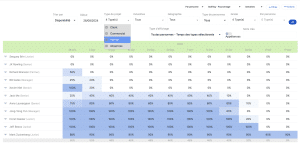
Visibility on occupancy by employees, in days or as a percentage in Stafiz.
- Employee portal: Consultants enter their time, absences and expense reports in a simple and modern interface. This data automatically feeds into planning, margins, invoicing and financial exports. Thanks to accounting , HRIS, BI or payroll connectors, Stafiz can be properly integrated into the existing ecosystem without multiplying tools.
These functionalities form a complete foundation for unifying data and making the operational and financial management of consulting firms more reliable.
What are the use cases of Stafiz for consulting firms?
Stafiz addresses several typical scenarios faced by consulting firms and IT Services and IT consulting firms, especially when they want to structure their operations and improve profitability.
- Consulting firms that want to unify CRM, resource planning, production and finance: Stafiz centralizes the entire value cycle in a single platform, allowing sales, operations and finance teams to work with a single and reliable data. This unification eliminates information loss and improves profitability on a mission-by-mission basis.
- The IT Services fast-growing: Stafiz helps scaling organizations to control their margins, anticipate capacity and manage several BUs without losing agility. The platform unifies management, package and technical assistance in a single repository, making it easier to monitor key KPIs.
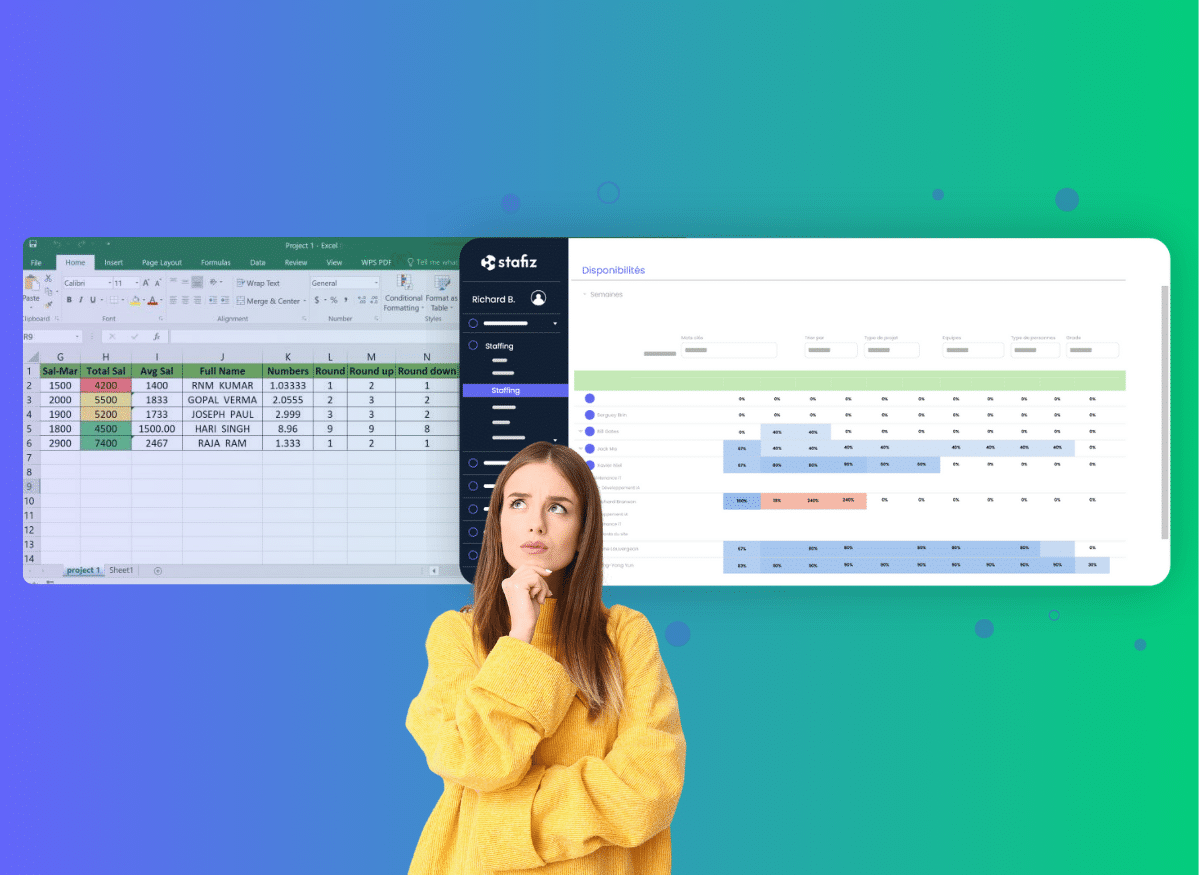
- Companies that feel limited by Excel: Stafiz replaces spreadsheets and dispersed tools (CRM, project management, invoicing, accounting) with an integrated system. Margins, capacity, and profitability are calculated automatically, eliminating time-consuming errors and re-entries.
Thanks to its business positioning and the integration of the resource planning and financial data, Stafiz is suitable for both growing structures and organizations looking to standardize their processes or move away from a fragmented operation in Excel.
What advantages does Stafiz bring to consulting firms?
Stafiz's benefits go beyond simple centralization: the solution provides advanced financial management and resource optimization capabilities.
- Very wide functional coverage: CRM, resource planning, projects, invoicing and finance are centralized in a single tool, ensuring process continuity that is difficult to achieve with fragmented solutions.
- Financial management: Stafiz automatically calculates turnover according to the right methodologies, margins by project and by period, as well as financial forecasts (landings, cash flow). This analytical depth allows predictive and not reactive management.
- Complete management of the resource planning : The tool structures planning for all types of activities, analyzes future resource needs, and proposes the best assignments using matching AI. The search engine automatically identifies the most relevant profile.
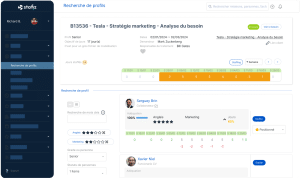
Stafiz's powerful search engine also uses AI to provide you with the best possible staff assignments.
Thanks to this business-oriented positioning, Stafiz stands out as a structuring tool for service companies.
In addition, Stafiz is ready for the transition to electronic invoicing : this will make this transition easier for you!
What limits should be anticipated before adopting Stafiz?
Like any ERP covering a wide functional scope, Stafiz has certain points of vigilance, especially for the smallest structures or those looking for a very light tool.
- The solution is broader than simple project management tools: Stafiz's functional richness requires an implementation framework to select the modules adapted to your structure, set up workflows and train teams.
- The platform may seem too complete for a micro-firm. Structures with less than 10 people, looking only for time tracking and simple invoicing, may find Stafiz oversized. In this case, a phased approach (starting with isolated modules: time + billing) is recommended before enabling the advanced features of resource planning and financial management.
These limits require a clear framework to properly size your project and select the relevant modules.
What size and profile of companies does Stafiz correspond to?
Stafiz primarily targets structured or growing service organizations, where capacity management, project margins, and resource planning becomes critical.
- Optimal Size : consulting firms and IT Services from 10 to 500+ employees. Below 10 people, the investment can exceed the immediate profit unless there is expected strong growth. Beyond 500 employees, the solution remains suitable but requires particular attention to the multi-entity architecture.
- Target Sectors : consulting in strategy, management, digital transformation, IT Services, engineering companies, technical design offices, operational audit firms. All the professions selling qualified time and managing complex multi-resource projects.
- Organizational maturity : companies in the structuring or scaling phase that have gone beyond the artisanal stage but maintain a culture of agility. You potentially have several BUs or types of activities, you potentially operate internationally, and you are looking to industrialize without rigidity.
Everwin: a Historic ERP for Consulting Firms
Everwin offers two versions: SX (modern cloud) and GX (very rich history), covering all management needs for consulting firms from 50 to 1000+ employees.
What are the key features of Everwin for ERPs?
Everwin offers a set of coherent building blocks to cover the standard needs of service companies, whether it is business follow-up or administrative management.
- ERP for service companies: the solution covers the CRM, project management, time tracking, expense reports, invoicing and reporting in a single environment. Consultants record their time and expenses on a web or mobile interface, and this information feeds into the value calculation, invoicing, and business case. Companies that are looking for a stable functional base find it a methodical framework for organizing their business portfolio.
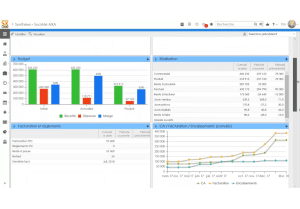
- Customizable dashboards: Everwin offers a library of out-of-the-box reports to track sales activity, job performance, or resource utilization. These dashboards are adapted to the needs of departments who want to have a regular and structured reading of their activity without going through specific BI developments. This approach offers an actionable vision of the forecast and the realized, useful for preparing budgetary and operational trade-offs.
This proven functional foundation provides a solid foundation for organizations seeking a structured and recognized management framework in the industry.
What are the use cases of Everwin for consulting firms?
Everwin is particularly well suited to the expectations of companies looking for stability, continuity and consolidation in their operational management.
- Consulting firms looking for a robust ERP: Firms looking for a stable, industry-proven tool that can support established processes find Everwin a solution that aligns with their management practices. The platform is based on a long presence on the French market and an extensive installed base.
- Organizations that need standardized reporting: Everwin offers a wide set of pre-configured reports. These reports cover profitability, billing forecasts, sales activity, and team utilization. Structures that need to feed a management committee or produce recurring analyses find an operational analytical framework from the moment they are commissioned. This approach is suitable for companies that want to quickly have reliable indicators without hiring a dedicated BI project or multiplying manual extractions.
These use cases illustrate that the solution is primarily aimed at mature structures that want a reliable ERP that is already widely adopted by their sector.
What benefits does Everwin bring to consulting firms?
The solution capitalizes on a long presence on the market and a functional richness built up over the years.
- Large installed base: proven and stable solution, with more than twenty years of existence and thousands of active customers, guaranteeing a continuous and reliable product roadmap." (Emphasis on stability and continuity).
- Solid coverage of traditional needs: the functional scope is suitable for companies that prefer a structured solution rather than an assembly of specialized tools. Everwin brings together all the expected building blocks (projects, time, invoicing, reporting), with years of continuous improvement
- Integrated tax compliance : through the acquisition of Ventya, Everwin offers a registered Partner Dematerialization Platform (PDP) directly connected to the ERP. You issue, receive, and report in a single system, reducing interfaces and the risk of non-compliance.
- Ecosystem of integrator partners : everwin relies on a network of certified partners capable of supporting the deployment and customization of their solution in firms with already structured processes.
Everwin is therefore a secure choice for companies looking for robustness, compliance and functional depth.
What are the limits before adopting Everwin?
Some features of the solution can be a hindrance for organizations looking for mobility, speed or modern interfaces.
- Ergonomics could be improved on some versions : although Everwin SX modernizes the interface, the historic GX version retains a less fluid ergonomics than recent cloud-native solutions.
- Heavy implementation for small structures: Everwin projects, particularly on GX, involve significant configuration and training phases. For a small organization (less than 50 people), this cycle may seem disproportionate compared to plug-and-play solutions.
- High total cost: Everwin's TCO (licenses, maintenance, hosting, integrator support) can exceed that of pure subscription-based SaaS solutions. This additional cost, justified by the functional depth, requires a precise calculation of the ROI.
These limitations require a precise assessment of internal needs to ensure that the functional depth justifies the project load.
What size and profile of companies does Everwin correspond to?
Everwin mainly targets established structures whose internal processes are already formalized and extended to several teams.
- Recommended size : companies with 50 to 1000 employees, with existing and well-established internal processes, and a significant number of parallel projects.
- Privileged sectors : engineering, technical design offices, IT Services on complex lump-sum projects, audit and consulting firms with multi-year business management. All the business lines requiring detailed traceability of operations and regular and detailed reporting, with high reliability, and a data structure that supports cross-functional analyses,
- Organizational maturity : established structures with formalized processes and teams dedicated to management (management control, sales administration, accounting).
- Security-first : Organizations where business continuity and regulatory compliance take precedence over the interface. You value proven robustness over the latest user experience.
The software is therefore suitable for organizations that need a robust ERP capable of managing a large volume of projects and business.
Axelor: an Open-Source Modular ERP for Consulting Professionals
Axelor is aimed at organizations that are looking for a customizable ERP thanks to its open-source and low-code architecture. The platform allows workflows to be fine-tuned, but requires a certain level of technical maturity. Here's what it brings (and what it requires) from a consulting firm.
What are the key features of Axelor for ERPs?
Axelor combines ERP, CRM and BPM in a modular open-source foundation designed to adapt to a wide range of business processes.
- Modular platform: Axelor brings together ERP, CRM and BPM in a low-code base composed of finance, CRM, projects, HR and invoicing modules. Each brick is activated according to your priorities.
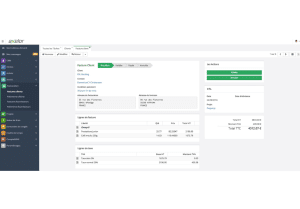
- Service management & invoicing: For service companies, the tool manages the time spent, the package or the progress, while calculating costs, margins and budgets per customer or project. Billing rules follow your business models (actual vs. forecast tracking).
- Financial management & e-invoicing: Axelor centralizes expenses, revenues, costs per project and cash flow. The modules include paperless invoicing, with a clear trajectory towards e-invoicing compliance 2026 (PDP candidate status).
This modular architecture makes it a flexible solution that can grow with your business needs.
What are the use cases of Axelor for consulting firms?
Axelor is primarily aimed at companies wishing to deeply customize their workflows and structure several activities within the same platform.
- Firms with a CIO or an integrator: Axelor is primarily aimed at organizations with an IT team or an integration partner capable of configuring modules, adapting workflows and maintaining the platform.
- Multi-activity organizations: structures combining several professions (consulting, engineering, training, possibly product publishing) take advantage of its modularity. Modules can be added or adjusted without multiplying tools, which is suitable for composite operating models.
- Consulting firms in need of a customizable generalist ERP: Axelor is suitable for companies looking for a modular base for business management, without being constrained by a vertical ERP imposing a standardized operation. The tool then serves as a basis for modeling specific internal processes, including business validation circuits.
The tool becomes particularly interesting for structures with an IT team or an integrator ready to model internal processes.
What advantages does Axelor bring to consulting firms?
Axelor emphasizes flexibility and adaptation to business specificities through its low-code approach.
- Great flexibility: Axelor is based on a platform in which each module (finance, CRM, projects, HR, invoicing) is activated according to your priorities. It's a low-code solution, which means your teams can easily adapt it to your business processes. You change your internal processes as your business evolves, a rare ability to scale in an ERP.
- Service-oriented project management and invoicing: the dedicated modules manage the invoicing models used in consulting (time spent, fixed price or progress) with the monitoring of costs, margins and budgets by client or project. Axelor consolidates expenses, revenues and cash flow in a single repository.
- Open-source: The open-source model gives you full access to the system's code. You keep control of your data, future developments and the choice of your service providers, which avoids dependence on a single publisher.
This customization capacity makes it possible to build an ERP that is very well adjusted to internal practices, avoiding the constraints of overly standardized tools.
What are the limitations of the Axelor software?
Axelor's modularity implies a more technical implementation project than that of a ready-to-use verticalized ERP.
- Heavy integration project: Axelor requires real configuration work: needs analysis, configuration of modules, customization of workflows, and sometimes specific development. A firm without a CIO or integrator partner quickly experiences the limits of low-code.
- Less immediate business features: The very specific needs of the Council (resource planning , capacity projections, margin scenarios) are not ready for use. They require advanced configuration where a verticalized solution offers them natively.
These elements call for a reflection on the resources available internally to guarantee a controlled deployment.
Who is the Axelor software for?
- Optimal size: Axelor is suitable for companies with 50 or more employees, who have the time and resources to carry out a comprehensive and demanding integration project.
- Target sectors: consulting firms, IT Services, engineering companies and design offices find in Axelor a foundation capable of unifying their activities, especially when their business models combine intellectual service, technical projects and operations requiring precise financial monitoring.
- Specific business processes: Companies with workflows that differ significantly from market standards that want to model their internal rules, as low-code allows them to create validation or management workflows that are fully tailored to their business methods.
Karanext: a French ERP for Consulting Companies
Karanext offers an all-in-one base to structure sales management, missions and invoicing. Designed for service companies, it aims for the right balance between simplicity, functional coverage and centralization. Here are the cases in which it adapts well and where it shows its limits.
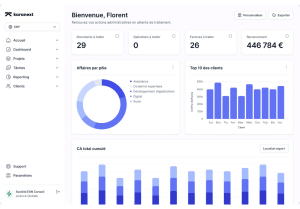
What are the key features of Karanext for ERPs?
Karanext offers a complete functional base designed to structure sales management, missions and invoicing.
- ERP for business services: Karanext brings together in a single platform the monitoring of assignments, the management of fixed-price projects, the management of production and financial visibility. This unified logic facilitates the circulation of data and aligns the work of the sales, operational and administrative teams.
- Sales centralization: the CRM brings together opportunities, quotes and costings, while calculating the projected profitability from the pre-sales stage. The continuity between these stages avoids the frequent breaks between the commercial promise and the execution of the missions.
- Project monitoring and invoicing: the solution frames the resource planning, planning, time entry and invoicing, with a view of margins and project KPIs. Validated data automatically propagates to the accounting, reducing the discrepancies between production and recognized revenue.
It is a solution suitable for organizations with a minimum of technical maturity and wishing to avoid the limitations of proprietary solutions.
What are the use cases of Karanext for consulting firms?
Karanext offers a functional set dedicated to service companies wishing to centralize commercial management, project management and invoicing.
- Consulting firms looking for an all-in-one French ERP: Karanext is aimed at structures that want to bring together CRM, mission management and invoicing in the same environment, without multiplying the tools or complicating their internal exchanges. The approach is suitable for organizations that favor a French publisher capable of covering a wide scope without entering into overly specialized business mechanisms.
- The IT Services and growing firms wishing to move away from Excel: Karanext responds to teams that still manage their projects and invoicing through dispersed files. The move to a centralized platform provides a more reliable framework for times, milestones and billable production, with a level of configuration adapted to structures that want to industrialize their practices without launching a heavy ERP project.
The tool thus offers a homogeneous basis for structuring the essential processes of consulting firms and IT Services.
What benefits does Karanext bring to consulting firms?
Karanext responds to structures looking for simplicity, centralization and automation of their administrative operations.
- Tool designed for service companies: Karanext covers the typical needs of consulting, IT Services and engineering, with a functional scope large enough to structure CRM, production, time and invoicing without multiplying applications. This approach is suitable for organizations that are looking for a single foundation rather than a suite of specialized tools.
- Good balance between sales management, project management, time and invoicing: the teams follow up on opportunities, cost assignments, enter their time and consolidate invoicing data in a common repository, which facilitates daily operational management.
- French solution (hosting, support, local context) which can facilitate exchanges on regulatory, HR and accounting aspects. The teams have access to local support and a solution aligned with the practices of the French market.
These use cases demonstrate that it is aimed at organizations wishing to move away from Excel and gain consistency without deploying a heavy ERP.
What are the limits to using Karanext as an ERP for consulting?
Karanext highlights a balance between commercial management, production and invoicing, in a unified and intuitive environment.
- Karanext is a generalist ERP designed for service companies in the broad sense (consulting, IT Services, engineering). Some expectations that are very specific to consulting remain less advanced than in a verticalized tool like Stafiz. It's more of a solution focused on administrative efficiency rather than complex analytical needs.
- Personalization and analytical depth are lacking compared to a solution that is very focused on financial management. Karanext's strength lies in simplifying the back office, not in building sophisticated analytical models. A prior review of internal expectations is required to avoid a functional gap.
This pragmatic approach will suit companies that prioritize efficiency and speed of use.
What size and profile of companies does Karanext correspond to?
The generalist vocation of the solution can show its limits for organizations with very advanced analytical or business expectations.
- Optimal size: Karanext is suitable for consulting firms with 10 to 300 employees. At this stage, teams are looking to structure CRM, production and invoicing without supporting an ERP that is too complex or cumbersome to deploy.
- Target sector: the positioning covers consulting, engineering and design offices. Organizations selling qualified time, with a mix of time and expenses, find a cohesive environment to centralize day-to-day operations.
It is therefore essential to validate the functional adequacy before the project, especially for complex financial management needs.
Atimeus: a SaaS ERP for Consulting Firms
Atimeus favours a production-centric approach: monitoring of time, margin, assignments and invoicing. Its strength lies in its simplicity of use and speed of deployment, which makes it an attractive solution for growing structures. Here are its priority uses and points of vigilance.
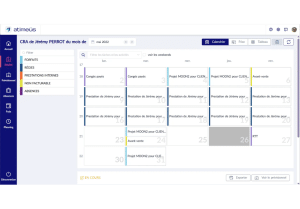
What are the key features of Atimeus for ERPs?
Atimeus focuses on the business fundamentals of consulting firms, with a production-oriented approach and data reliability.
- ERP SaaS services: Atimeus brings together the needs of IT Services, consulting firms, web agencies, and engineering companies in a single cloud environment. You centralize production, time, financial management and invoicing without an internal infrastructure.
- Consultant Follow-up: the tool structures daily uses: time and CRA entry, management of leave and expenses, visualization of the resource planning forecast. This operational base makes the data used for invoicing and margins more reliable.
- Mission management: project managers manage assignments, risks, remaining costs, advancement, margins, subcontracting and purchases/resales. The whole creates a clear reading of the performance mission by mission, with alerts on drifts.
- Invoicing and financial reporting: Atimeus generates invoices on the customer side, tracks deadlines, values turnover and automatically calculates FAE/PCA provisions. Business indicators (billable utilization rate, turnover, margin) are updated in real time to secure closing and management.
The solution is therefore a coherent tool for monitoring missions, time and profitability on a daily basis.
What are the use cases of Atimeus for consulting firms?
Atimeus is mainly designed for organizations that want to make their operational processes more reliable while maintaining a solution that is easy to deploy and use.
- The IT Services and firms that want a production-centric ERP: Atimeus is suitable for organizations whose operational priority remains the execution of missions. Time tracking, visibility on the margin and control of the remaining work to be done structure a daily management, without an advanced CRM layer.
- Structures seeking to make invoicing and monthly closing more reliable. The solution secures the critical stages of the financial cycle: time validated, invoices generated without forgetting, FAE/PCA provisions automatically calculated. Teams limit re-entry, reduce errors, and stabilize cash flow while speeding up closing.
It is becoming a relevant choice for organizations looking for a production-centric ERP before expanding their functional scope.
What benefits does Atimeus bring to consulting firms?
Atimeus values user experience and speed of adoption, two essential elements in businesses based on data entry by consultants.
- Solution designed for the consulting model: you have a direct reading of operational performance without complex configurations, which is suitable for structures that want to make their production more reliable before expanding their functional scope.
- Practicality-oriented interface: ergonomics are designed for consultants, project managers and management. Times fill up quickly, schedule views remain legible, and key information is accessible from a simple dashboard. This approach reduces friction and increases the quality of the data collected.
- Rapid SaaS deployment: Cloud architecture reduces technical requirements and accelerates provisioning. Atimeus can be adopted in a matter of weeks, making it suitable for organizations looking to secure time, management, and billing without launching a long-term ERP project.
This approach improves the completeness of the data and reinforces the quality of operational management.
What limits should you anticipate before adopting Atimeus?
Some bricks, in particular advanced CRM or multi-BU management, are less developed than in more complete ERPs.
- Limited pre-sales scope: Atimeus is less focused on the pre-sales / advanced CRM part and multi-BU management than some more complete ERPs. Teams that manage structured sales cycles (detailed pipeline, scoring, automations) will need to maintain a complementary tool or rely on a broader solution.
- Less developed multi-BU management: For organizations that have multiple entities, cost centers, or BUs that require advanced consolidations, reporting capabilities will need to be examined precisely to validate their fit with your business model.
- Integration ecosystem to be analyzed: companies with a lot of tools (BI, HRIS, payroll or finance) will have to check the depth of the connectors and the maturity of the API, because the expected interoperability conditions the industrialization load to be expected.
Organizations with high business or analytical complexity will therefore need to provide add-ons or an alternative solution.
What size and profile of companies does Atimeus correspond to?
Atimeus targets growing teams looking to stabilize their production and invoicing without committing to a heavy ERP project.
- Recommended size: consulting firms and web agencies with 10 to 200 people in the structuring and growth phase, when the main challenge is to make production, time tracking and monthly invoicing more reliable.
- Suitable industries: Organizations that rely on intellectual delivery benefit from a tool that focuses on the consultant, the mission, and operational profitability.
This orientation makes it a solution suitable for structures of 10 to 200 people who prioritize simplicity and speed.
Projectworks: PSA for Consulting Firms and Services
Projectworks adopts a PSA logic focused on the relationship between time, projects and profitability. It is particularly suitable for organizations wishing to make their financial forecasts more reliable and integrate their invoicing with Anglo-Saxon accounting tools. Here is how it is positioned among the solutions on the market.
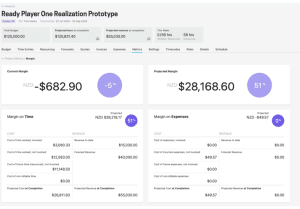
What are the key features of Projectworks for ERPs?
Projectworks is based on the triptych of time, projects and profitability, with a PSA logic focused on financial management and forecasting.
- Specialized PSA (professional services automation) platform: Projectworks structures the management of consulting, engineering, architecture and software companies around a single foundation that links planning, time tracking, invoicing and profitability.
- Resourcing & forecasting: The solution includes resource planning, load forecasting, and billing forecasting, which helps project managers arbitrate months in advance.
- Time and expense tracking: Consultants record their hours and expenses in a modern interface. Each entry simultaneously affects progress, invoicing and profitability, which makes it possible to obtain a consistent measure of the actual and the forecast.
- Project Management: Projectworks tracks budgets sold, remaining to be done, milestones, and risks. Matching actual progress to budget highlights potential drifts and helps recalculate the financial landing before it deteriorates.
- Invoicing & financial reporting: the tool generates invoices from validated times and current contracts. The dashboards present recognized turnover, profitability per client, margin per project or team, and revenue forecasts in line with international standards.
This positioning makes it a particularly relevant tool for forecasting and profitability-oriented teams.
What are the use cases of Projectworks for consulting firms?
The solution is aimed at structures looking for a strong coherence between planning, progress, invoicing and financial projection.
- Consulting firms that want to connect time, resources and profitability: Projectworks includes time tracking, resource planning forecast, progress and margin in the same tool. Teams have a consistent reading of what is realized and what is forecasted, which clarifies the impact of allocations on future margins.
- International or English-speaking organizations: Organizations that work in English and already use Xero, QuickBooks, MYOB, HubSpot, or Salesforce find in Projectworks a seamless continuity between production, invoicing, and accounting. This consistency comes from its English-speaking DNA and native connectors.
- Companies that abandon spreadsheets for project tracking: management wants to move away from Excel to make time tracking, invoicing and pipeline more reliable. Projectworks replaces exploded files with a structured system that automatically calculates load, projected turnover and project margin.
It is therefore a natural choice for internationalized organizations or organizations accustomed to the Anglo-Saxon accounting ecosystems.
What benefits does Projectworks bring to consulting firms?
Projectworks focuses on financial accuracy and integration within an extensive software ecosystem.
- Focus on the link between projects, time and profitability: Projectworks structures the relationship between planned load, time entered and recognized margin. You can visualize the impact of an assignment on the future result, which makes arbitrations more reliable than in a scattered follow-up. This PSA logic refocuses management on critical financial indicators: expense, recognized turnover, profitability and effort consumed.
- Extensive accounting and CRM integrations: the tool is part of a very well-equipped Anglo-Saxon ecosystem: Xero, QuickBooks, MYOB, HubSpot, Salesforce. Gateways reduce the gap between production, invoicing, and cost accounting, making closings safer and faster internal approvals.
- UX oriented towards professional services: the interface avoids the weight of a generalist ERP. Consultants find their tasks, hours, and expenses frictionless. Managers have direct access to the pipeline, forecasts, and margins. All of this forms a lighter environment that is better suited to jobs where billable time remains the structuring variable.
This approach reinforces margin management and the reliability of forecasts in complex project contexts.
What limitations should you anticipate before adopting Projectworks?
Some key building blocks of consulting, such as local accounting or French HR specificities, are not covered natively.
- Closer to a PSA than a full ERP: Projectworks covers the link between time → project → invoicing, but does not replace a complete accounting system or a structured back-office (payroll, purchasing, complex expense reports). Teams should keep a second financial tool or rely on a third-party accounting solution like Xero, QuickBooks, or MYOB.
- Partial administrative layer: the lack of HR or integrated accounting modules means assembly work for organizations looking for a single platform covering CRM, production, finance and internal management. French firms used to "all-in-one" ERP will have to validate this modular approach before the project.
- Used mainly in English: the DNA produced remains English-speaking, despite a desire for linguistic openness. Small French-speaking teams or structures in which not all consultants are fluent in English may encounter friction in use that slows down adoption.
These limits should be anticipated for organizations that are very rooted in the French market or are looking for an all-in-one platform.
Who is Projectworks ERP for?
Projectworks is mainly aimed at project-oriented structures that already use international accounting or CRM tools.
- Recommended size: Projectworks is aimed at consulting firms, architectural or engineering firms, as well as B2B software companies with 20 to 500 employees. From twenty or so employees, the link between resource planning, time entry and profitability becomes structuring; Projectworks then provides a coherent backbone to organize this management. Beyond 500 employees, its PSA positioning remains relevant for structures looking for a lightweight tool connected to their accounting system rather than a complete ERP.
- Organizational profile: Organizations working with recurring assignment models, time-based billing or regular budget milestones clearly benefit from the product. Teams that are used to English are more likely to adopt the interface and workflows, as the tool was initially designed for the US/UK/NZ markets.
- Expected maturity: Projectworks is particularly suitable for structures that have already introduced a financial management logic and wish to industrialize the projection of margins, turnover and resource planning.
It is a solution adapted to firms of 20 to 500 people looking for a financial PSA rather than a complete business ERP.
Centric: PLM and Planning Platform for Product-Driven Companies
Centric is not a consulting ERP but a PLM (Product Lifecycle Management) platform dedicated to product-oriented companies. Its interest in consulting firms therefore depends heavily on their involvement in product development. Here are the contexts in which it can complement a business ERP.
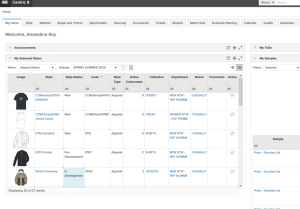
What are the key features of Centric for ERP?
Centric focuses exclusively on product lifecycle management, which is separate from ERP for intellectual services.
- PLM platform that covers the product lifecycle from concept to restocking, centralizing product data, materials, collections and suppliers. It structures the entire product life cycle, from concept to marketing, by centralizing technical data, materials, variants, suppliers and collection items. This approach creates a single repository used by the design, development, sourcing and quality teams.
- Cloud-based planning, pricing & inventory suite: The platform extends PLM with modules dedicated to assortment planning, inventory level management, restocking management and pricing strategies. These building blocks are based on advanced statistical models that analyze demand, past sales and supply chain constraints to adjust operational decisions.
- Integrated PXM Brick: Centric includes a PIM/DAM layer to orchestrate product content for e-commerce, marketplaces, and internal catalogs. This building block governs marketing data, media, technical attributes, and distribution flows within a unified SaaS environment.
What are Centric's use cases for consulting firms?
Centric applies to industries where mastering product development, collections and sourcing is a strategic issue.
- Product-Centric Industries: Centric supports organizations where product development speed, collection control, and assortment management structure performance. The sectors concerned include fashion, luxury, retail, consumer goods, furniture and cosmetics, with design, merchandising and supply chain teams that rely on a centralized product repository to reduce creation cycles and make supplier exchanges more reliable.
- Consulting firms involved in product development: used as an alternative to an ERP, the tool serves as a common working platform between consultants and internal teams. It is then integrated as a complementary business brick, while the management of missions, resource planning or invoicing is based on a more specialized consulting ERP such as Stafiz, Everwin, Karanext or Axelor.
Its use in consulting therefore remains indirect, mainly through support missions for industrial customers.
What benefits does Centric bring to consulting firms?
Its functional depth on PLM makes it a must-have solution for brands with a complex product cycle.
- Advanced product specialization: Centric mainly targets product-oriented industries : fashion, luxury, retail, consumer goods, furniture, cosmetics, etc. where the pace of product development, time-to-market and assortment management are strategic. This specialization extends to business workflows specific to the fashion, luxury and retail sectors, avoiding the heavy adaptations often imposed by generalist ERPs.
- AI-powered planning, pricing, and inventory modules: Analytics models anticipate demand, identify overstock areas, adjust prices, and guide assortment priorities. This approach guides decisions related to margins, stock levels and restocking, with a granularity adapted to the short cycles of the collections.
- Global cloud platform: The multi-site, multi-language architecture facilitates coordination between teams in different countries, whether it's design, procurement or production. This capability supports global organizations whose product development requires structured day-to-day coordination.
However, this advantage remains limited to product-oriented environments and does not extend to the business needs of consulting.
What limitations should you anticipate before adopting Centric?
The platform does not cover the core processes of consulting firms: missions, time, resource planning or billing.
- It's not a complete business ERP : Centric does not natively cover mission management, time tracking, or resource planning, or billing services. The platform focuses exclusively on the product lifecycle. In the majority of cases, it requires an ERP dedicated to the management of consulting activities.
- Project sized for large organizations : the implementation is aimed at international brands with extensive design, merchandising, sourcing and supply chain teams. Project load, change management and the prior structuring of product data create a high entry threshold for medium-sized consulting firms.
- Niche positioning : For a non-retail/consumer goods firm, Centric does not provide any direct business value. The platform remains relevant only for structures that are deeply involved in their customers' product development.
It should therefore be considered as a complementary tool, and not as an ERP for the management of intellectual services.
What size and profile of companies does Centric correspond to?
Centric is primarily aimed at global brands that manage a large volume of collections and product data.
- International brands and retailers: Centric is primarily aimed at fashion, luxury, retail, cosmetics, furniture or consumer goods organizations with 50 to several thousand employees. These environments handle a large volume of collections, product variants, and supplier data, which justifies the use of specialized PLM.
- Multi-site and multi-language organizations: The platform is suitable for groups operating with distributed teams that need a single repository to standardize their product workflows, harmonize approvals, and control time-to-market.
- Limited relevance for a generalist consulting firm, because the billing or the resource planning do not find operational gains, as Centric does not cover consulting business workflows (time, margin, teams). It complements an ERP, it does not replace it.
Its use in a consulting firm is only relevant in structures specializing in retail, fashion or product development.
What are the Benefits of an ERP for Consulting Firms?
A consulting firm cannot afford to approximate its workload, margin or capacity. ERP software for consulting firms structures processes, unifies data and transforms often reactive management into anticipatory management. It becomes the backbone that links missions, resources and financial performance.
The specific challenges of multi-project management
In a IT Services, the teams work simultaneously on several missions whose deadlines, priorities and skills needs are constantly evolving. Without an ERP adapted to consulting firms, these trade-offs are made on intuition, which weakens planning, quality and profitability. A dedicated tool provides an objective framework and continuous visibility on the entire project portfolio to:
- arbitrating scarce resources between several missions in parallel: key skills are often solicited on several projects at the same time. Without an ERP, this arbitration is done "on sight", creating errors, overloads, delays and even tensions;
- avoid scheduling conflicts between customers, teams and BUs: when a schedule slips by one week, the impact on other missions is immediately apparent in the ERP (resources blocked, milestones shifted, delays in cascade). Managers then have a lever to reorganize intelligently;
- give consolidated visibility on current and projected workload: The ERP displays the past, ongoing and 3-6 month workload per consultant, team or BU. This workload plan sheds light on HR trade-offs: recruitment, subcontracting, postponements, or prioritization of high-value projects;
- prioritise projects based on value and not on the urgency of the moment: thanks to data on profitability, customer criticality or risks, an ERP helps to allocate resources to the missions with the best business impact;
- standardize multi-project management methods: without a common reference system, each manager manages with his or her own personal methods. A common tool homogenizes the steps, statuses and indicators, making portfolios comparable from one manager to another.
An ERP transforms multi-project management, often artisanal, into structured, readable and predictive management, making it possible to anticipate rather than suffer.
Profitability requirements and the need for financial visibility
The profitability of a consulting firm is based on a detailed understanding of the real performance of projects, clients and teams. A specialized ERP makes this visibility immediate, by consolidating operational, financial and HR data in a single repository. This continuity transforms an a posteriori reading into a dynamic management that informs daily decisions in different ways.
- Detailed monitoring of profitability by project, client, BU and consultant: The ERP monitors, in real time, the budget sold vs. realized, the gross margin, the ADR the billable utilization rate (ratio of billable activities to available time) and variances from initial targets. This granularity reveals where value is actually being created and where it is deteriorating. Project managers have indicators to analyze project deviations and immediately adjust the remaining work or team composition.
- Calculating the "true cost" of resources and projects. It is no longer a question of comparing a ADR to a busy salary. The ERP models the full costs: employees, subcontracting, operational costs, purchases of products necessary for the mission. This approach clarifies the real profitability and avoids the illusions of margin linked to a partial view of costs.
- Anticipation of cash flow and cash flow needs. The projection of expected receipts (based on invoices, due dates, historical delays) secures cash flow. Finance departments identify future tensions earlier and adjust reminders, advance payments or contractual negotiations.
- The automatic link between production → invoicing → unified accounting. In many organizations, time is entered in one tool, planning in another, invoicing in a third, and accounting in a fourth. The validated hours automatically feed into the invoicing, which then feeds the pre-accounting via connectors. Data becomes reliable, traceable and complete.
Stafiz allows you, for example, to go as far as pre-accounting, then to send the information back to the accounting software (by connector / integration)
- Real-time performance management, not only at the end of the month, because monthly accounting reporting often comes too late to avoid delays. An ERP provides financial indicators for project management : margin to date, margin to completion, intercontract rate, speed of budget consumption. Managers adjust load, priorities or resource planning before it is too late.
With an ERP, profitability is no longer seen retrospectively: it is managed continuously, project by project, consultant by consultant.
The need for scalability
As the firm grows, the artisanal model based on collective memory, personal files and adjustments as they go quickly reaches its limits. Scalability becomes a structuring issue: how to maintain control of margins, workload and processes when the team goes from 10 to 50 and then to 150 consultants?
A good specialized ERP for consulting firms should allow you to:
- Go from a few consultants to several dozen without losing control: ERP absorbs this complexity by unifying data, schedules, capacities and margins in a single system.
- Industrialize processes without rigidifying them. Time validation, invoicing preparation, margin monitoring, reporting: what worked in a small team becomes unmanageable without automation. An ERP designed for consulting structures these workflows without preventing special cases.
- Manage the transition to multiple BUs, legal entities, or countries; These are all constraints that complicate economic reading and consolidation. The ERP structures these perimeters while maintaining a consolidated view for strategic management.
- Limit dependence on "heroes" and personal files. Without a central system, information relies on a few experts and their local Excel files. In the growth phase, this becomes a major risk. ERP centralizes customer data, projects, margins and avoids individual silos.
The implementation of these structured and centralized processes is one of the great advantages of an ERP for consulting firms, ensuring the sustainability and control of your growth.
What are the must-have ERP modules for a consulting firm?
A consulting firm cannot rely on a generalist ERP: its challenges are time, workload and margin, not stock management. The really useful modules are those that orchestrate the sales pipeline, resource planning and the financial chain, in order to drive the business with unified data.
The project management and resource planning module
The performance of a firm is based on its ability to structure assignments, anticipate the workload and assign the right skills at the right time. A project management module truly designed for consulting then becomes a key piece: it aligns forecasting, planning and execution, while protecting the margin. The objective is not only to monitor projects, but to give teams a reliable reading to adjust the trade-offs on a daily basis by:
- Modeling of the different types of assignments (time management, fixed price, mixed): the module must simply manage projects on a time-spent basis, on a fixed basis, with milestones, penalties, T&M, etc., to reflect the real economic models of the firm.
- Fine-grained planning by consultant, profile, skill and project. Beyond a Gantt, it is necessary to be able to allocate project resources to the right missions, according to their skills, their seniority, their availability and business priorities.
- The current and projected load vision. The module must offer views by consultant, team and BU: what is sold, planned, optional, and periods of under-load/over-load to anticipate recruitments or arbitrations.
- Monitoring the progress of the project vs. budget. The ERP must make it possible to monitor the remaining work to be done, the discrepancies between planned and consumed times, scope drifts, and to warn upstream of the risks of margin slippage.
- Time management and timesheets. The ERP for consulting firms allows employees to enter their time and create workflows to validate these times if necessary. The ERP for consulting firms allows employees to enter their time and create workflows to validate this time if necessary
Customer CRM and sales follow-up
The commercial management of a firm is based on a consolidated vision of accounts, opportunities and client exchanges. This layer is sometimes carried by an internal CRM to the ERP, sometimes by an external CRM (HubSpot, Salesforce, etc.) connected via API. The challenge remains the same: to have a continuous flow between what is sold, what is planned in the schedule and what will actually be delivered. The ERP must therefore structure the commercial information and link it directly to the projects, without data breakage. It therefore allows:
- Centralization of accounts, contacts and exchange histories. CRM gathers data to put an end to information scattered in mailboxes: contacts, appointments, key emails, past opportunities, projects delivered. All teams access the same repository to prepare a proposal, follow up with a prospect or analyze the potential of an account.
- the management of the opportunity pipeline and calls for tenders. The pipeline is visualized in the form of Kanban: qualification stages, probability of win, amounts, estimated start dates. This vision feeds into planning: the future need for the workload is estimated based on probable deals, not just signed deals.
- the creation of a direct link between opportunities won and the creation of projects. Once the mission has been won, the ERP must automatically transform the opportunity into a project, with budget, milestones, and target team, in order to limit re-entries and errors.
- monitoring conversion rates, sales margins and the mix of offers. This calculation makes it possible to identify the most profitable offers, the most loyal customers, the longest sales cycles, etc. These analyses guide the prioritization choices and the development strategy.
- Sales/delivery alignment via data. By linking CRM and project management, ERP ensures continuity between what is sold (price, scope, schedule) and what is actually delivered, reducing misunderstandings and unrealistic commitments.
The automated invoicing and financial reporting part
The financial reliability of a firm is based on a continuous chain between production, invoicing and accounting. While contractual models are superimposed in service companies (control room, package, subscriptions, milestones, etc.), the ERP must automate these mechanisms to reduce delays, limit errors and offer an almost immediate view of performance indicators.
- Automation of invoicing from time tracking and milestones. Invoices are generated as soon as the contractual conditions are met: time validated, milestone reached, package delivered or subscription expired.
- Management of multiple billing schemes. Monthly invoicing, on progress, on delivery, pre-invoicing, deposits: the module must cover the diversity of consulting firms' practices, by client and by type of mission.
- Seamless integration with accounting and treasury. The ERP exports accounting entries in a standard format, synchronizes receipts, identifies late payments, and tracks DSO. The production chain → invoices → accounting → cash then operates as a single process, without scattered re-entry.
- Real-time financial reporting by project, client and BU. The dashboards display the turnover, the gross margin, the net margin, the DSO, the invoicing rate, to manage the firm on a daily basis and no longer only at the close.
- Strategic decision-making support. By consolidating commercial, operational and financial data, ERP reporting makes it possible to decide: which offers to push, which BUs to strengthen, what types of projects to stop, where to invest in recruitment or marketing.
By automating the financial chain and making performance visible without delay, ERP transforms invoicing and reporting into direct management levers and not disconnected administrative tasks.
Choosing a Consulting Firm ERP: a Follow-Through Checklist
Based on your answers, you will quickly identify if you need:
- an all-in-one ERP specialising in consulting such as Stafiz;
- a robust generalist ERP such as Everwin or Karananext;
- a flexible open-source ERP such as Axelor);
- a forecasting-oriented PSA such as Projectworks);
- an ERP focused on production that is quick to deploy such as Atimeus);
- or a PLM outside the consulting perimeter such as Centric).
Does your firm need an ERP that can unify CRM, resource planning, production and finance?
Yes→ You need an ERP suitable for consulting firms like Stafiz, which really covers the entire value chain.
No→ A more generalist ERP such as Karanext or Everwin SX may be enough.
The management of the resource planning and workload plan critical for your profitability?
Yes→ Choose a solution with a real planning module (Stafiz, Atimeus, Projectworks).
No→ ERP software for more administrative consulting firms (Karanext, Everwin) will do the trick.
Do you need a detailed follow-up of the project margin, the margin at completion and the billable utilization rate in real time?
Yes→ Go for a specialized consulting ERP: Stafiz, Atimeus, Projectworks.
No→ A solution focused on "business management" such as Everwin or Karanext will be sufficient.
Does your firm manage multiple BUs, entities, countries, or business models?
Yes→ Choose ERPs capable of managing multi-BU and multi-models: Stafiz, Axelor, Everwin GX.
No→ Simpler solutions such as Atimeus or Karanext are more than suitable.
Do you want a plug-and-play ERP or a highly customizable system?
Turnkey ERP → Stafiz, Atimeus, Karanext.
Customizable ERP → Axelor.
Very structuring ERP for key accounts → Everwin GX.
Does your firm already use an external CRM (HubSpot, Salesforce, etc.) that you want to keep?
Yes→ Look for compatible solutions: Stafiz, Axelor, Projectworks.
No → An ERP with integrated CRM (Karanext, Everwin SX/GX) can simplify your IS.
Is your business focused exclusively on consulting, or do you also work on product-oriented projects?
Counsel/ IT Services / Engineering→ Stafiz, Everwin, Axelor, Atimeus, Karanext, Projectworks.
Strong product dimension (retail, fashion, consumer goods) → Centric, in addition to a business ERP.
Disclaimer
This comparison of ERP software for consulting firms is the result of an internal study carried out in December 2025, and cross-references different sources, such as the official websites of the software, as well as their documentation. The information will be regularly reviewed to keep the content as up-to-date as possible. Our goal is to help you determine your selection criteria and to orient your search as closely as possible to your needs. However, please take into account the possible non-exhaustiveness of the comparison, due to potential changes to be expected, and a limited scope of research.
Questions:
An ERP is a centralized system that manages all of a company's internal processes: finance, HR, project management, invoicing, etc. A CRM, on the other hand, is dedicated to commercial interactions: contact management, opportunity follow-up and exchange history. In a consulting firm, ERP is the engine of operations and invoicing, while CRM is the tool of sales.
The total cost of ownership (TCO) of an ERP includes the initial costs: licensing, implementation, and team training. It also includes recurring costs, which are often underestimated: maintenance, updates, technical support and hosting. To assess the relevance of the investment, the TCO must be compared to the expected ROI and productivity gains generated by the solution.